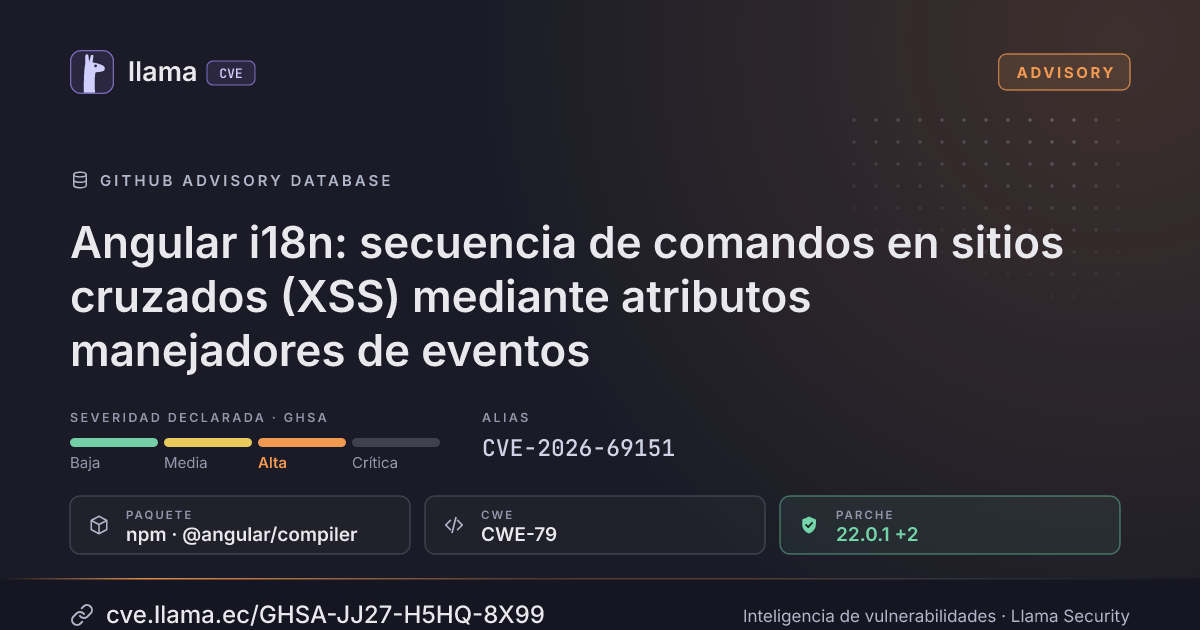
GHSA-JJ27-H5HQ-8X99
Angular i18n: Cross-Site Scripting (XSS) via event-handler attributes
Ciclo de vida de la vulnerabilidad
| Fecha | Fase | Evento | Detalle |
|---|---|---|---|
| Remediación | Parche 22.0.1 | @angular/compiler · -54 d desde divulgación | |
| Remediación | Parche 20.3.27 | @angular/compiler · -5 d desde divulgación | |
| Remediación | Parche 21.2.19 | @angular/compiler · -5 d desde divulgación | |
| Divulgación | Publicada | GHSA-JJ27-H5HQ-8X99 divulgada | |
| Divulgación | Modificada | Última actualización del registro | |
| Monitoreo | Detectada | Ingresó al índice |
A Cross-Site Scripting (XSS) vulnerability has been identified in the Angular compiler's internationalization (i18n) pipeline. Although Angular disallows binding to event-handler attributes such as `onclick` and `onerror` through standard attribute validation (`validateAttribute()` / `validateProperty()`), the i18n metadata collection path allowed these same attribute names to be marked for translation using `i18n-on*` attributes (e.g., `i18n-onerror`).
When exploited, a lower-trust translation file could replace a benign static handler such as `onerror="void 0"` with arbitrary executable JavaScript in the localized build.
The following example illustrates a vulnerable pattern:
<img src="foo.jpg" onerror="void 0" i18n-onerror />Impact
When exploited, this vulnerability allows arbitrary JavaScript execution within the context of the vulnerable application's domain if an attacker can control or influence the translation files used during localization. This can lead to:
- Session Hijacking: Accessing session cookies, tokens, or sensitive user data.
- Unauthorized Actions: Performing actions on behalf of the authenticated user.
Patched Versions
- 22.0.1
- 21.2.19
- 20.3.27
Workarounds
Ensure that static event-handler attributes (e.g., `onerror`, `onclick`) are never marked for internationalization (`i18n-on*`) in application templates, and ensure translation files are sourced from trusted origins.
Incluye detalles técnicos publicados por el investigador. Úselos solo para validar y corregir sus propios sistemas.
Rangos afectados
Estado del parche por paquete
| Paquete / producto | Estado | Corregida en | Desde divulgación | Última versión |
|---|---|---|---|---|
npm@angular/compiler |
Corregida | 20.3.27, 21.2.19, 22.0.1 | -5 d · -5 d · -54 d | 22.2.6 no afectada |
npm@angular/core |
Corregida | 20.3.27, 21.2.19, 22.0.1 | -5 d · -5 d · -54 d | 22.2.6 no afectada |
20.3.2721.2.1922.0.1Arsenal público
Sin exploits, módulos ni PoC públicos conocidos a la fecha de verificación.
https://github.com/angular/angular/security/advisories/GHSA-jj27-h5hq-8x99https://github.com/angular/angular/pull/68821https://github.com/angular/angular/pull/69306https://github.com/angular/angular/commit/417a4071a776464d549509ed3aec121dbd2fda5ehttps://github.com/angular/angular/commit/6c41f5ca01c0ae045fc7d929b72853a11eb55865https://github.com/angular/angularLas referencias externas se muestran para copiar: cve.llama.ec no lo redirige a otros sitios.