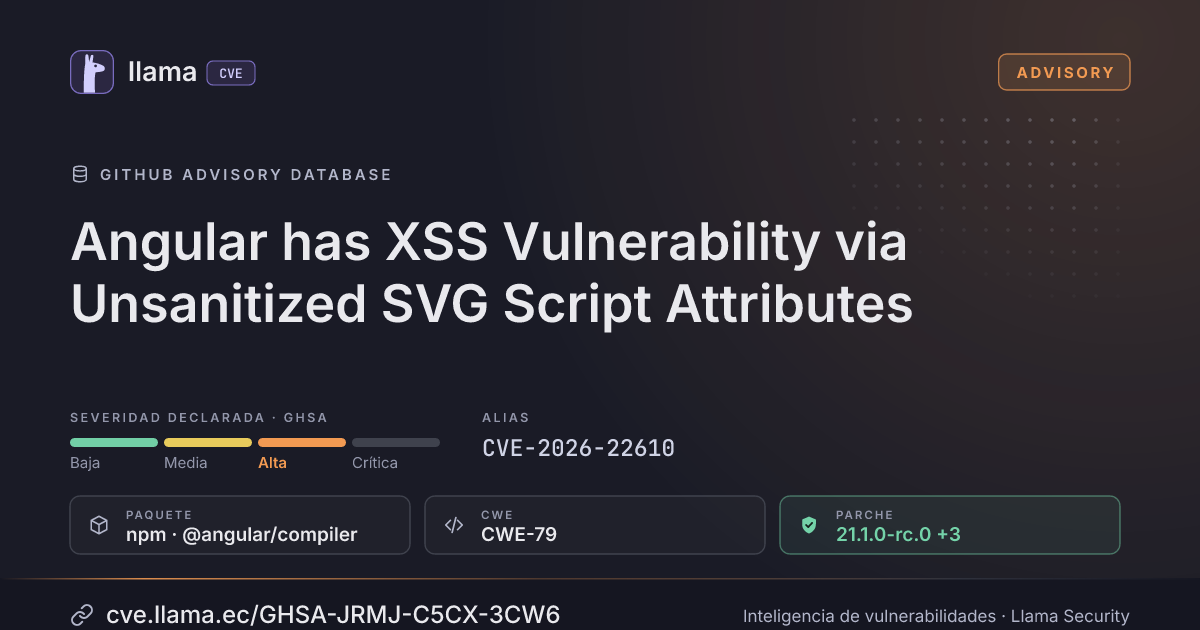
GHSA-JRMJ-C5CX-3CW6
Angular has XSS Vulnerability via Unsanitized SVG Script Attributes
Ciclo de vida de la vulnerabilidad
| Fecha | Fase | Evento | Detalle |
|---|---|---|---|
| Remediación | Parche 19.2.18 | @angular/compiler · -2 d desde divulgación | |
| Remediación | Parche 20.3.16 | @angular/compiler · -2 d desde divulgación | |
| Remediación | Parche 21.0.7 | @angular/compiler · -2 d desde divulgación | |
| Remediación | Parche 21.1.0-rc.0 | @angular/compiler · -1 d desde divulgación | |
| Divulgación | Publicada | GHSA-JRMJ-C5CX-3CW6 divulgada | |
| Divulgación | Modificada | Última actualización del registro | |
| Monitoreo | Detectada | Ingresó al índice |
A Cross-Site Scripting (XSS) vulnerability has been identified in the Angular Template Compiler. The vulnerability exists because Angular’s internal sanitization schema fails to recognize the `href` and `xlink:href` attributes of SVG `<script>` elements as a Resource URL context.
In a standard security model, attributes that can load and execute code (like a script's source) should be strictly validated. However, because the compiler does not classify these specific SVG attributes correctly, it allows attackers to bypass Angular's built-in security protections.
When template binding is used to assign user-controlled data to these attributes for example, `<script [attr.href]="userInput">` the compiler treats the value as a standard string or a non-sensitive URL rather than a resource link. This enables an attacker to provide a malicious payload, such as a `data:text/javascript` URI or a link to an external malicious script.
### Impact
When successfully exploited, this vulnerability allows for arbitrary JavaScript execution within the context of the victim's browser session. This can lead to:
- Session Hijacking: Stealing session cookies, localStorage data, or authentication tokens.
- Data Exfiltration: Accessing and transmitting sensitive information displayed within the application.
- Unauthorized Actions: Performing state-changing actions (like clicking buttons or submitting forms) on behalf of the authenticated user.
Attack Preconditions
- The victim application must explicitly use SVG `<script>` elements within its templates.
- The application must use property or attribute binding (interpolation) for the `href` or `xlink:href` attributes of those SVG scripts.
- The data bound to these attributes must be derived from an untrusted source (e.g., URL parameters, user-submitted database entries, or unsanitized API responses).
### Patches
- 19.2.18
- 20.3.16
- 21.0.7
- 21.1.0-rc.0
### Workarounds
Until the patch is applied, developers should:
- Avoid Dynamic Bindings: Do not use Angular template binding (e.g., `[attr.href]`) for SVG `<script>` elements.
- Input Validation: If dynamic values must be used, strictly validate the input against a strict allowlist of trusted URLs on the server side or before it reaches the template.
Resources
- https://github.com/angular/angular/pull/66318
Incluye detalles técnicos publicados por el investigador. Úselos solo para validar y corregir sus propios sistemas.
Rangos afectados
Estado del parche por paquete
| Paquete / producto | Estado | Corregida en | Desde divulgación | Última versión |
|---|---|---|---|---|
npm@angular/compiler |
Corregida | 19.2.18, 20.3.16, 21.0.7, 21.1.0-rc.0 | -2 d · -2 d · -2 d · -1 d | 22.2.6 no afectada |
npm@angular/core |
Corregida | 19.2.18, 20.3.16, 21.0.7, 21.1.0-rc.0 | -2 d · -2 d · -2 d · -1 d | 22.2.6 no afectada |
19.2.1820.3.1621.0.721.1.0-rc.0Arsenal público
Sin exploits, módulos ni PoC públicos conocidos a la fecha de verificación.
https://nvd.nist.gov/vuln/detail/CVE-2026-22610https://github.com/angular/angular/security/advisories/GHSA-jrmj-c5cx-3cw6https://github.com/angular/angular/pull/66318https://github.com/angular/angular/commit/91dc91bae4a1bbefc58bef6ef739d0e02ab44d56https://cert-portal.siemens.com/productcert/html/ssa-253495.htmlhttps://cert-portal.siemens.com/productcert/html/ssa-485750.htmlhttps://github.com/angular/angularLas referencias externas se muestran para copiar: cve.llama.ec no lo redirige a otros sitios.