GHSA-M77J-JGX5-Q3J7
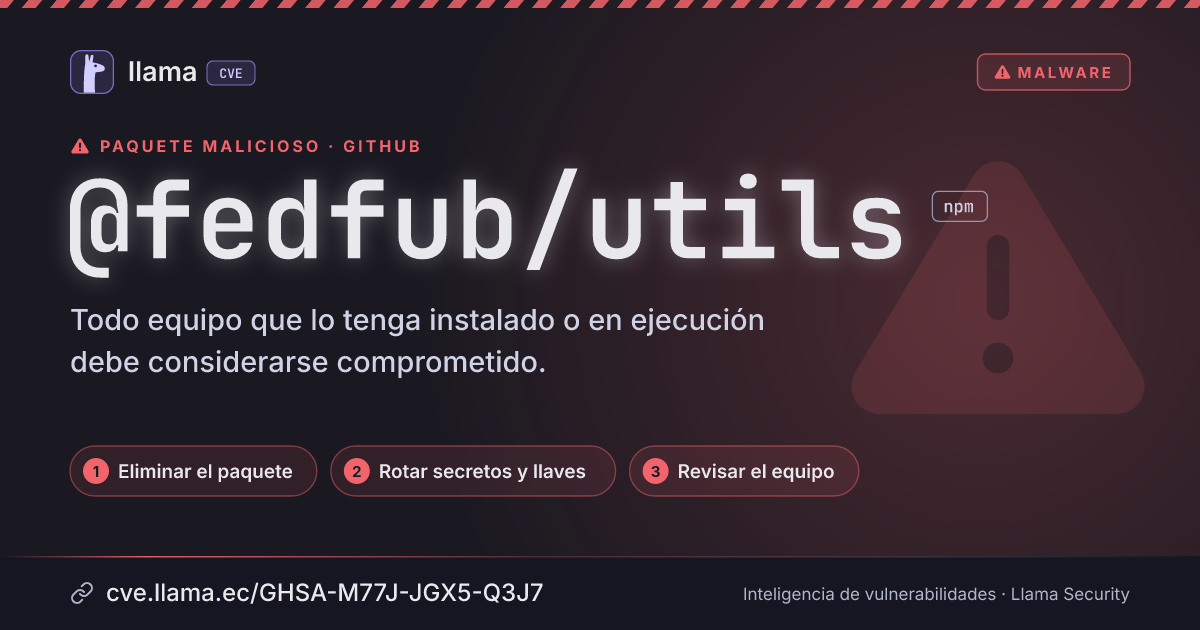
Malicious code in @fedfub/utils (npm)
Texto original en inglés · Ver en español
Ciclo de vida de la vulnerabilidad
| Fecha | Fase | Evento | Detalle |
|---|---|---|---|
| Divulgación | Publicada | GHSA-M77J-JGX5-Q3J7 divulgada | |
| Divulgación | Modificada | Última actualización del registro | |
| Monitoreo | Detectada | Ingresó al índice | |
| Monitoreo | Verificada | Última verificación contra las fuentes |
Malicious package. Advertised as "Utility helpers for Node.js", but the postinstall hook runs `worm.js` (also the package main), a self-propagating credential stealer. On install it collects every environment variable matching KEY/SECRET/TOKEN/PASS/AWS/JWT/STRIPE/PAYPAL/DB_/DATABASE/REDIS/MONGO, up to 5000 characters of every source file under the working directory, and the contents of ~/.ssh, then POSTs them with hostname, username and platform to https://73.218.105.44:8080/collect. It then tries to republish itself under each dependency name of the host project as `<name>-security-patch@99.0.0` via `npm publish`, injects itself into package.json files under the home directory, persists with an `@reboot` crontab entry (or a SYSTEM onlogon scheduled task on Windows), and polls /cmd every 30 seconds, executing whatever command the server returns and posting the output to /result. In a sandboxed install the postinstall connected to 73.218.105.44 and wrote the crontab entry. The package has since been removed from the npm registry. The same author published @fedfub/string-utils with a minified copy of the same code.
---
Credit: OpenSSF https://github.com/ossf/malicious-packages (source https://github.com/ossf/malicious-packages/blob/9088efa4c05d7f983aacb67c4ad74070629b53c0/osv/malicious/npm/@fedfub/utils/MAL-2026-20291.json)
Versiones afectadas
1.0.1Estado del parche por paquete
| Paquete / producto | Estado | Corregida en | Desde divulgación | Última versión |
|---|---|---|---|---|
npm@fedfub/utils |
Sin parche | — | — | — |
Arsenal público
Sin exploits, módulos ni PoC públicos conocidos a la fecha de verificación.
https://github.com/ossf/malicious-packages/blob/9088efa4c05d7f983aacb67c4ad74070629b53c0/osv/malicious/npm/@fedfub/utils/MAL-2026-20291.jsonhttps://github.com/advisories/GHSA-m77j-jgx5-q3j7Las referencias externas se muestran para copiar: cve.llama.ec no lo redirige a otros sitios.