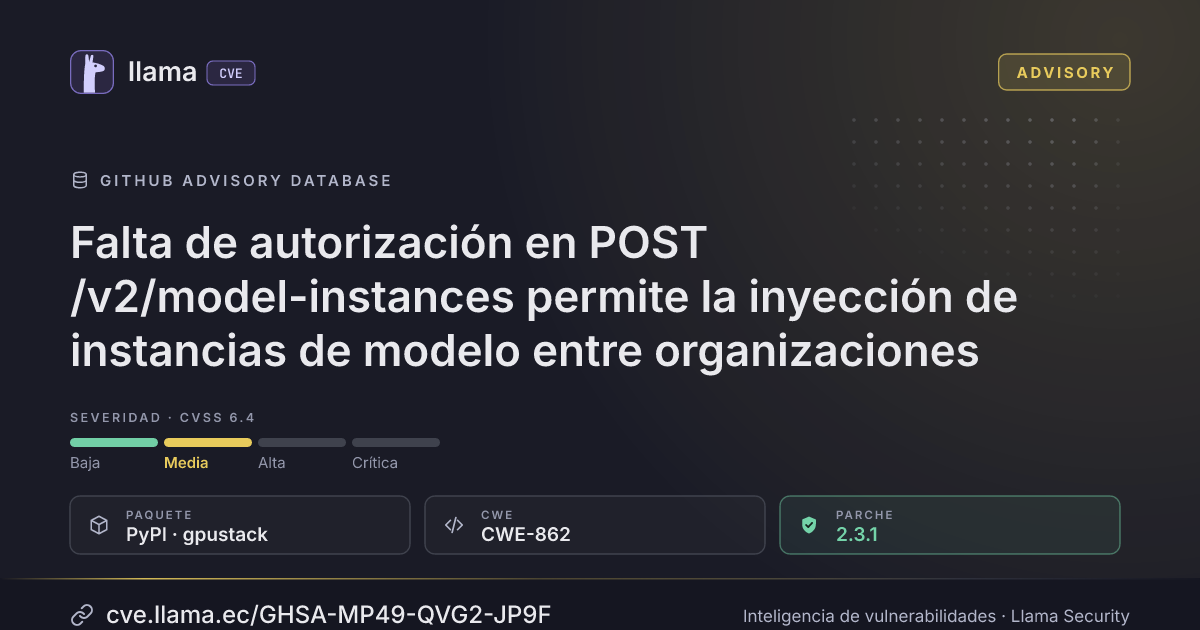
GHSA-MP49-QVG2-JP9F
Missing authorization on POST /v2/model-instances allows cross-tenant model-instance injection
Texto original en inglés · Ver en español
CVSS:3.1/AV:N/AC:L/PR:L/UI:N/S:C/C:N/I:L/A:L
Fuente: GitHub
Ciclo de vida de la vulnerabilidad
| Fecha | Fase | Evento | Detalle |
|---|---|---|---|
| Divulgación | Publicada | GHSA-MP49-QVG2-JP9F divulgada · CVSS 6.4 (GitHub) | |
| Divulgación | Modificada | Última actualización del registro | |
| Remediación | Parche 2.3.1 | gpustack · 0 d desde divulgación | |
| Monitoreo | Detectada | Ingresó al índice | |
| Monitoreo | Verificada | Última verificación contra las fuentes |
Summary
A missing authorization check in `POST /v2/model-instances` allows an organization owner to create model instances associated with another organization's model.
The handler retrieves the referenced model without checking the caller's access and assigns the model's ownership to the new instance. An attacker can therefore insert unauthorized instance records into another organization's deployment, including records marked as running.
Affected configurations
Exploitation requires an authenticated organization owner with access to the model-instance creation API and knowledge or discovery of a model ID belonging to another organization.
Ordinary organization members and users limited to personal scope cannot access this management operation. Deployments without organization owners managing separately owned models do not meet the prerequisite for this cross-organization attack.
Impact
Unauthorized instance records can affect a model's replica and readiness accounting and interfere with inference routing, causing request failures or incorrect responses.
In deployments where the gateway builds upstream destinations from instance-provided addresses, an injected running instance may direct inference traffic to an attacker-controlled endpoint. Requests routed to that endpoint may expose their contents and receive attacker-controlled responses.
The routing impact depends on the gateway configuration and whether the injected instance is incorporated into active routing before reconciliation removes or changes it. Reconciliation may limit the duration of an individual injection but does not prevent repeated unauthorized creation.
Affected versions
GPUStack versions >= 2.2.0 and < 2.3.1.
Patches
GPUStack 2.3.1 checks the caller's access to the parent model before creating a model instance.
New instances inherit their ownership and cluster bindings from the authorized parent model. Explicit ownership or cluster values that conflict with the parent model are rejected.
Workarounds
Until upgrading, restrict access to `POST /v2/model-instances` to trusted platform administrators and required internal service principals.
Review affected deployments for unexpected model instances. Removing unauthorized records alone does not prevent further injection while the vulnerable endpoint remains accessible.
Incluye detalles técnicos publicados por el investigador. Úselos solo para validar y corregir sus propios sistemas.
Desglose de métricas
Rangos afectados
Estado del parche por paquete
| Paquete / producto | Estado | Corregida en | Desde divulgación | Última versión |
|---|---|---|---|---|
pypigpustack |
Corregida | 2.3.1 | 0 d | 2.3.1 no afectada |
2.3.1Arsenal público
Sin exploits, módulos ni PoC públicos conocidos a la fecha de verificación.
https://github.com/gpustack/gpustack/security/advisories/GHSA-mp49-qvg2-jp9fLas referencias externas se muestran para copiar: cve.llama.ec no lo redirige a otros sitios.