GHSA-MVM8-X28H-FW3Q
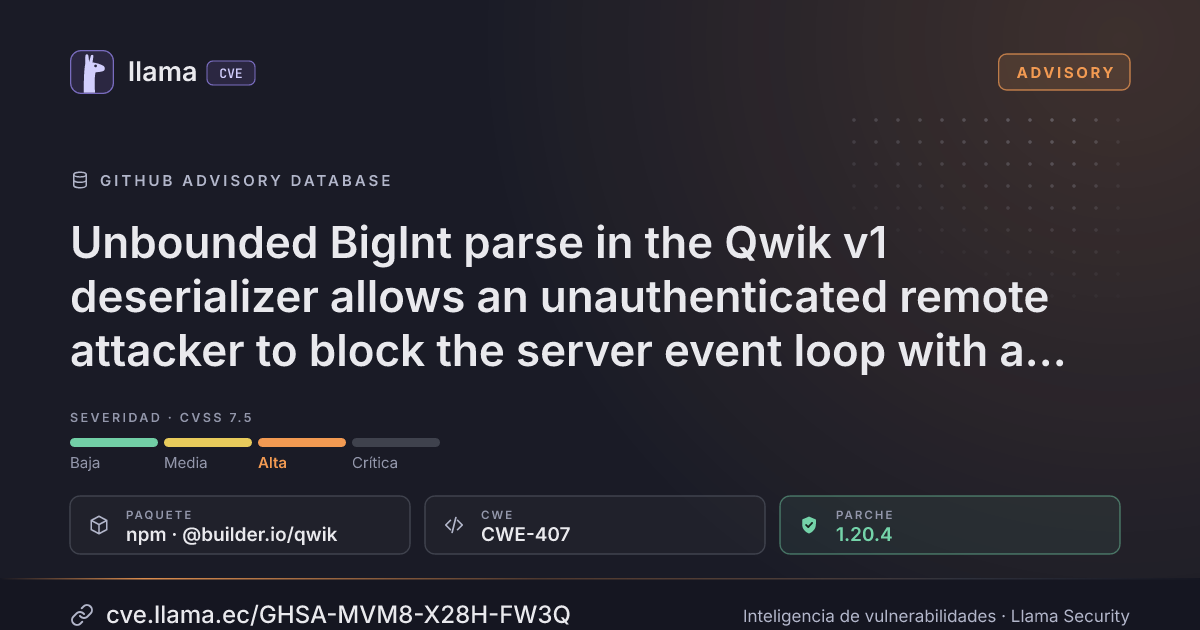
Unbounded BigInt parse in the Qwik v1 deserializer allows an unauthenticated remote attacker to block the server event loop with a single request
CVSS:3.1/AV:N/AC:L/PR:N/UI:N/S:U/C:N/I:N/A:H
Fuente: GitHub
Ciclo de vida de la vulnerabilidad
| Fecha | Fase | Evento | Detalle |
|---|---|---|---|
| Remediación | Parche 1.20.4 | @builder.io/qwik · -9 d desde divulgación | |
| Divulgación | Publicada | GHSA-MVM8-X28H-FW3Q divulgada · CVSS 7.5 (GitHub) | |
| Monitoreo | Detectada | Ingresó al índice | |
| Monitoreo | Verificada | Última verificación contra las fuentes |
Summary
`BigIntSerializer.$prepare$` calls `BigInt()` on the raw serialized string with no length limit, and decimal BigInt parsing is super-linear in V8. Every `_objs` string beginning with U+0018 reaches it through `_deserializeData`.
Qwik Router reaches that path from an unauthenticated POST to any page route. `checkCSRF` applies its origin comparison only to simple content types, so `application/qwik-json` skips it; the gate requires only that the `qfunc` query value equal the `X-QRL` header, both caller-chosen; and `parseBody()` deserializes the body before the QRL hash is compared.
Measured on the project's own empty starter at 1.20.3, built with the official node-server adapter: one 9.54 MiB body holding a single BigInt record blocked the event loop for 2514 ms while an unrelated request for the real page waited 2416 ms. An identical volume of data without the U+0018 prefix took 40 ms, which locates the cost in the conversion rather than the transfer.
The v2 line already carries the fix. GHSA-2v54-72rw-xh94 describes the same defect in `@qwik.dev/core` and was closed in 2.0.0-rc.4 by rejecting BigInt payloads that do not match `/^-?\d{1,1000}$/`. The v1 serializer never received that guard.
Impact
Availability only, remote and unauthenticated.
Affected: any application on `@builder.io/qwik` 1.0.0 through 1.20.3 served through Qwik Router with at least one page route, which is the default shape. No `server$` function has to exist, no route has to opt in, and no configuration change is required.
An attacker blocks the Node.js event loop, so the process stops serving anyone: other users' pages, health checks and background timers all wait. Four concurrent requests held the process for about ten seconds. The cost to the attacker is bandwidth alone, and repeating the request sustains the outage rather than causing a single stall.
Not affected: the v2 line from 2.0.0-rc.4 onward; deployments with no server runtime, such as a purely static build. A proxy that caps request bodies well below the 10 MiB default reduces the cost per request proportionally, which lowers the practical impact without removing the defect.
Desglose de métricas
Rangos afectados
Estado del parche por paquete
| Paquete / producto | Estado | Corregida en | Desde divulgación | Última versión |
|---|---|---|---|---|
npm@builder.io/qwik |
Corregida | 1.20.4 | -9 d | 1.20.4 no afectada |
1.20.4Arsenal público
Sin exploits, módulos ni PoC públicos conocidos a la fecha de verificación.
https://github.com/QwikDev/qwik/security/advisories/GHSA-mvm8-x28h-fw3qLas referencias externas se muestran para copiar: cve.llama.ec no lo redirige a otros sitios.