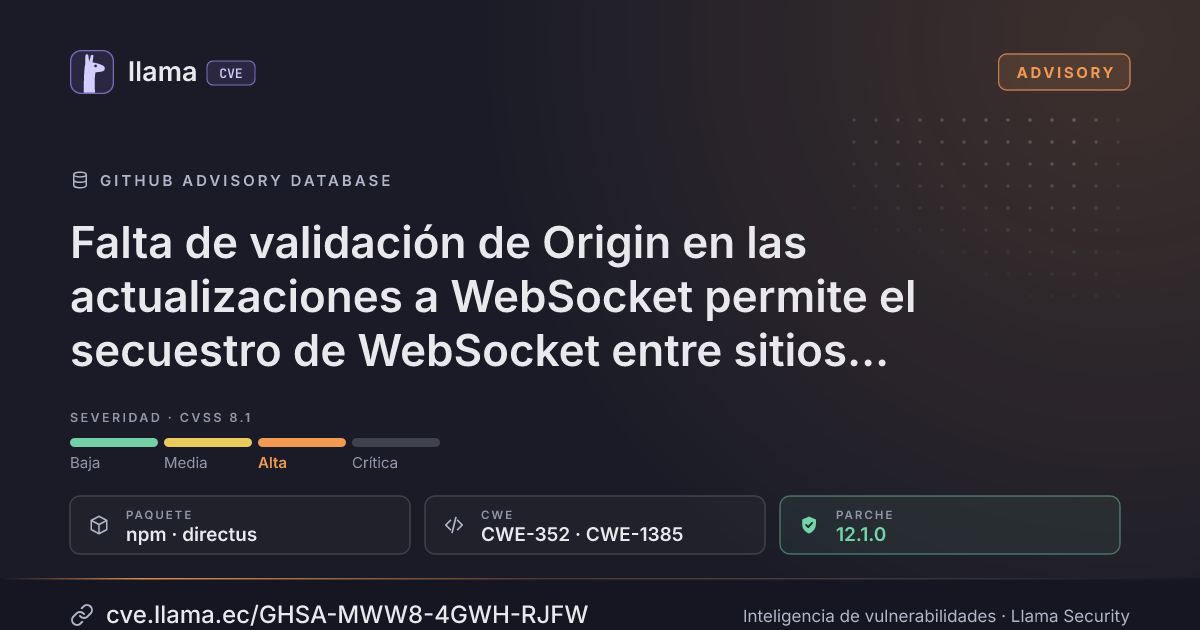
GHSA-MWW8-4GWH-RJFW
Missing Origin validation on WebSocket upgrades allows Cross-Site WebSocket Hijacking
CVSS:3.1/AV:N/AC:L/PR:N/UI:R/S:U/C:H/I:H/A:N
Fuente: GitHub
Ciclo de vida de la vulnerabilidad
| Fecha | Fase | Evento | Detalle |
|---|---|---|---|
| Remediación | Parche 12.1.0 | directus · -35 d desde divulgación | |
| Divulgación | Publicada | GHSA-MWW8-4GWH-RJFW divulgada · CVSS 8.1 (GitHub) | |
| Monitoreo | Detectada | Ingresó al índice | |
| Monitoreo | Verificada | Última verificación contra las fuentes |
Missing Origin validation on WebSocket upgrades allows Cross-Site WebSocket Hijacking
Summary
The WebSocket upgrade handler accepted cross-origin upgrade requests that carried the `directus_session_token` session
cookie, without validating the `Origin` header of the handshake. A browser automatically attaches cookies to a WebSocket
handshake and, unlike the REST and GraphQL transports, the upgrade path is registered directly on the HTTP server and
therefore never passes through the CORS middleware. In affected deployments, a page on an attacker-controlled origin
could open a WebSocket to a Directus instance and have the connection authenticated as the visiting user.
Details
When a WebSocket upgrade request arrived with a session cookie present, the connection was authenticated from that
cookie and the socket was established with the corresponding user's accountability. No comparison was made against the
request host, `PUBLIC_URL`, or the `CORS_ORIGIN` allowlist before accepting the upgrade.
The cookie branch was evaluated ahead of the configured WebSocket authentication mode, so setting `WEBSOCKETS_REST_AUTH`
or `WEBSOCKETS_GRAPHQL_AUTH` to `handshake` or `strict` did not prevent a cookie-bearing handshake from being accepted.
Exploitation requires all of the following:
- WebSockets are enabled (`WEBSOCKETS_ENABLED=true`). This is not the default.
- The victim is signed in using session cookie authentication, which is the mode the Admin App uses.
- The victim's browser attaches the session cookie to the attacker's cross-origin handshake. This happens when
- The victim visits the attacker-controlled page while their session is valid.
Impact
An attacker who can get a signed-in user to load a page under their control can drive an authenticated WebSocket session
with that user's permissions. Over that connection they can read, create, update, and delete items, and open
subscriptions, on any collection the victim has access to. If the victim is an administrator, this extends to system
collections such as `directus_users`, `directus_roles`, and `directus_permissions`.
The attacker's page can read WebSocket responses directly, so this results in data disclosure as well as unauthorized
writes. The session token itself is `HttpOnly` and is not exposed to the attacker's script.
Workarounds
For deployments that cannot upgrade immediately:
- Disable WebSockets (`WEBSOCKETS_ENABLED=false`) if they are not in use.
- Avoid `SESSION_COOKIE_SAME_SITE=none`. Serving the Admin App and the API from the same site allows the default `lax`
- Enforce an `Origin` allowlist for the WebSocket paths at a reverse proxy in front of Directus.
- Treat control of any subdomain sharing the API's registrable domain as equivalent to control of the session, and
Credit
Reported by @tonghuaroot
Incluye detalles técnicos publicados por el investigador. Úselos solo para validar y corregir sus propios sistemas.
Desglose de métricas
Rangos afectados
Estado del parche por paquete
| Paquete / producto | Estado | Corregida en | Desde divulgación | Última versión |
|---|---|---|---|---|
npmdirectus |
Corregida | 12.1.0 | -35 d | 12.6.1 no afectada |
12.1.0Arsenal público
Sin exploits, módulos ni PoC públicos conocidos a la fecha de verificación.
https://github.com/directus/directus/security/advisories/GHSA-mww8-4gwh-rjfwLas referencias externas se muestran para copiar: cve.llama.ec no lo redirige a otros sitios.