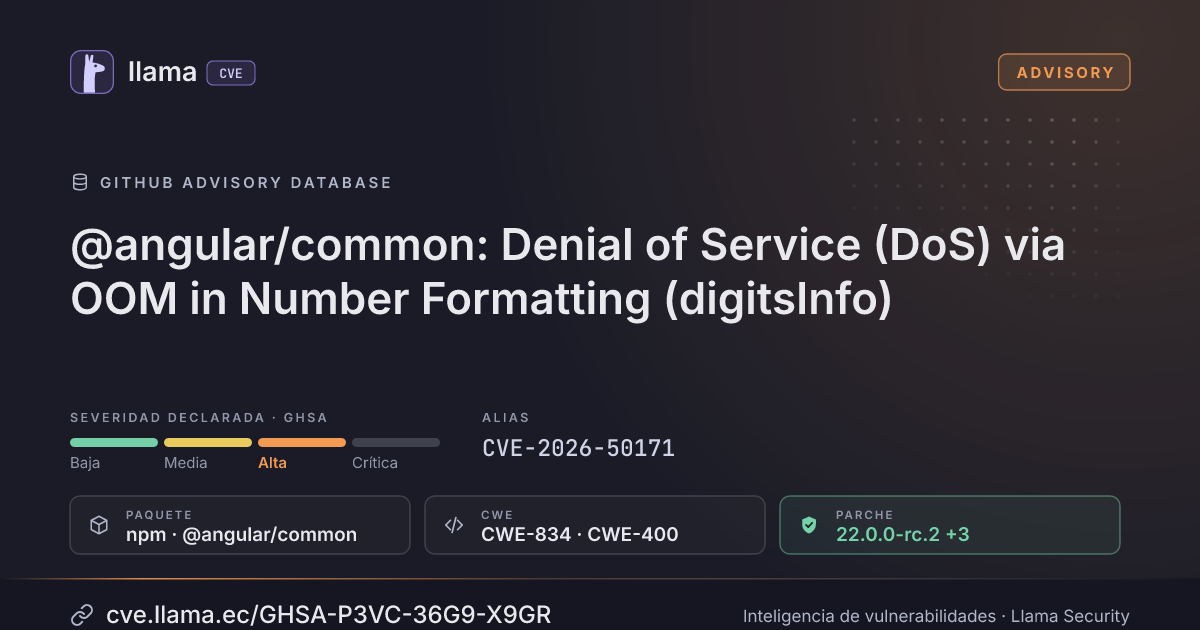
GHSA-P3VC-36G9-X9GR
@angular/common: Denial of Service (DoS) via OOM in Number Formatting (digitsInfo)
Ciclo de vida de la vulnerabilidad
| Fecha | Fase | Evento | Detalle |
|---|---|---|---|
| Remediación | Parche 19.2.23 | @angular/common · -19 d desde divulgación | |
| Remediación | Parche 20.3.22 | @angular/common · -19 d desde divulgación | |
| Remediación | Parche 21.2.15 | @angular/common · -18 d desde divulgación | |
| Remediación | Parche 22.0.0-rc.2 | @angular/common · -18 d desde divulgación | |
| Divulgación | Publicada | GHSA-P3VC-36G9-X9GR divulgada | |
| Divulgación | Modificada | Última actualización del registro | |
| Monitoreo | Detectada | Ingresó al índice |
A Denial of Service (DoS) vulnerability exists in the `@angular/common` package of Angular. The `formatNumber` function, which is also utilized by `DecimalPipe`, `PercentPipe`, and `CurrencyPipe`, does not properly validate the upper bounds of the `digitsInfo` parameter. Specifically, the minimum and maximum fraction digits parsed from the `digitsInfo` string (e.g., `1.2-4`) are converted to integers and used without limits.
When parsing a maliciously crafted `digitsInfo` string with excessively large fraction digit values (e.g., `1.200000000-200000000`), the internal `roundNumber` function attempts to pad the digits array to match the requested fraction size. This results in an unbounded loop that repeatedly pushes elements into an array.
Impact
Successful exploitation of this vulnerability allows an attacker to trigger resource exhaustion, leading to a Denial of Service (DoS):
- Server-Side Rendering (SSR): In applications using SSR (e.g., `@angular/ssr`), an attacker can crash the Node.js server process due to a `JavaScript heap out of memory` error. This affects the availability of the application for all users.
- Client-Side Rendering (CSR): In standard client-side applications, the unbounded loop will block the main thread, freezing the user's browser tab and making it unresponsive.
Attack Preconditions
For this vulnerability to be exploitable, the following conditions must be met:
- Vulnerable Component Usage: The application must use Angular's number formatting utilities, such as the `formatNumber` function directly, or via template pipes (`DecimalPipe`, `PercentPipe`, `CurrencyPipe`).
- Attacker-Controlled Parameter: The `digitsInfo` parameter passed to these utilities must be customizable or directly controlled by untrusted user input (e.g., parsed from query parameters, user preference settings, or API responses that accept user-defined formatting options). If `digitsInfo` is trusted or limited to a known, defined range for its value, the vulnerability is not exploitable by external attackers.
### Patches
- 22.0.0-rc.2
- 21.2.15
- 20.3.22
- 19.2.23
### Credits
This vulnerability was discovered and reported by CodeMender from Google DeepMind https://deepmind.google/blog/introducing-codemender-an-ai-agent-for-code-security/.
Incluye detalles técnicos publicados por el investigador. Úselos solo para validar y corregir sus propios sistemas.
Rangos afectados
Estado del parche por paquete
| Paquete / producto | Estado | Corregida en | Desde divulgación | Última versión |
|---|---|---|---|---|
npm@angular/common |
Corregida | 19.2.23, 20.3.22, 21.2.15, 22.0.0-rc.2 | -19 d · -19 d · -18 d · -18 d | 22.2.6 no afectada |
19.2.2320.3.2221.2.1522.0.0-rc.2Arsenal público
Sin exploits, módulos ni PoC públicos conocidos a la fecha de verificación.
https://nvd.nist.gov/vuln/detail/CVE-2026-50171https://github.com/angular/angular/security/advisories/GHSA-p3vc-36g9-x9grhttps://github.com/angular/angular/pull/68840https://github.com/angular/angularLas referencias externas se muestran para copiar: cve.llama.ec no lo redirige a otros sitios.