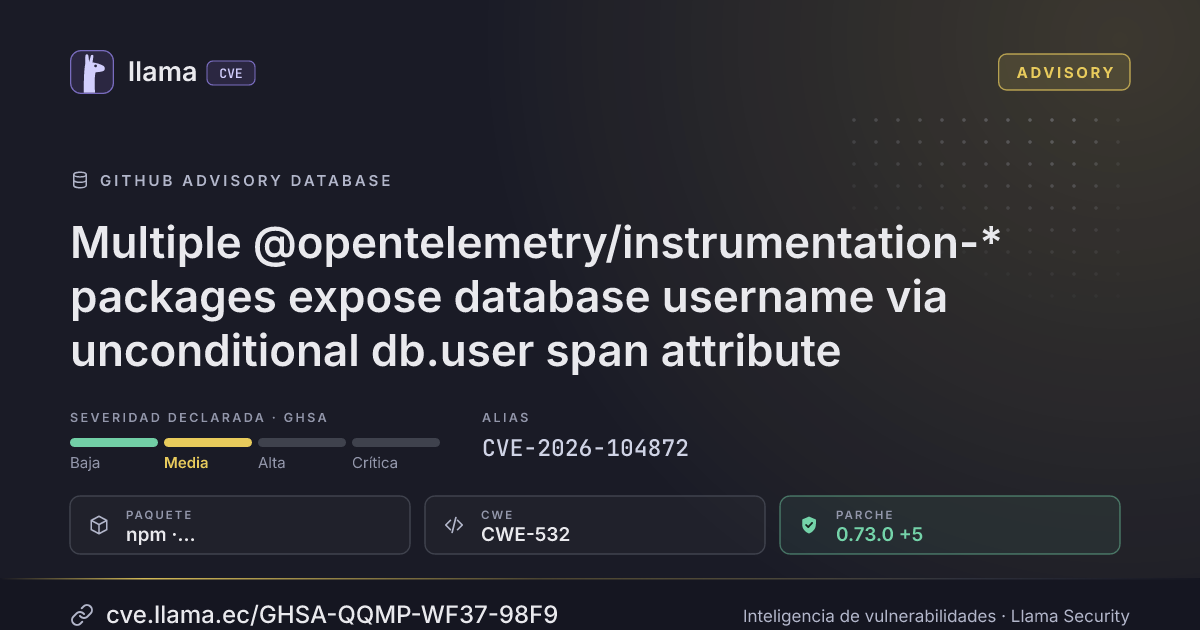
GHSA-QQMP-WF37-98F9
Multiple @opentelemetry/instrumentation-* packages expose database username via unconditional db.user span attribute
Ciclo de vida de la vulnerabilidad
| Fecha | Fase | Evento | Detalle |
|---|---|---|---|
| Remediación | Parche 0.66.0 | @opentelemetry/instrumentation-cassandra-driver · -74 d desde divulgación | |
| Remediación | Parche 0.40.0 | @opentelemetry/instrumentation-tedious · -74 d desde divulgación | |
| Remediación | Parche 0.46.0 | @opentelemetry/instrumentation-oracledb · -74 d desde divulgación | |
| Remediación | Parche 0.67.0 | @opentelemetry/instrumentation-mongoose · -74 d desde divulgación | |
| Divulgación | Publicada | GHSA-QQMP-WF37-98F9 divulgada | |
| Divulgación | Modificada | Última actualización del registro | |
| Monitoreo | Detectada | Ingresó al índice |
Impact
Multiple `@opentelemetry/instrumentation-*` packages recorded the database connection username as the `db.user`
span attribute on every instrumented database operation. This attribute was emitted unconditionally — it was
not gated by `enhancedDatabaseReporting` or any other opt-in flag, and it was the default behaviour for
all users of the affected packages until the patched releases shipped on 2026-07-23.
The attribute is forwarded to every configured observability backend (Jaeger, Zipkin, Datadog, OTLP
collectors, etc.). Depending on the database account naming convention in use, the exported value may
reveal:
- Internal service account names that disclose architecture topology.
- Role-encoded usernames (e.g. `admin_readwrite`, `app_readonly_prod`) useful for privilege inference.
- Database account naming patterns useful for credential enumeration.
Affected packages (all are vulnerable from the first published version through the version listed below):
| Package | Vulnerable range | Patched version |
|---------|-----------------|-----------------|
| `@opentelemetry/instrumentation-cassandra-driver` | `< 0.66.0` | `0.66.0` |
| `@opentelemetry/instrumentation-knex` | `< 0.65.0` | `0.65.0` |
| `@opentelemetry/instrumentation-mongoose` | `< 0.67.0` | `0.67.0` |
| `@opentelemetry/instrumentation-mysql` | `< 0.67.0` | `0.67.0` |
| `@opentelemetry/instrumentation-mysql2` | `< 0.67.0` | `0.67.0` |
| `@opentelemetry/instrumentation-oracledb` | `< 0.46.0` | `0.46.0` |
| `@opentelemetry/instrumentation-pg` | `< 0.73.0` | `0.73.0` |
| `@opentelemetry/instrumentation-tedious` | `< 0.40.0` | `0.40.0` |
Patches
Fixed in the coordinated release on 2026-07-23 via
feat!: only emit stable http, network and database attributes (#3585) https://github.com/open-telemetry/opentelemetry-js-contrib/pull/3585.
Upgrade to the patched version listed in the table above for each instrumentation package in use.
Workarounds
No configuration-level workaround exists in the affected versions: the `db.user` attribute cannot be
suppressed without patching. As a partial mitigation, a custom `SpanProcessor` can be used to strip `db.user` from spans before they leave the process:
// Example: drop db.user in a custom SpanProcessor
class StripDbUserProcessor implements SpanProcessor {
  onStart(span: Span) {
    span.setAttribute('db.user', null);
  }
  onEnd() {}
  shutdown() { return Promise.resolve(); }
  forceFlush() { return Promise.resolve(); }
}
Users who control the downstream collector can also filter the attribute at the collector pipeline level.
Rangos afectados
Estado del parche por paquete
| Paquete / producto | Estado | Corregida en | Desde divulgación | Última versión |
|---|---|---|---|---|
npm@opentelemetry/instrumentation-cassandra-driver |
Corregida | 0.66.0 | -74 d | 0.70.0 no afectada |
npm@opentelemetry/instrumentation-tedious |
Corregida | 0.40.0 | -74 d | 0.44.0 no afectada |
npm@opentelemetry/instrumentation-oracledb |
Corregida | 0.46.0 | -74 d | 0.50.0 no afectada |
npm@opentelemetry/instrumentation-mongoose |
Corregida | 0.67.0 | -74 d | 0.71.0 no afectada |
npm@opentelemetry/instrumentation-mysql |
Corregida | 0.67.0 | -74 d | 0.71.0 no afectada |
0.40.00.46.00.65.00.66.00.67.00.73.0Arsenal público
Sin exploits, módulos ni PoC públicos conocidos a la fecha de verificación.
https://nvd.nist.gov/vuln/detail/CVE-2026-104872https://github.com/open-telemetry/opentelemetry-js-contrib/security/advisories/GHSA-qqmp-wf37-98f9https://github.com/open-telemetry/opentelemetry-js-contrib/pull/3585https://github.com/open-telemetry/opentelemetry-js-contrib/commit/27e172a9e0d549559056ccd58f27d13467454156https://github.com/open-telemetry/opentelemetry-js-contrib/commit/5b7dd0e102e940d653e04b08b5a1b721a8271037https://github.com/open-telemetry/opentelemetry-js-contribLas referencias externas se muestran para copiar: cve.llama.ec no lo redirige a otros sitios.