GHSA-QRXM-FQHP-JWVM
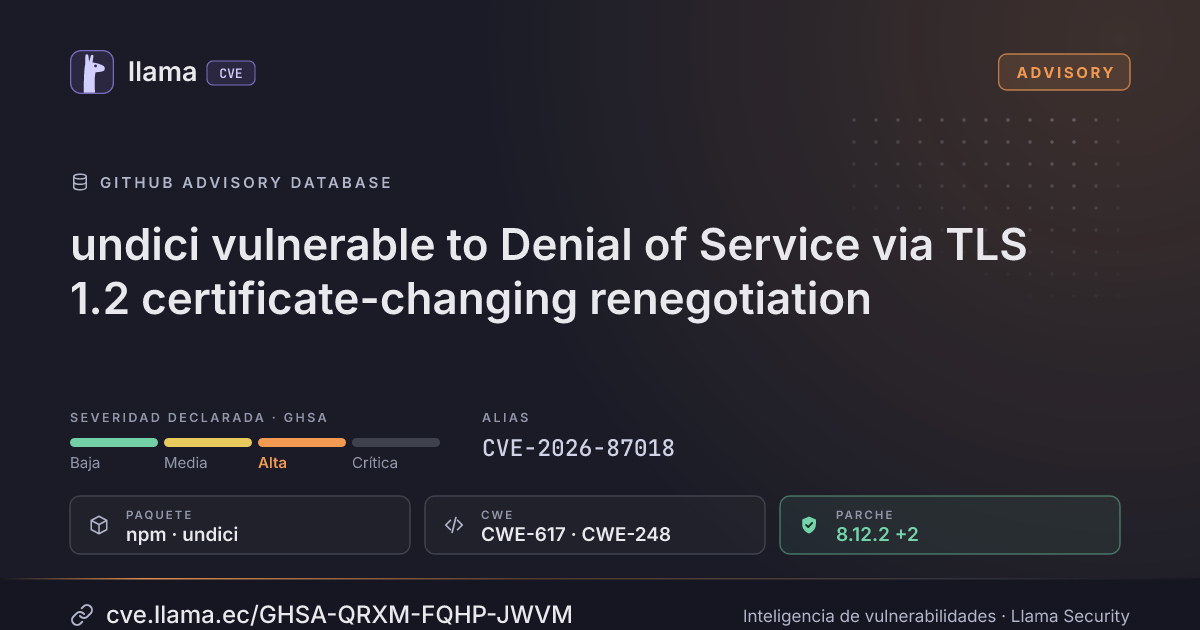
undici vulnerable to Denial of Service via TLS 1.2 certificate-changing renegotiation
Ciclo de vida de la vulnerabilidad
| Fecha | Fase | Evento | Detalle |
|---|---|---|---|
| Remediación | Parche 6.29.1 | undici · -12 d desde divulgación | |
| Remediación | Parche 7.30.1 | undici · -12 d desde divulgación | |
| Remediación | Parche 8.12.2 | undici · -12 d desde divulgación | |
| Divulgación | Publicada | GHSA-QRXM-FQHP-JWVM divulgada | |
| Divulgación | Modificada | Última actualización del registro | |
| Monitoreo | Detectada | Ingresó al índice |
Impact
undici crashes the client process when a TLS 1.2 server renegotiates after the connection is established and presents a different, CA-trusted certificate whose hostname does not match the requested host. Node.js re-runs hostname verification on the renegotiated handshake and destroys the socket with `ERR_TLS_CERT_ALTNAME_INVALID`. undici's established socket error handler asserted that this error code could never occur, so the peer-controlled error became an uncaught `AssertionError` that terminates the Node.js process. Both the HTTP/1.1 and HTTP/2 paths are affected.
A malicious or compromised HTTPS endpoint reached through undici or the global `fetch()` can crash the client with a single server-initiated renegotiation, taking down all in-flight requests and background work in the process. Only TLS 1.2 is affected, because TLS 1.3 does not support renegotiation. Exploitation does not require a CA compromise: the attacker controls the endpoint and can present two ordinary valid certificates, the first matching the requested URL and the second intentionally not matching it.
Patches
Upgrade to undici 6.29.1, 7.30.1, or 8.12.2.
Workarounds
Restrict outbound connections to TLS 1.3, for example by setting `connect: { minVersion: 'TLSv1.3', maxVersion: 'TLSv1.3' }` on the client or agent, so that renegotiation cannot occur, when the target endpoints support TLS 1.3.
Incluye detalles técnicos publicados por el investigador. Úselos solo para validar y corregir sus propios sistemas.
Rangos afectados
Estado del parche por paquete
| Paquete / producto | Estado | Corregida en | Desde divulgación | Última versión |
|---|---|---|---|---|
npmundici |
Corregida | 6.29.1, 7.30.1, 8.12.2 | -12 d · -12 d · -12 d | 8.12.4 no afectada |
6.29.17.30.18.12.2Arsenal público
Sin exploits, módulos ni PoC públicos conocidos a la fecha de verificación.
https://nvd.nist.gov/vuln/detail/CVE-2026-87018https://github.com/nodejs/undici/security/advisories/GHSA-qrxm-fqhp-jwvmhttps://github.com/nodejs/undici/commit/12cfd96c3f430897656e3edc1c5e02be8c1cd309https://github.com/nodejs/undici/commit/b40fbfc0651703cf9fa9f6ced68b679f28d8bb28https://github.com/nodejs/undici/commit/e257e9f8fb42eedd50727b9cf65e548c8925e4a8https://cna.openjsf.org/security-advisories.htmlhttps://github.com/nodejs/undicihttps://github.com/nodejs/undici/releases/tag/v6.29.1https://github.com/nodejs/undici/releases/tag/v7.30.1https://github.com/nodejs/undici/releases/tag/v8.12.2Las referencias externas se muestran para copiar: cve.llama.ec no lo redirige a otros sitios.