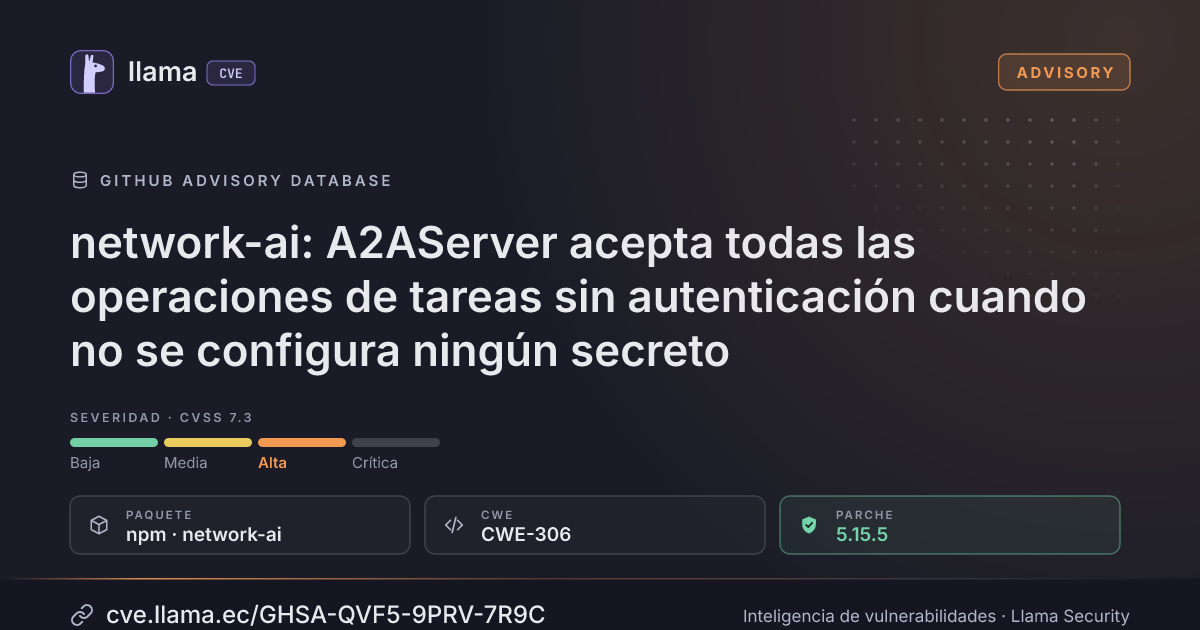
GHSA-QVF5-9PRV-7R9C
network-ai: A2AServer accepts all task operations unauthenticated when no secret is configured
CVSS:3.1/AV:N/AC:L/PR:N/UI:N/S:U/C:L/I:L/A:L
Fuente: GitHub
Ciclo de vida de la vulnerabilidad
| Fecha | Fase | Evento | Detalle |
|---|---|---|---|
| Divulgación | Publicada | GHSA-QVF5-9PRV-7R9C divulgada · CVSS 7.3 (GitHub) | |
| Remediación | Parche 5.15.5 | network-ai · 0 d desde divulgación | |
| Monitoreo | Detectada | Ingresó al índice | |
| Monitoreo | Verificada | Última verificación contra las fuentes |
Summary
The `A2AServer` class in `lib/a2a-server.ts` exposes a Google A2A agent over HTTP with task operations (`tasks/send`, `tasks/get`, `tasks/cancel`). Its Bearer authentication is applied only when a `secret` option is configured; the option is optional with no default, and `startServer()` starts the server without checking that a secret is present. When an operator starts the server without a secret (the default), the authentication block is skipped entirely and any network client can submit tasks to the executor, retrieve task results, and cancel tasks with no credentials. Unlike the package's MCP servers, which refuse to start without a secret, the A2A server fails open.
Root Cause
Authentication in the request router is guarded by `if (this.options.secret) { ... }`. When no secret is configured the condition is falsy, the entire block that validates the `Authorization: Bearer` header is skipped, and the request proceeds to task handling. There is no fail-closed startup check: `startServer()` creates and listens on the HTTP server regardless of whether a secret was provided, in contrast to the MCP transports whose `listen()` methods reject startup when the secret is empty. The result is that the default configuration of a network-facing agent endpoint has no authentication.
lib/a2a-server.ts
  - A2AServerOptions.secret is declared optional (secret?: string); constructor assigns no default
  - A2AServer.startServer(port, hostname='127.0.0.1') calls createServer(...).listen() with no secret check
  - A2AServer.route(): if (this.options.secret) { verify Bearer header; 401 on mismatch }
      -> when secret is undefined, the whole auth block is skipped
  - handleSend() then calls this.options.executor(text, metadata) on attacker-supplied text
Impact
An unauthenticated attacker who can reach an A2A server started without a secret gains full access to its task interface: submit arbitrary task text to the configured executor (`tasks/send`), read stored task results (`tasks/get`), and cancel tasks (`tasks/cancel`). The task text is attacker-controlled and passed directly to the developer-supplied executor, so the concrete impact beyond the A2A server depends on what that executor does; within the A2A server itself an attacker can create and cancel task records and read their outputs. The server defaults to binding `127.0.0.1`, which limits exposure, but the A2A protocol is specifically intended for inter-agent network communication, so operators are expected to bind it to reachable interfaces, and container networks, co-located processes, and DNS rebinding can reach even a loopback bind. The project's own documentation describes the A2A server as Bearer-gated, so the fail-open default contradicts the documented security posture.
Proof of Concept
Prerequisite: an A2AServer instance started without a secret, for example:
  new A2AServer({ name: 'demo', executor }).startServer(4100, '0.0.0.0')
reachable at http://TARGET:PORT.- Read the agent card and observe that it advertises no authentication schemes.
- Submit a task with no `Authorization` header and observe that it is executed.
# Agent card advertises no auth when no secret is configured:
curl -s http://TARGET:PORT/.well-known/agent.json
# -> {"name":"demo",...,"authentication":{"schemes":[]}}

# Unauthenticated task submission is accepted and executed:
curl -s http://TARGET:PORT/tasks -X POST -H 'Content-Type: application/json' \
  -d '{"jsonrpc":"2.0","id":1,"method":"tasks/send",
       "params":{"message":{"parts":[{"type":"text","text":"attacker task"}]}}}'
HTTP/1.1 200 OK
Content-Type: application/json
{"jsonrpc":"2.0","id":1,"result":{"id":"<task-id>","status":{"state":"completed"},
"artifacts":[{"name":"result","parts":[{"type":"text","text":"<executor output>"}]}]}}Attack Chain
- Exposure: An operator constructs an `A2AServer` without a `secret` and starts it via `startServer()`, which listens without any startup validation of the secret.
- Control: The attacker fully controls the JSON-RPC request body, including the task text carried in `params.message.parts[].text`.
- Path: The request reaches `route()`, matches the `POST /tasks` (or `POST /`) branch, and advances toward task handling.
- Guard: The Bearer authentication block is wrapped in `if (this.options.secret)`; with no secret configured the block is skipped and no authorization occurs.
- Primitive: `handleSend()` extracts the task text and invokes the configured executor, while `tasks/get` and `tasks/cancel` read and mutate stored task records.
- Result: The attacker submits arbitrary tasks, reads their results, and cancels tasks without any credentials.
Bypass Evidence
The relevant protection is the Bearer check in `route()`. The strongest challenge to the finding is that omitting a secret is an operator decision, analogous to deliberately disabling a control. That framing does not hold: the operator does not actively disable a guard; the default state of the optional field is unauthenticated, and the documentation describes the component as Bearer-gated, so a developer following it would reasonably expect enforcement. The default loopback bind is a mitigation rather than a guard, and does not block container-network, co-located, DNS-rebinding, or deliberate non-loopback deployments. The package already established that optional authentication on network-serving components is a defect by making its MCP transports refuse to start without a secret; the A2A server retains the fail-open pattern. No prior advisory covers the A2A server, and no code path adds a default secret or a startup secret check.
Affected Versions
- Ecosystem: `npm`
- Package: `network-ai`
- Confirmed affected range: `<= 5.15.4`
- Latest release checked: `5.15.4` (npm registry
https://registry.npmjs.org/network-ai) - Fix status: not fixed
The fail-open default has been present since the A2A server was introduced; the exact introducing version was not independently established, so the range is bounded only by the latest published release, 5.15.4.
Suggested Fix
Make the A2A server fail closed. Require a non-empty secret before serving task operations: have `startServer()` (and the handler for programmatic mounts) refuse to start, or reject every task request with 401, when no secret is configured, matching the MCP transports' `listen()` behavior. Alternatively, make `secret` a required option so the type system and constructor enforce its presence. The authentication check in `route()` should be unconditional for the task routes rather than gated on the presence of a secret. If an unauthenticated mode is intentionally supported for local development, it should require an explicit opt-in and emit a clear warning when binding to a non-loopback address.
---
Reported by zx.
Incluye detalles técnicos publicados por el investigador. Úselos solo para validar y corregir sus propios sistemas.
Desglose de métricas
Rangos afectados
Estado del parche por paquete
| Paquete / producto | Estado | Corregida en | Desde divulgación | Última versión |
|---|---|---|---|---|
npmnetwork-ai |
Corregida | 5.15.5 | 0 d | 6.0.1 no afectada |
5.15.5Arsenal público
Sin exploits, módulos ni PoC públicos conocidos a la fecha de verificación.
https://github.com/Jovancoding/Network-AI/security/advisories/GHSA-qvf5-9prv-7r9cLas referencias externas se muestran para copiar: cve.llama.ec no lo redirige a otros sitios.