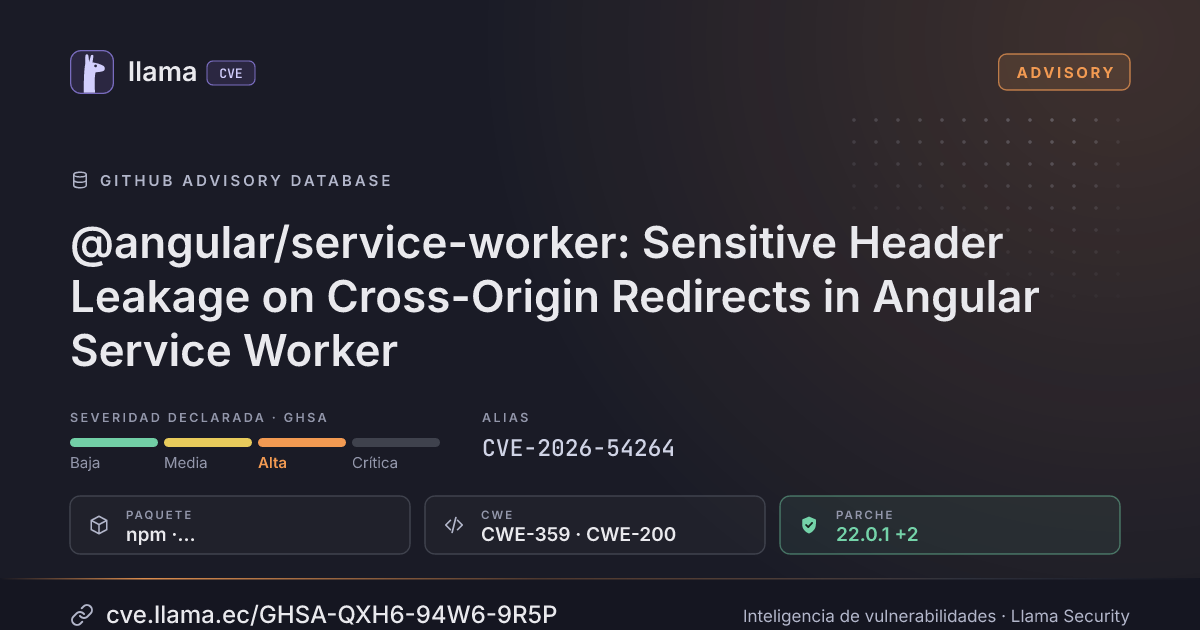
GHSA-QXH6-94W6-9R5P
@angular/service-worker: Sensitive Header Leakage on Cross-Origin Redirects in Angular Service Worker
Ciclo de vida de la vulnerabilidad
| Fecha | Fase | Evento | Detalle |
|---|---|---|---|
| Remediación | Parche 20.3.25 | @angular/service-worker · -5 d desde divulgación | |
| Remediación | Parche 21.2.17 | @angular/service-worker · -5 d desde divulgación | |
| Remediación | Parche 22.0.1 | @angular/service-worker · -5 d desde divulgación | |
| Divulgación | Publicada | GHSA-QXH6-94W6-9R5P divulgada | |
| Divulgación | Modificada | Última actualización del registro | |
| Monitoreo | Detectada | Ingresó al índice |
An information disclosure vulnerability exists in the `@angular/service-worker` package of the Angular framework. When the Service Worker fetches assets, it preserves metadata (such as headers) from the original request. However, on cross-origin redirects, the Service Worker fails to strip sensitive headers, violating the Fetch redirect algorithm.
This allows a remote attacker to obtain sensitive credentials (e.g., `Authorization` tokens, `Proxy-Authorization` credentials, or session cookies) by triggering a cross-origin redirect to an untrusted external origin.
### Impact
If an application configured with the Angular Service Worker fetches assets with credential headers (such as `Authorization` header), and one of those requests is redirected to a different origin, the Service Worker will forward those headers to the new origin. This exposes critical credentials and session identifiers to unauthorized third-party servers.
### Attack Preconditions
For this vulnerability to be exploitable:
1. Vulnerable Configuration: The application must utilize the `@angular/service-worker` package to fetch assets.
2. Credentialed Requests: The application must attach sensitive request headers (like `Authorization`, `Proxy-Authorization`, or rely on cookies) to asset-group requests.
3. Redirect Flow: These requests must encounter a cross-origin redirect to an attacker-controlled or untrusted domain.
### Patched Versions
* 22.0.1
* 21.2.17
* 20.3.25
### Credits
This vulnerability was discovered and reported by CodeMender from Google DeepMind https://deepmind.google/blog/introducing-codemender-an-ai-agent-for-code-security/.
Incluye detalles técnicos publicados por el investigador. Úselos solo para validar y corregir sus propios sistemas.
Rangos afectados
Estado del parche por paquete
| Paquete / producto | Estado | Corregida en | Desde divulgación | Última versión |
|---|---|---|---|---|
npm@angular/service-worker |
Corregida | 20.3.25, 21.2.17, 22.0.1 | -5 d · -5 d · -5 d | 22.2.6 no afectada |
20.3.2521.2.1722.0.1Arsenal público
Sin exploits, módulos ni PoC públicos conocidos a la fecha de verificación.
https://nvd.nist.gov/vuln/detail/CVE-2026-54264https://github.com/angular/angular/security/advisories/GHSA-qxh6-94w6-9r5phttps://github.com/angular/angular/pull/69029https://github.com/angular/angular/commit/47d68dcb26266316647133ab6385e77fc3e5ae08https://github.com/angular/angularLas referencias externas se muestran para copiar: cve.llama.ec no lo redirige a otros sitios.