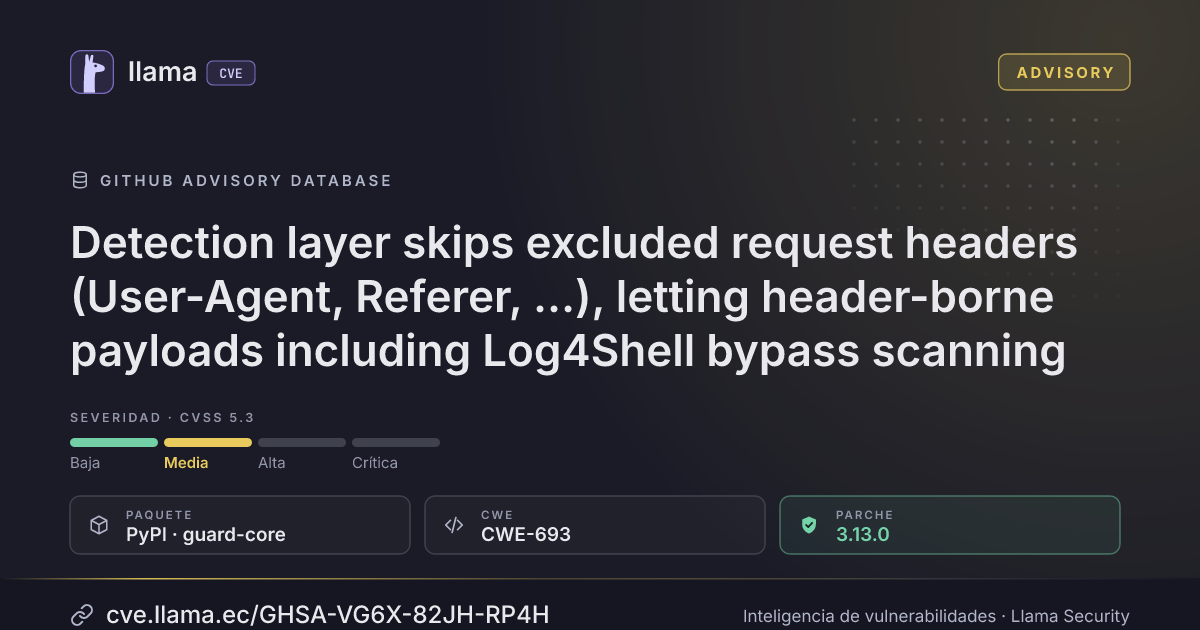
GHSA-VG6X-82JH-RP4H
Detection layer skips excluded request headers (User-Agent, Referer, ...), letting header-borne payloads including Log4Shell bypass scanning
CVSS:3.1/AV:N/AC:L/PR:N/UI:N/S:U/C:N/I:L/A:N
Fuente: GitHub
Ciclo de vida de la vulnerabilidad
| Fecha | Fase | Evento | Detalle |
|---|---|---|---|
| Divulgación | Publicada | GHSA-VG6X-82JH-RP4H divulgada · CVSS 5.3 (GitHub) | |
| Monitoreo | Detectada | Ingresó al índice | |
| Monitoreo | Verificada | Última verificación contra las fuentes |
Summary
guard-core's request-header scanner excludes a hardcoded set of headers from all detection scanning, so attack payloads delivered through those headers, most importantly `User-Agent` (the canonical Log4Shell delivery vector) and `Referer` (a classic XSS vector), are never inspected by the detection engine in any released version. This is a failure of guard-core's detection protection mechanism (CWE-693), not a compromise of guard-core itself or of the host application.
Impact
`_scan_headers` in `guard_core/utils.py` skips every header in the hardcoded `_DEFAULT_EXCLUDED_HEADERS` set (`host`, `user-agent`, `accept`, `accept-encoding`, `connection`, `origin`, `referer`, and the `sec-fetch-*` / `sec-ch-ua-*` client-hint headers) before running any detection pattern. The exclusion exists to avoid false positives on chaotic, client-supplied header values, but the `excluded_detection_headers` configuration is additive-only (`_resolve_excluded_headers`), so a consumer cannot remove the built-in exclusions.
As a result, a payload of any detection category (SQL injection, XSS, command injection, Log4Shell `${jndi:...}`, etc.) delivered through an excluded header is not scanned end-to-end. The highest-impact concrete case is Log4Shell: the original and still-common delivery vector is a `${jndi:ldap://...}` string placed in the `User-Agent` header, which guard-core never inspects.
This is a gap in guard-core's DETECTION LAYER. It does not, by itself, compromise guard-core or the protected application. Real-world impact requires an independently vulnerable downstream component (for example, an application that logs the `User-Agent` value through a vulnerable Log4j version). What fails is the detection and blocking that a consumer would reasonably expect guard-core to provide for those headers.
CWE-693: Protection Mechanism Failure.
Affected versions
All released versions of guard-core (`< 3.13.0`).
The code identifiers used above (`_scan_headers`, `_DEFAULT_EXCLUDED_HEADERS`) are the current (3.x) names. The same behavior, a request-header scan that skips a hardcoded excluded set including `user-agent`, has existed since the earliest release (0.1.0) via an inline `excluded_headers` set in `guard_core/utils.py` (verified at 0.1.0, 1.0.0, and 1.2.1, where the skip wraps the detection call itself). The 2.0.0 refactor into `_scan_headers` / `_DEFAULT_EXCLUDED_HEADERS` only renamed pre-existing behavior. The exclusion, and therefore the bypass, is present in every released version, hence the affected range `< 3.13.0`.
Framework adapters (fastapi-guard, flaskapi-guard, djapi-guard) inherit this behavior through their guard-core dependency and are remediated by upgrading guard-core. This advisory is filed against guard-core as the single affected package rather than duplicated per adapter.
Patches
guard-core 3.13.0 introduces an "always-scan" pattern set that is applied even to excluded headers, seeded with the Log4Shell `${jndi:}` pattern. Because `${jndi:` has no legitimate occurrence in user input, scanning excluded headers for it adds no false-positive surface, closing the Log4Shell-via-`User-Agent` vector secure-by-default. The general header exclusion is retained for all other patterns to avoid false positives on chaotic client headers, so header-borne payloads of other categories remain outside the detection layer's scope by design (see Mitigations).
Mitigations / workarounds
For affected versions (`< 3.13.0`) there is NO complete configuration remedy: because `excluded_detection_headers` is additive-only, the built-in exclusions cannot be removed through configuration. Recommended actions:
- Upgrade to guard-core 3.13.0 or later once available, which closes the Log4Shell / `User-Agent` case secure-by-default.
- As defense in depth for all header-borne payload categories (including after upgrading, since the detection layer still does not inspect excluded headers for non-jndi patterns), apply application-level input hardening and keep downstream components patched (for example, Log4j >= 2.17.1).
References
- `guard_core/utils.py`: `_DEFAULT_EXCLUDED_HEADERS`, `_scan_headers`, `_resolve_excluded_headers`.
Severity
Moderate. `CVSS:3.1/AV:N/AC:L/PR:N/UI:N/S:U/C:N/I:L/A:N` (5.3). Network-reachable, no privileges or interaction; guard-core's own confidentiality and availability are unaffected (C:N/A:N); integrity impact is limited to the bypassed detection layer (I:L), and scope is unchanged (S:U) since actual harm is gated on an independently vulnerable downstream component.
Desglose de métricas
Rangos afectados
Estado del parche por paquete
| Paquete / producto | Estado | Corregida en | Desde divulgación | Última versión |
|---|---|---|---|---|
PyPIguard-core |
Corregida | 3.13.0 | — | — |
3.13.0Arsenal público
Sin exploits, módulos ni PoC públicos conocidos a la fecha de verificación.
https://github.com/Guard-Core/guard-core/security/advisories/GHSA-vg6x-82jh-rp4hLas referencias externas se muestran para copiar: cve.llama.ec no lo redirige a otros sitios.