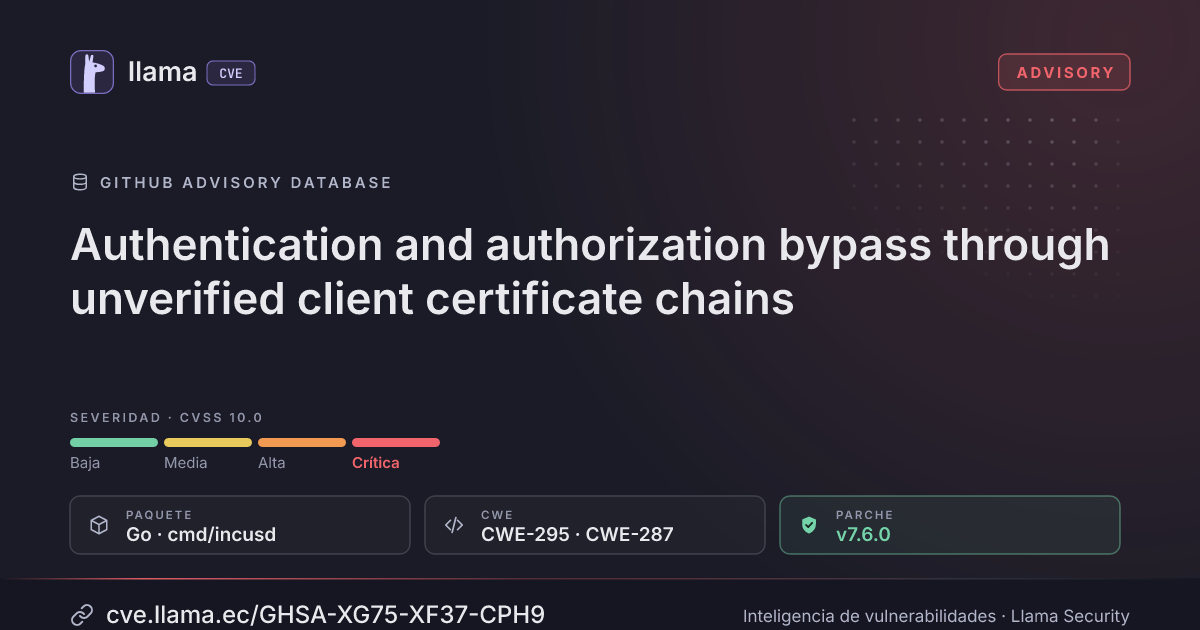
GHSA-XG75-XF37-CPH9
Authentication and authorization bypass through unverified client certificate chains
CVSS:3.1/AV:N/AC:L/PR:N/UI:N/S:C/C:H/I:H/A:H
Fuente: GitHub
Ciclo de vida de la vulnerabilidad
| Fecha | Fase | Evento | Detalle |
|---|---|---|---|
| Divulgación | Publicada | GHSA-XG75-XF37-CPH9 divulgada · CVSS 10 (GitHub) | |
| Monitoreo | Detectada | Ingresó al índice | |
| Monitoreo | Verificada | Última verificación contra las fuentes |
Summary
The HTTPS listener requests client certificates without verifying them,
so the TLS handshake only proves that the client holds the private key
of the first certificate in the chain it presents. The remaining
certificates are entirely client controlled.
The authentication and certificate ownership checks compared every
certificate in the presented chain against the trust store. A client
could therefore authenticate as any trusted certificate by appending
that certificate's public part to its own chain, without holding the
matching private key.
This has been the case since the initial release.
Impact
Any client able to reach the HTTPS listener can authenticate as any
trusted client, metrics or server certificate for which it has the
public certificate, including as a cluster member, which bypasses
authorization entirely.
Server certificates are returned by every TLS handshake, so no prior
access is needed to obtain one. Appending the server's own certificate
grants access to the database gateway, and on a cluster appending
another member's certificate grants internal cluster access. Client
certificates can be read by any trusted client through the certificates
API or obtained from any server the client connected to.
The same flaw lets a client renew or delete any trust store entry
through the self-service paths, and affects the authentication of the
agent connection between the host and virtual machines.
The unverified presented chain was also passed to the authorization
scriptlet, so a client could feed it attacker-chosen certificates to
influence scriptlet-based authorization decisions. This includes
clients not authenticated through mutual TLS, such as token or OIDC
clients, which can still present an arbitrary certificate during the
handshake.
Workarounds
Restrict network access to the HTTPS listener to trusted hosts. There
is no configuration based workaround.
Desglose de métricas
Rangos afectados
Estado del parche por paquete
| Paquete / producto | Estado | Corregida en | Desde divulgación | Última versión |
|---|---|---|---|---|
Gogithub.com/lxc/incus/v7/cmd/incusd |
Corregida | v7.6.0 | — | — |
v7.6.0Arsenal público
Sin exploits, módulos ni PoC públicos conocidos a la fecha de verificación.
https://github.com/lxc/incus/security/advisories/GHSA-xg75-xf37-cph9Las referencias externas se muestran para copiar: cve.llama.ec no lo redirige a otros sitios.