GHSA-XGFR-24JQ-VV8H
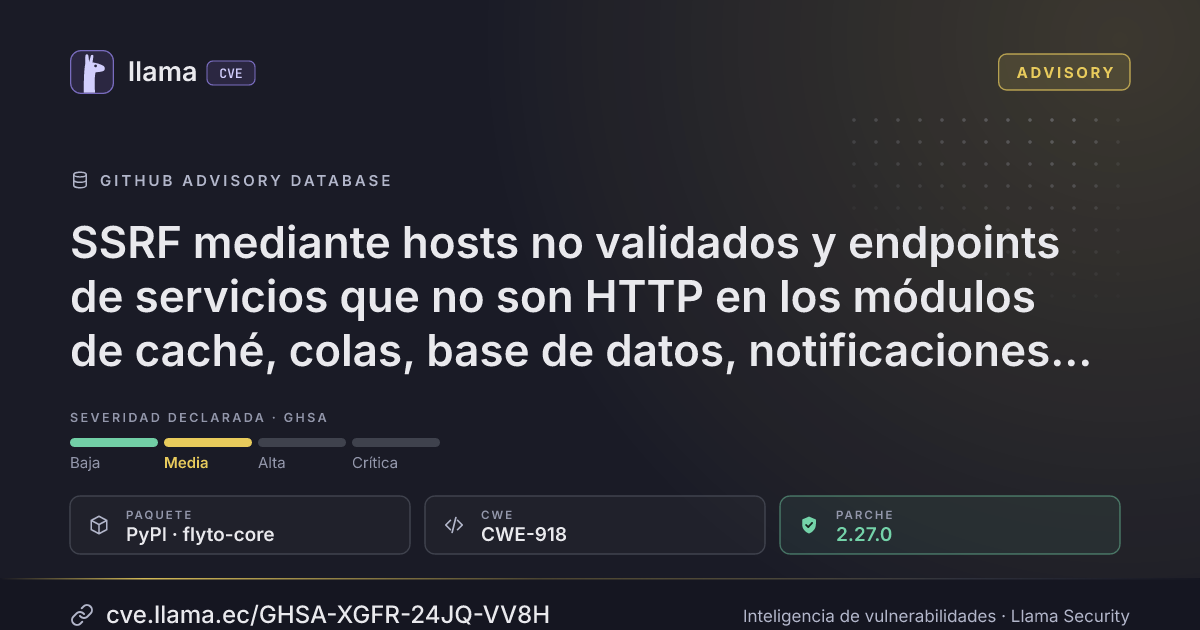
SSRF via unvalidated host and non-HTTP service endpoints in cache, queue, db, notification and network modules
Ciclo de vida de la vulnerabilidad
| Fecha | Fase | Evento | Detalle |
|---|---|---|---|
| Remediación | Parche 2.27.0 | flyto-core · -6 d desde divulgación | |
| Divulgación | Publicada | GHSA-XGFR-24JQ-VV8H divulgada | |
| Monitoreo | Detectada | Ingresó al índice | |
| Monitoreo | Verificada | Última verificación contra las fuentes |
Impact
`validate_url_ssrf` only understands `http`/`https`. Modules that open a raw TCP connection take a bare hostname, or a `redis://` endpoint, and had no shared guard available to call — so the gap was structural rather than an oversight in any one module:
- `cache.get` / `cache.set` / `cache.clear` / `cache.delete` / `queue.enqueue` / `queue.dequeue` / `queue.size` — `redis_url` was dialled unchecked. `cache.*` and `queue.*` declare no `required_permissions` and are allowed by default.
- `network.ping` / `network.traceroute` / `network.port_scan` / `port.wait` — `host` unchecked, no permissions required. A ready-made internal network scanner.
- `db.redis.get` / `db.redis.set` / `db.mysql.query` — `host` unchecked.
- `notification.email.send` — `smtp_server` unchecked, and the module carries `username`/`password` to whatever answers, so this both probes internal hosts and delivers SMTP credentials to them.
Targets include the cloud instance metadata endpoint. IPv4-mapped IPv6 literals such as `::ffff:127.0.0.1` were also unhandled outside `port.check`.
Patches
Fixed in 2.27.0, which adds two shared guards to `core.utils`: `enforce_outbound_host` for raw TCP hosts and `enforce_outbound_service_url` for non-HTTP endpoints. Both apply one policy — loopback allowed, `FLYTO_ALLOWED_HOSTS` allowed, `FLYTO_ALLOW_PRIVATE_NETWORK` allowed, otherwise resolve and reject private, link-local, metadata or unresolvable targets, failing closed on resolution failure.
The host resolver that closed GHSA-v7q9-pr72-5fmv (IP literals range-checked directly so IPv6 transition forms cannot skip the check) was promoted out of `port.check` into `core.utils.resolve_guard_ip` and now backs every host-taking module.
`ssh.exec`, `ssh.sftp_upload` and `ssh.sftp_download` received the same guard; they are denied by the default module policy, so exploiting those requires an operator grant.
Breaking change
This is why 2.27.0 is a minor rather than a patch. Connections to private or link-local hosts now require `FLYTO_ALLOWED_HOSTS` or `FLYTO_ALLOW_PRIVATE_NETWORK=true`. Loopback is unaffected, so self-hosted Redis/MySQL/SMTP on `localhost` continues to work.
Workarounds
Deny the affected modules via `FLYTO_MODULE_DENYLIST`, or run the workflow engine on a host with no route to internal services or the metadata endpoint.
Incluye detalles técnicos publicados por el investigador. Úselos solo para validar y corregir sus propios sistemas.
Rangos afectados
Estado del parche por paquete
| Paquete / producto | Estado | Corregida en | Desde divulgación | Última versión |
|---|---|---|---|---|
pypiflyto-core |
Corregida | 2.27.0 | -6 d | 2.41.0 no afectada |
2.27.0Arsenal público
Sin exploits, módulos ni PoC públicos conocidos a la fecha de verificación.
https://github.com/flytohub/flyto-core/security/advisories/GHSA-xgfr-24jq-vv8hLas referencias externas se muestran para copiar: cve.llama.ec no lo redirige a otros sitios.