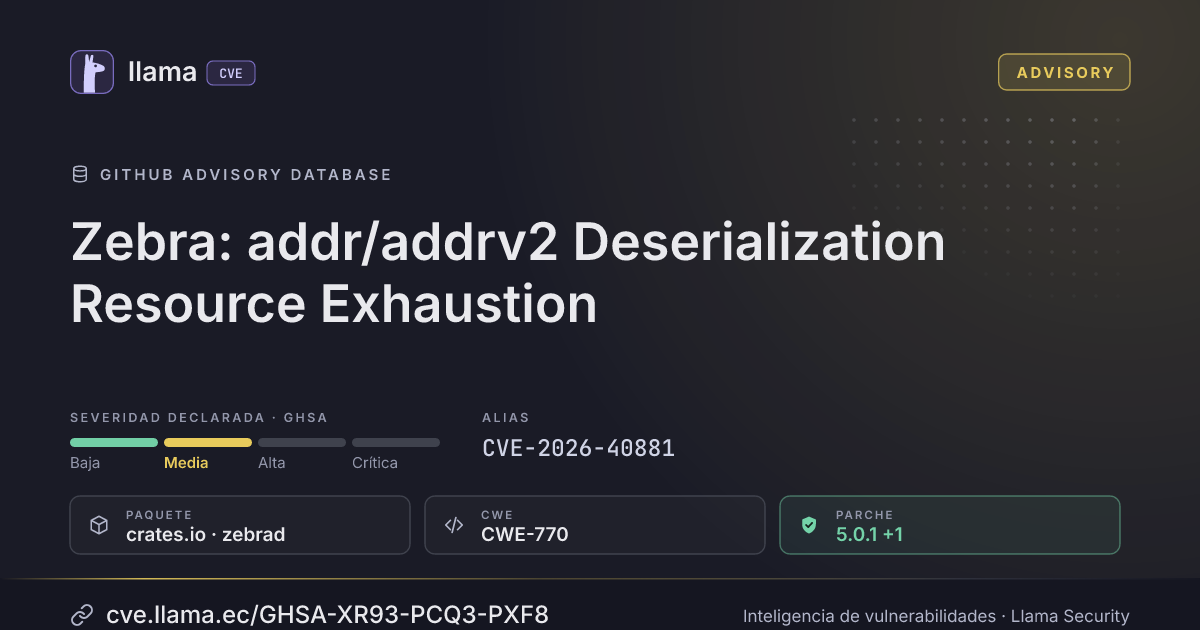
GHSA-XR93-PCQ3-PXF8
Zebra: addr/addrv2 Deserialization Resource Exhaustion
Ciclo de vida de la vulnerabilidad
| Fecha | Fase | Evento | Detalle |
|---|---|---|---|
| Remediación | Parche 4.3.1 | zebrad · -1 d desde divulgación | |
| Remediación | Parche 5.0.1 | zebra-network · -1 d desde divulgación | |
| Divulgación | Publicada | GHSA-XR93-PCQ3-PXF8 divulgada | |
| Divulgación | Modificada | Última actualización del registro | |
| Monitoreo | Detectada | Ingresó al índice |
CVE-2026-40881: addr/addrv2 Deserialization Resource Exhaustion
Summary
When deserializing `addr` or `addrv2` messages, which contain vectors of addresses, Zebra would fully deserialize them up to a maximum length (over 233,000) that was derived from the 2 MiB message size limit. This is much larger than the actual limit of 1,000 messages from the specification. Zebra would eventually check that limit but, at that point, the memory for the larger vector was already allocated. An attacker could cause out-of-memory aborts in Zebra by sending multiple such messages over different connections.
Severity
Moderate - This is a Denial of Service Vulnerability that could allow an attacker to crash a Zebra node.
Affected Versions
All Zebra versions prior to version 4.3.1.
Description
The vulnerability exists in the `read_addr/addrv2` functions in `codec.rs`. It deserializes a vector of addresses with the `zcash_deserialize()` trait method, which uses as a upper bound the result of `T::max_allocation()`. For theses types, it was derived from dividing the max message size (2 MiB) by the minimum serialized size of one entry. For AddrV1: 2_097_152 / 30 = 69,904. For AddrV2: 2_097_152 / 9 = 233,016. Only after deserialization was the `MAX_ADDRS_IN_MESSAGE = 1000` limit checked.
An attacker could exploit this by:
1. Creating `addr` or `addrv2` messages with a large number of entries.
2. Submitting them to a Zebra node, possibly through multiple connections, to attempt to get Zebra into an out-of-memory state.
Impact
Denial of Service
- Attack Vector: Network.
- Effect: Zebra node crash.
- Scope: Any impacted Zebra node.
Fixed Versions
This issue is fixed in Zebra 4.3.1.
The fix changes the `max_allocation()` method for the relevant types to return 1,000, thus blocking larger values prior to deserialization.
Mitigation
Users should upgrade to Zebra 4.3.1 or later immediately.
There are no known workarounds for this issue. Immediate upgrade is the only way to ensure the node remains not vulnerable to the denial of service attack.
Credits
Thanks @Zk-nd3r for finding and reporting the issue, and suggesting the fix.
Incluye detalles técnicos publicados por el investigador. Úselos solo para validar y corregir sus propios sistemas.
Rangos afectados
Estado del parche por paquete
| Paquete / producto | Estado | Corregida en | Desde divulgación | Última versión |
|---|---|---|---|---|
crates.iozebrad |
Corregida | 4.3.1 | -1 d | 7.0.0 no afectada |
crates.iozebra-network |
Corregida | 5.0.1 | -1 d | 15.0.0 no afectada |
4.3.15.0.1Arsenal público
Sin exploits, módulos ni PoC públicos conocidos a la fecha de verificación.
https://nvd.nist.gov/vuln/detail/CVE-2026-40881https://github.com/ZcashFoundation/zebra/security/advisories/GHSA-xr93-pcq3-pxf8https://github.com/ZcashFoundation/zebraLas referencias externas se muestran para copiar: cve.llama.ec no lo redirige a otros sitios.