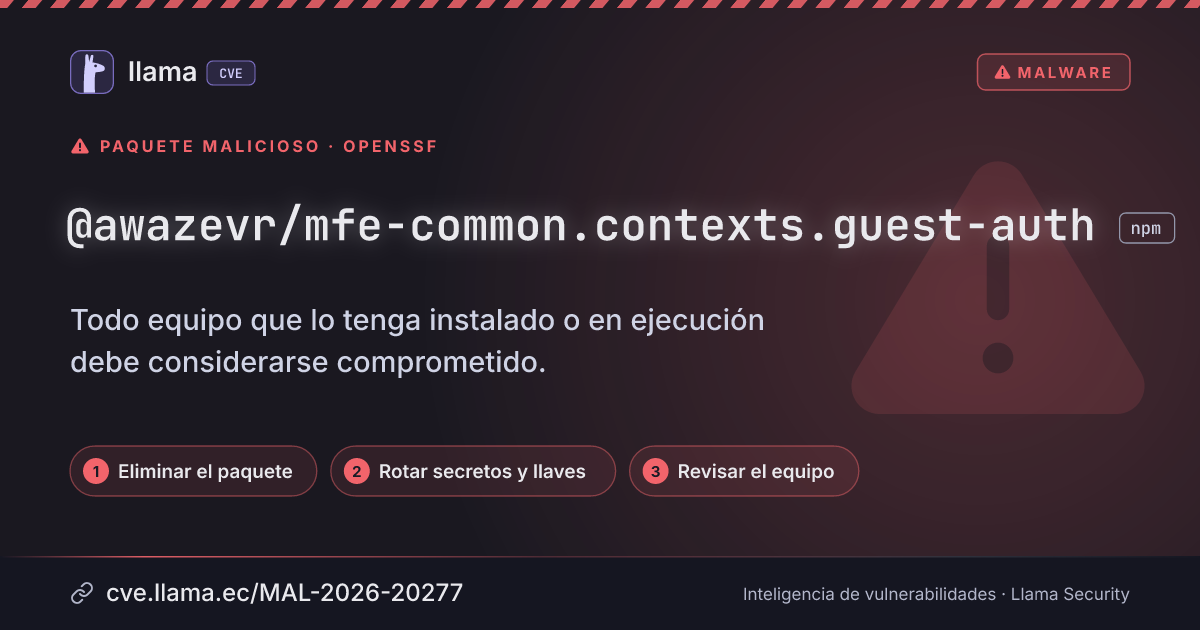
MAL-2026-20277
Malicious code in @awazevr/mfe-common.contexts.guest-auth (npm)
Ciclo de vida de la vulnerabilidad
| Fecha | Fase | Evento | Detalle |
|---|---|---|---|
| Divulgación | Publicada | MAL-2026-20277 divulgada | |
| Divulgación | Modificada | Última actualización del registro | |
| Monitoreo | Detectada | Ingresó al índice | |
| Monitoreo | Verificada | Última verificación contra las fuentes |
Package @awazevr/mfe-common.contexts.guest-auth publishes to the unregistered public-registry scope @awazevr, which is used by a third-party organization for private internal packages. The package.json declares a postinstall script that executes shell commands (whoami, hostname) on every install, prefixed with an echoed banner identifying the artifact as a dependency-confusion proof-of-concept. Any build system that resolves this scope from the public npm registry (for example, a CI job misconfigured to fetch an internal @awazevr dependency without a scoped-registry pin) auto-executes the author's shell code on install. The current payload only prints local host identifiers rather than exfiltrating or fetching remote code, but the install-time arbitrary command execution path and the scope-shadowing mechanism are fully functional, and the same vector delivers whatever commands subsequent versions place in the postinstall script. Self-identification as bug-bounty research does not change the installer-facing behavior: the lifecycle hook runs attacker-authored commands on the installer host.
Versiones afectadas
1.0.0Estado del parche por paquete
| Paquete / producto | Estado | Corregida en | Desde divulgación | Última versión |
|---|---|---|---|---|
npm@awazevr/mfe-common.contexts.guest-auth |
Sin parche | — | — | — |
Arsenal público
Sin exploits, módulos ni PoC públicos conocidos a la fecha de verificación.
https://www.npmjs.com/package/@awazevr/mfe-common.contexts.guest-auth/v/1.0.0Las referencias externas se muestran para copiar: cve.llama.ec no lo redirige a otros sitios.