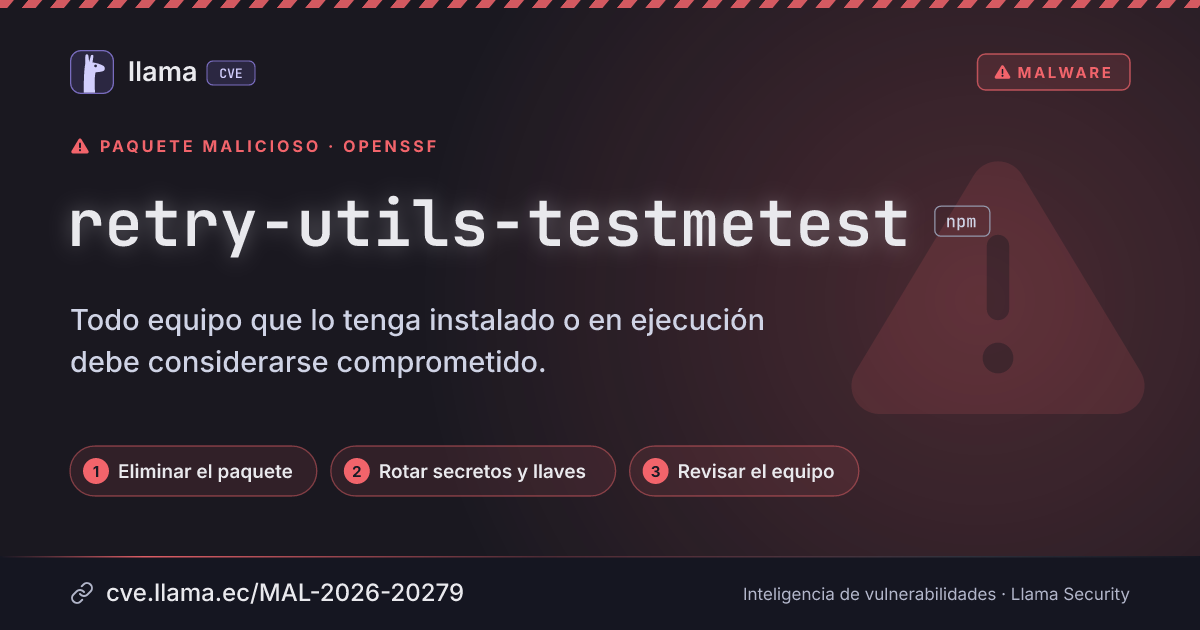
MAL-2026-20279
Malicious code in retry-utils-testmetest (npm)
Ciclo de vida de la vulnerabilidad
| Fecha | Fase | Evento | Detalle |
|---|---|---|---|
| Divulgación | Publicada | MAL-2026-20279 divulgada | |
| Divulgación | Modificada | Última actualización del registro | |
| Monitoreo | Detectada | Ingresó al índice | |
| Monitoreo | Verificada | Última verificación contra las fuentes |
The package advertises itself as a lightweight retry utility but ships no library code consistent with that purpose. binding.gyp declares a stub target with no native sources (.c/.cc/.cpp) and uses GYP command-expansion syntax (`<!(node index.js...)`) in an action, causing npm's automatic `node-gyp rebuild` to execute index.js at install time. index.js is a multi-layer obfuscated loader: a Caesar-shifted string is passed to eval; the decoded loader AES-128-GCM-decrypts an in-file blob (yielding a getBunPath helper), then AES-128-GCM-decrypts and brotli-decompresses lib_native.dat into a second-stage script, writes it to a temporary file, and spawns it. Execution is routed through the Bun runtime (via getBunPath()) rather than Node, evading Node-based install-time inspection. The ~319 KB lib_native.dat is named to masquerade as a native shared library but contains high-entropy AES-128-GCM ciphertext with no plaintext strings. The combination — stub binding.gyp with no native sources used only to trigger install-time execution, Caesar+AES+Brotli layered obfuscation, encrypted payload disguised as a native library, and alternate-runtime execution via Bun — is a dropper delivering attacker-controlled code to any machine that runs `npm install` on this package.
Versiones afectadas
1.0.3Estado del parche por paquete
| Paquete / producto | Estado | Corregida en | Desde divulgación | Última versión |
|---|---|---|---|---|
npmretry-utils-testmetest |
Sin parche | — | — | — |
Arsenal público
Sin exploits, módulos ni PoC públicos conocidos a la fecha de verificación.
https://www.npmjs.com/package/retry-utils-testmetest/v/1.0.3Las referencias externas se muestran para copiar: cve.llama.ec no lo redirige a otros sitios.