llamaCVEVulnerability Intelligence
/
Quay

CVE-2026-123710

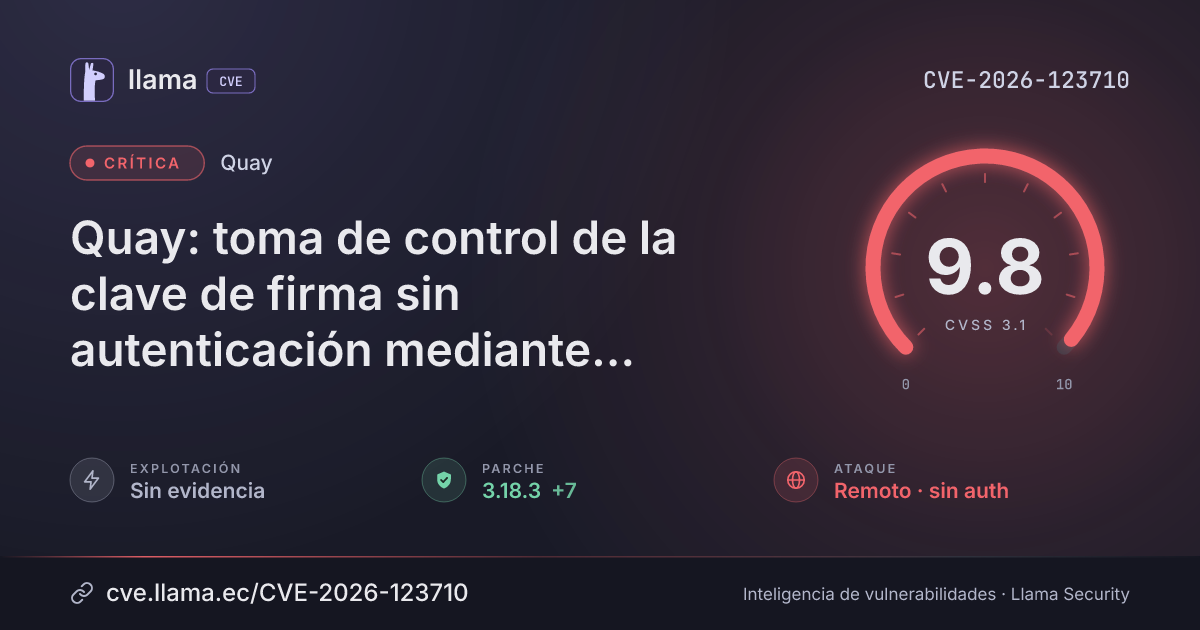
Quay unauthenticated signing-key takeover via key rotation

Without logging in, an attacker can add their own signing key, then read private images and replace repository tags.

Texto original en inglés · Ver en español

Solo en configuraciones específicasParche disponibleimproper input validation
Descargar PNG JSON
CVSS 3.1
9.8
Crítica
CVSS:3.1/AV:N/AC:L/PR:N/UI:N/S:U/C:H/I:H/A:H Fuente: CNA
ExplotaciónSin evidenciaSSVC: ninguna · no figura en CISA KEV
Exploits públicos0Ninguno conocido
Parche8 versiones3.9.28 · 3.10.28 · 3.12.24 · 3.14.10 …
Exposición9 dDesde la divulgación, 11 nov 2026, 10:02 a. m.
Detección3 minDesde la divulgación hasta su ingreso al índice
Decisión SSVCAtender
Priorizar en el próximo ciclo de cambios
Sin explotación conocida, automatizable e impacto técnico total. Hay versiones corregidas disponibles.
No es el fin del mundo. Es el fin de tu tranquilidad.Agenda el parche antes del almuerzo, ¿sí?
Timeline

Ciclo de vida de la vulnerabilidad

Hoy
Divulgación
Publicada
Evaluación SSVC
Modificada
Explotación
Remediación
Monitoreo
Detectada +1
Fuente: ENISA EUVD
Verificada
11 nov 26
12 nov 26
13 nov 26
20 nov 26
21 nov 26
11 nov 26
14 nov 26
16 nov 26
19 nov 26
21 nov 26
FechaFaseEventoDetalle
Divulgación Publicada CVE-2026-123710 divulgada · CVSS 9.8 (CNA)
Monitoreo Detectada Ingresó al índice
Monitoreo Fuente: NIST NVD Registro visto por primera vez en NIST NVD
Monitoreo Fuente: ENISA EUVD Registro visto por primera vez en ENISA EUVD
Divulgación Evaluación SSVC CISA-ADP · explotación ninguna
Divulgación Modificada Última actualización del registro
Monitoreo Verificada Última verificación contra las fuentes
Resumen
Resumen generado por IA · CC-BY 4.0 · 11 nov 2026

Red Hat Quay is affected. Remotely and without logging in, an attacker can register their own signing key with the registry's key rotation endpoint, then use it to read and write private images and replace repository tags.

Only affects Project Quay with FEATURE_ANONYMOUS_ACCESS enabled, in versions before 3.9.28, 3.10.28, 3.12.24, 3.14.10, 3.15.9, 3.16.7, 3.17.7 and 3.18.3. Fixed in those versions.

¿Qué significa?An unauthenticated attacker can take over the registry's signing key through service key rotation. The attacker installs a signing key that never expires and uses it to forge registry tokens. Those tokens grant read and write access to every repository, including private images, and allow tags to be replaced.
¿Quién está afectado?The bug affects Project Quay releases before 3.9.28, 3.10.28, 3.12.24, 3.14.10, 3.15.9, 3.16.7, 3.17.7 and 3.18.3, and only when FEATURE_ANONYMOUS_ACCESS is enabled, since that setting makes /v2/auth mint tokens for anonymous callers. Red Hat Quay 3.9 through 3.18 and Red Hat Quay 5, along with the mirror registry for Red Hat OpenShift 2.0, are also listed as affected products. To check, look at the Quay version in the deployment and at the FEATURE_ANONYMOUS_ACCESS setting in the configuration.
¿Qué hacer?Upgrade to the fixed release for the release line in use: 3.9.28, 3.10.28, 3.12.24, 3.14.10, 3.15.9, 3.16.7, 3.17.7 or 3.18.3. The facts name no vendor patch IDs for this issue.
Descripción original del registro (redhat)

A flaw was found in Red Hat Quay. An unauthenticated client can obtain an anonymous registry token with an audience it controls, present that token to the service key rotation endpoint, and install its own approved signing key with no expiry. Registry tokens signed with that key are accepted for any repository, allowing read and write access to private images and replacement of repository tags.

Contexto

Condiciones y alcance

Condiciones necesarias para que el fallo sea explotable
01
FEATURE_ANONYMOUS_ACCESS is enabled, so /v2/auth mints tokens for anonymous callers“when FEATURE_ANONYMOUS_ACCESS is enabled”
MitigaciónRestrict access to the /keys endpoint at the proxy or load balancer so only trusted internal components can reach it.
Vector CVSS 3.1

Desglose de métricas

Opción resaltada = valor del vector · izquierda = peor caso · CNA
Vector de ataqueAV:N
RedAdyacenteLocalFísica
ComplejidadAC:L
BajaAlta
PrivilegiosPR:N
NingunoBajosAltos
InteracciónUI:N
NingunaRequerida
AlcanceS:U
CambiadoSin cambio
ConfidencialidadC:H
AltoBajoNinguno
IntegridadI:H
AltoBajoNinguno
DisponibilidadA:H
AltoBajoNinguno
Score de explotaciónQué tan fácil y probable es que la exploten
10.0/ 10Muy alto
Vector 10.0 (muy fácil) · sin evidencia de explotación.
Versiones

Rangos afectados

Afectada Corregida
quay< 3.9.28
quay≥ 3.10.0 < 3.10.28
quay≥ 3.12.0 < 3.12.24
quay≥ 3.14.0 < 3.14.10
quay≥ 3.15.0 < 3.15.9
quay≥ 3.16.0 < 3.16.7
quay≥ 3.17.0 < 3.17.7
quay≥ 3.18.0 < 3.18.3
3.9.28
3.10.0
3.10.28
3.12.0
3.12.24
3.14.0
3.14.10
3.15.0
3.15.9
3.16.0
3.16.7
3.17.0
3.17.7
3.18.0
3.18.3
Remediación

Estado del parche por paquete

Paquete / productoEstadoCorregida enDesde divulgaciónÚltima versión
quay
Corregida 3.9.28, 3.10.28, 3.12.24, 3.14.10, 3.15.9, 3.16.7, 3.17.7, 3.18.3 — —
Versiones corregidas3.9.283.10.283.12.243.14.103.15.93.16.73.17.73.18.3
Explotación

Arsenal público

Sin exploits, módulos ni PoC públicos conocidos a la fecha de verificación.

Registro
MitigaciónRestrict access to the /keys endpoint at the proxy or load balancer so only trusted internal components can reach it. Review audit logs for service_key_rotate and service_key_delete events with a null expiration_date, and remove any unrecognised approved service keys. Deleting a rogue key is not durable until a fixed build is deployed, because the anonymous request can install a new key.redhat
Referencias
Advisoryhttps://access.redhat.com/errata/RHSA-2026:100818
Advisoryhttps://access.redhat.com/errata/RHSA-2026:99019
Advisoryhttps://access.redhat.com/errata/RHSA-2026:99021
Advisoryhttps://access.redhat.com/errata/RHSA-2026:99022
Advisoryhttps://access.redhat.com/errata/RHSA-2026:99023
Advisoryhttps://access.redhat.com/errata/RHSA-2026:99024
Advisoryhttps://access.redhat.com/errata/RHSA-2026:99025
Advisoryhttps://access.redhat.com/errata/RHSA-2026:99026
Advisoryhttps://access.redhat.com/errata/RHSA-2026:99027
Análisishttps://bugzilla.redhat.com/show_bug.cgi?id=2568072
Otrahttps://access.redhat.com/security/cve/CVE-2026-123710
Otrahttps://access.redhat.com/solutions/7149923

Las referencias externas se muestran para copiar: cve.llama.ec no lo redirige a otros sitios.