llamaCVEVulnerability Intelligence
/
PHP

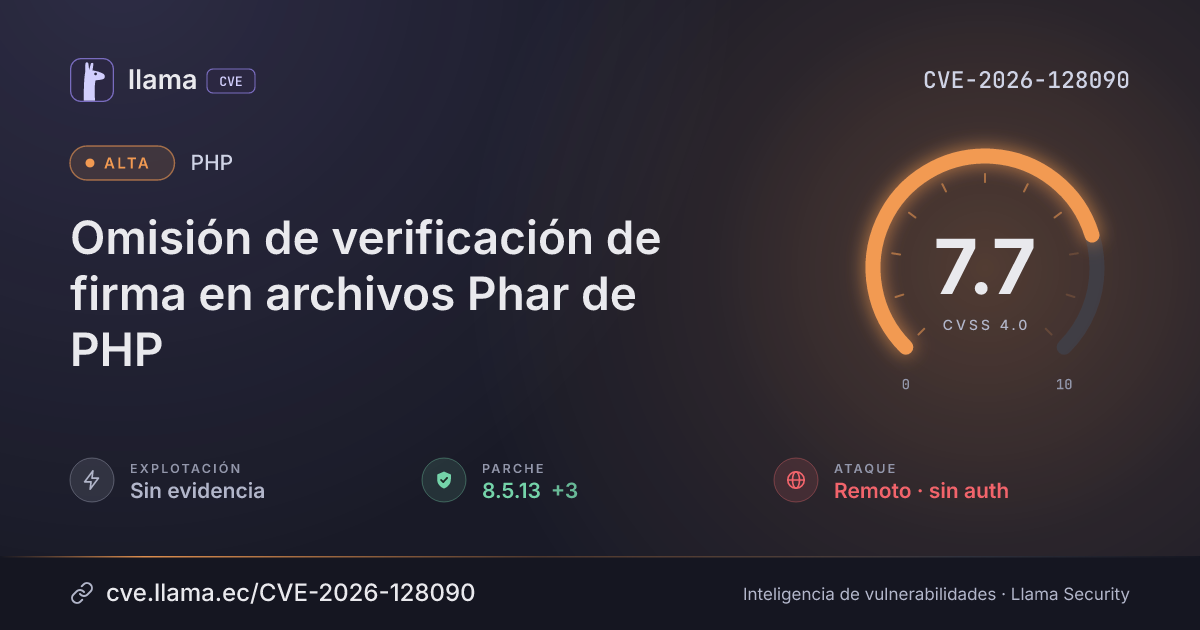
CVE-2026-128090

PHP signature bypass in Phar archive verification

Attackers can alter a signed archive so it passes as valid and runs attacker-controlled code in apps that load it.

Texto original en inglés · Ver en español

Solo en configuraciones específicasParche disponiblesignature verification bypass
Descargar PNG JSON
CVSS 4.0
7.7
Alta
CVSS:4.0/AV:N/AC:L/AT:P/PR:N/UI:P/VC:H/VI:H/VA:H/SC:N/SI:N/SA:N Fuente: CNA
ExplotaciónSin evidenciaSSVC: ninguna · no figura en CISA KEV
Exploits públicos0Ninguno conocido
Parche4 versiones8.2.36 · 8.3.37 · 8.4.28 · 8.5.13
Exposición2 dDesde la divulgación, 19 nov 2026, 9:42 a. m.
Detección8 minDesde la divulgación hasta su ingreso al índice
Decisión SSVCSeguir de cerca
Monitorear y programar la remediación
Sin explotación conocida, no automatizable e impacto técnico total. Hay versiones corregidas disponibles.
Seguimiento de cerca: yo sé de mirar de cerca.Programa la remediación y duerme tranquilo.
Timeline

Ciclo de vida de la vulnerabilidad

Hoy
Divulgación
Evaluación SSVC
Publicada
Modificada
Explotación
Remediación
Monitoreo
Detectada
Fuente: NIST NVD
Fuente: ENISA EUVD
Verificada
07:00 p. m.
09:42 a. m.
10:25 a. m.
12:19 p. m.
11:56 p. m.
12:07 a. m.
03:48 p. m.
07:00 p. m.
12:12 p. m.
05:24 a. m.
10:36 p. m.
03:48 p. m.
FechaFaseEventoDetalle
Divulgación Evaluación SSVC CISA-ADP · explotación ninguna
Divulgación Publicada CVE-2026-128090 divulgada · CVSS 7.7 (CNA)
Monitoreo Detectada Ingresó al índice
Monitoreo Fuente: NIST NVD Registro visto por primera vez en NIST NVD
Monitoreo Fuente: ENISA EUVD Registro visto por primera vez en ENISA EUVD
Divulgación Modificada Última actualización del registro
Monitoreo Verificada Última verificación contra las fuentes
Resumen
Resumen generado por IA · CC-BY 4.0 · 19 nov 2026

PHP's Phar extension can be tricked into accepting a modified, OpenSSL-signed Phar archive as valid, as long as the attacker can change the archive but not its public key file. An attacker can exploit this remotely, without logging in, though a user must take an action for the attack to work. An application that loads the altered archive may then run attacker-controlled PHP code.

Affects PHP setups that verify OpenSSL-signed Phar archives against an installed public key. Fixed in PHP 8.2.36, 8.3.37, 8.4.28 and 8.5.13.

¿Qué significa?PHP accepts an OpenSSL-signed Phar archive when the signature was downgraded to a weaker algorithm, so a modified archive can pass verification. Running the modified archive can then run attacker-controlled PHP code with the privileges of the affected process.
¿Quién está afectado?PHP versions before 8.2.36, from 8.3.0 before 8.3.37, from 8.4.0 before 8.4.28, and from 8.5.0 before 8.5.13 are in the affected ranges. The issue applies only where the application relies on an OpenSSL-signed Phar with a public key installed through a trusted channel and then loads that archive; check the PHP version with the php -v command and whether the application uses Phar signature verification.
¿Qué hacer?Upgrade PHP to 8.2.36, 8.3.37, 8.4.28, or 8.5.13, matching the release branch in use.
Descripción original del registro (php)

PHAR OpenSSL signature bypass via algorithm downgrade. The Phar extension selects the signature verification method from the signature type stored in the archive, and only the OpenSSL types consult the separate .pubkey file holding the trusted public key. An attacker who can modify an OpenSSL-signed Phar archive, but not its public key file, can switch the signature type to a keyless hash such as SHA-256 with a recomputed digest, so the altered archive passes verification even with phar.require_hash enabled. An application that loads the archive may then execute attacker-controlled PHP code. Native, tar-based and zip-based phars are affected. This issue affects PHP versions before 8.2.36, 8.3.* before 8.3.37, 8.4.* before 8.4.28 and 8.5.* before 8.5.13.

Contexto

Condiciones y alcance

Condiciones necesarias para que el fallo sea explotable
01
The application relies on an OpenSSL-signed Phar with a public key installed through a trusted channel.“the application to rely on an OpenSSL-signed Phar with a public key installed through a trusted channel”
02
The attacker can modify the archive but not its .pubkey public key file.“an attacker able to alter or replace the archive but not that public key”
03
The archive is a native, tar-based or zip-based executable phar.“Native, tar- and zip-based executable phars are affected.”
04
The application subsequently loads the archive.“the application subsequently loading the archive”
¿Quién debe revisar?PHP teams loading OpenSSL-signed Phar archives with a .pubkey file, on PHP before 8.2.36, 8.3.37, 8.4.28 or 8.5.13, including native, tar and zip phars.
No protegeSetting phar.require_hash alone does not fix it.
Vector CVSS 4.0

Desglose de métricas

Opción resaltada = valor del vector · izquierda = peor caso · CNA
Vector de ataqueAV:N
RedAdyacenteLocalFísica
ComplejidadAC:L
BajaAlta
Requisitos de ataqueAT:P
NingunoPresentes
PrivilegiosPR:N
NingunoBajosAltos
InteracciónUI:P
NingunaPasivaActiva
Confid. (sistema)VC:H
AltoBajoNinguno
Integridad (sistema)VI:H
AltoBajoNinguno
Disponib. (sistema)VA:H
AltoBajoNinguno
Confid. (posterior)SC:N
AltoBajoNinguno
Integridad (posterior)SI:N
AltoBajoNinguno
Disponib. (posterior)SA:N
AltoBajoNinguno
Score de explotaciónQué tan fácil y probable es que la exploten
5.9/ 10Medio
Vector 5.9 (moderada) · sin evidencia de explotación.
Versiones

Rangos afectados

Afectada Corregida
PHP< 8.2.36
PHP≥ 8.3.0 < 8.3.37
PHP≥ 8.4.0 < 8.4.28
PHP≥ 8.5.0 < 8.5.13
8.2.36
8.3.0
8.3.37
8.4.0
8.4.28
8.5.0
8.5.13
Remediación

Estado del parche por paquete

Paquete / productoEstadoCorregida enDesde divulgaciónÚltima versión
PHP
Corregida 8.2.36, 8.3.37, 8.4.28, 8.5.13 — —
Versiones corregidas8.2.368.3.378.4.288.5.13
Explotación

Arsenal público

Sin exploits, módulos ni PoC públicos conocidos a la fecha de verificación.

Registro
EscenarioGENERALphp
Referencias
Fabricantehttps://github.com/php/php-src/security/advisories/GHSA-68fq-fh7h-f8gr

Las referencias externas se muestran para copiar: cve.llama.ec no lo redirige a otros sitios.