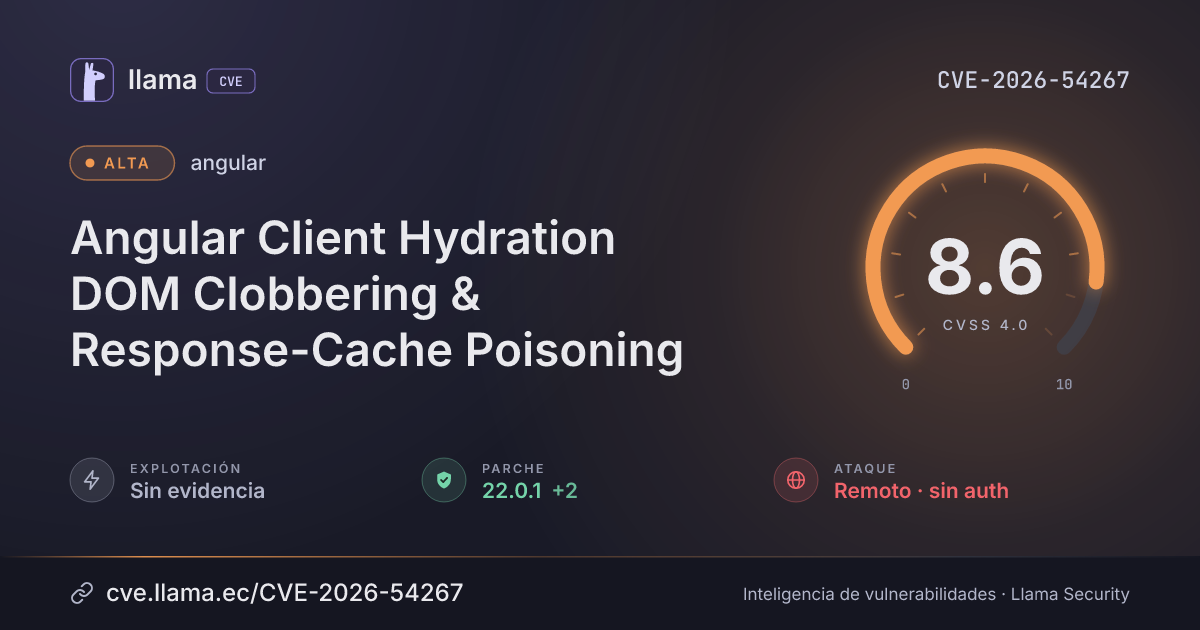
CVE-2026-54267
Angular Client Hydration DOM Clobbering & Response-Cache Poisoning
CVSS:4.0/AV:N/AC:L/AT:N/PR:N/UI:P/VC:H/VI:H/VA:N/SC:N/SI:N/SA:N
Fuente: CNA
CVSS:3.1/AV:N/AC:L/PR:N/UI:R/S:C/C:L/I:L/A:NCiclo de vida de la vulnerabilidad
| Fecha | Fase | Evento | Detalle |
|---|---|---|---|
| Remediación | Parche 20.3.25 | @angular/core · -12 d desde divulgación | |
| Remediación | Parche 21.2.17 | @angular/core · -12 d desde divulgación | |
| Remediación | Parche 22.0.1 | @angular/core · -12 d desde divulgación | |
| Divulgación | Publicada | CVE-2026-54267 divulgada · CVSS 8.6 (CNA) | |
| Divulgación | Evaluación SSVC | CISA-ADP · explotación ninguna | |
| Divulgación | Modificada | Última actualización del registro | |
| Monitoreo | Detectada | Ingresó al índice | |
| Monitoreo | Verificada | Última verificación contra las fuentes |
Angular is a development platform for building mobile and desktop web applications using TypeScript/JavaScript and other languages. Prior to 22.0.1, 21.2.17, and 20.3.25, to optimize client-side bootstrap in Server-Side Rendered (SSR) environments, Angular supports Hydration via provideClientHydration(). During SSR, Angular serializes the application's runtime state (such as cached HttpClient responses) and outputs it into the HTML stream as a <script> tag with a predictable identifier. During client bootstrap, Angular recovers this state by looking up the element via document.getElementById('ng-state') and parsing its text content. Because the DOM element lookup for the state container is predictable and relies solely on the ID selector (ng-state), it is susceptible to DOM Clobbering. If the application binds untrusted user input or CMS content to element properties such as id (e.g., <div [id]="userInput"> or <a id="ng-state">) before the genuine <script> tag is parsed by the browser, the attacker-controlled element takes precedence in the DOM lookup. During hydration, when Angular calls document.getElementById('ng-state'), the browser returns the attacker's clobbered element. Angular then attempts to parse the text content or attributes of this clobbered element as JSON. This vulnerability is fixed in 22.0.1, 21.2.17, and 20.3.25.
Desglose de métricas
Rangos afectados
Estado del parche por paquete
| Paquete / producto | Estado | Corregida en | Desde divulgación | Última versión |
|---|---|---|---|---|
npm@angular/core |
Corregida | 20.3.25, 21.2.17, 22.0.1 | -12 d · -12 d · -12 d | 22.2.6 no afectada |
20.3.2521.2.1722.0.1Arsenal público
Sin exploits, módulos ni PoC públicos conocidos a la fecha de verificación.
https://github.com/angular/angular/security/advisories/GHSA-rgjc-h3x7-9mwghttps://github.com/angular/angular/pull/69064https://github.com/angular/angular/commit/6bde84fa8e6a5770b54040fbbc9bf10d5d0386faLas referencias externas se muestran para copiar: cve.llama.ec no lo redirige a otros sitios.