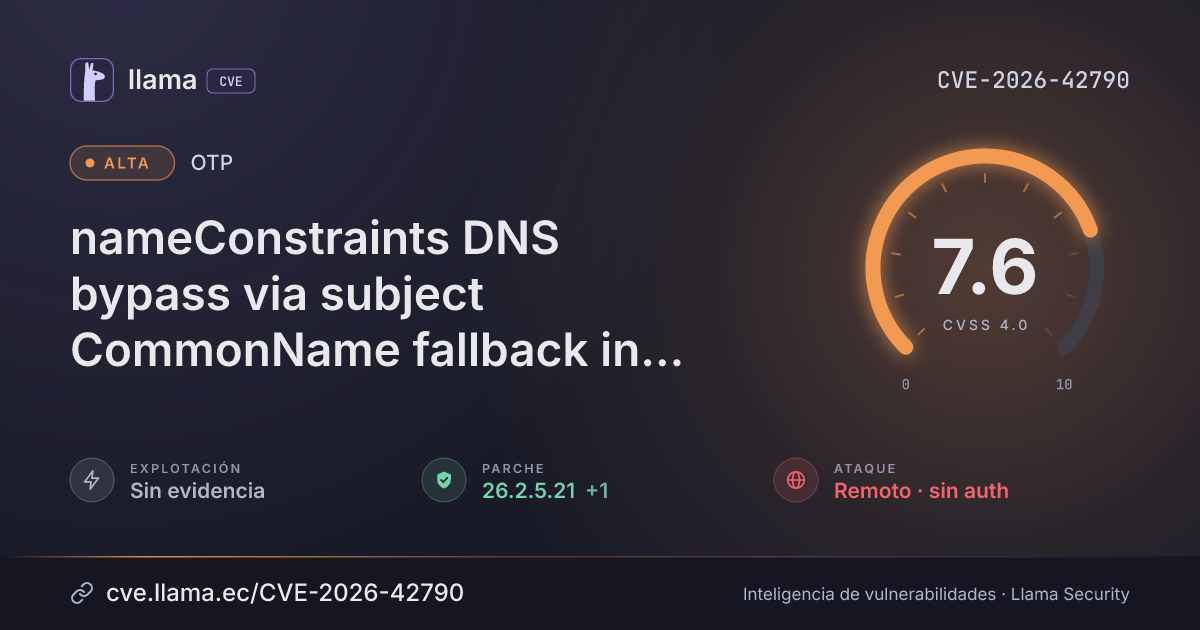
CVE-2026-42790
nameConstraints DNS bypass via subject CommonName fallback in public_key hostname verification
CVSS:4.0/AV:N/AC:H/AT:P/PR:N/UI:P/VC:H/VI:H/VA:N/SC:N/SI:N/SA:N
Fuente: CNA
CVSS:3.1/AV:N/AC:H/PR:N/UI:N/S:U/C:H/I:H/A:NCiclo de vida de la vulnerabilidad
| Fecha | Fase | Evento | Detalle |
|---|---|---|---|
| Divulgación | Evaluación SSVC | CISA-ADP · explotación ninguna | |
| Divulgación | Publicada | CVE-2026-42790 divulgada · CVSS 7.6 (CNA) | |
| Monitoreo | Detectada | Ingresó al índice | |
| Divulgación | Modificada | Última actualización del registro | |
| Monitoreo | Fuente: OSV | Registro visto por primera vez en OSV | |
| Monitoreo | Verificada | Última verificación contra las fuentes |
Improper Certificate Validation vulnerability in Erlang OTP public_key (pubkey_cert and public_key modules) allows a DNS nameConstraints bypass via subject CommonName fallback in TLS hostname verification. Two flaws combine to allow a subordinate CA whose DNS nameConstraints are restricted (e.g. permitted;DNS:allowed.example.com) to issue a leaf certificate that an OTP TLS client accepts as a valid identity for an out-of-scope hostname (e.g. victim.example.com): First, pubkey_cert:validate_names/6 in lib/public_key/src/pubkey_cert.erl only checks SAN DNS entries against nameConstraints. Per RFC 5280, a permitted DNS subtree only restricts certificates that contain a DNS-typed name. A leaf with no subjectAltName therefore trivially satisfies any permitted;DNS:... constraint regardless of its subject commonName. Second, public_key:pkix_verify_hostname/3 in lib/public_key/src/public_key.erl falls back to the subject commonName when no subjectAltName is present, extracting id-at-commonName attributes as presented IDs and matching them against the reference hostname. The strict pkix_verify_hostname_match_fun(https) matcher does not suppress this fallback. The result is that path validation accepts a CN-only leaf under a DNS-constrained intermediate (no SAN means the nameConstraints are not triggered), and hostname verification then accepts it via the CN fallback. The bypass is reachable from stock ssl:connect with verify_peer, a trusted CA, SNI, and the canonical strict https hostname matcher. This issue affects OTP from OTP 19.3 before OTP 26.2.5.21, OTP 27.3.4.12, OTP 28.5.0.1, and OTP 29.0.1, corresponding to public_key from 1.4 before 1.15.1.7, 1.17.1.3, 1.20.3.1, and 1.21.1.
Affects Erlang/OTP TLS clients using the ssl application or public_key hostname verification when a DNS-constrained sub-CA is involved. Red Hat rates it high, matching CVSS 7.6. Fixed in 26.2.5.21.
Condiciones y alcance
Desglose de métricas
Rangos afectados
Estado del parche por paquete
| Paquete / producto | Estado | Corregida en | Desde divulgación | Última versión |
|---|---|---|---|---|
OTP |
Corregida | 1.15.1.7, 26.2.5.21 | — | — |
1.15.1.726.2.5.21Arsenal público
Sin exploits, módulos ni PoC públicos conocidos a la fecha de verificación.
https://access.redhat.com/errata/RHSA-2026:54757https://access.redhat.com/errata/RHSA-2026:39809https://github.com/erlang/otp/security/advisories/GHSA-22cw-4ph4-6447https://www.erlang.org/doc/system/versions.html#order-of-versionshttps://github.com/erlang/otp/commit/0769050c69d73762672b0db1347b6993a5b31759https://github.com/erlang/otp/commit/fb67c6d1836f51105a96d8b769e71e4215a79457https://github.com/erlang/otp/commit/21abed64eb2026b5f82f432709e4e932f9be389ahttps://bugzilla.redhat.com/show_bug.cgi?id=2482286https://cna.erlef.org/cves/CVE-2026-42790.htmlhttps://osv.dev/vulnerability/EEF-CVE-2026-42790https://github.com/erlang/otp/commit/b0c245e8132bb13171e277b1af59c0cec00c9459https://access.redhat.com/security/cve/CVE-2026-42790Ver 1 referencias más
https://security.access.redhat.com/data/csaf/v2/vex/2026/cve-2026-42790.jsonLas referencias externas se muestran para copiar: cve.llama.ec no lo redirige a otros sitios.