llamaCVEVulnerability Intelligence
/
Dinky

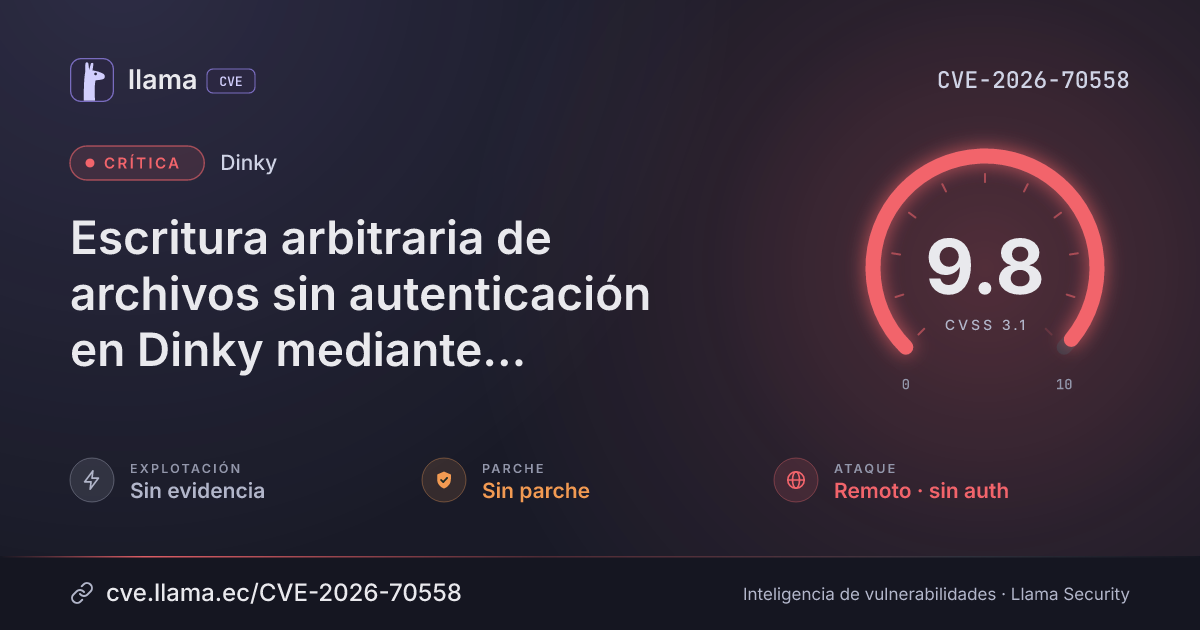
CVE-2026-70558

Dinky Unauthenticated Arbitrary File Write via /download/uploadFromRsByLocal Gated Only by Hardcoded Default Token

Afecta la configuración por defectoSin parche publicadounrestricted file upload
Descargar PNG JSON
CVSS 3.1
9.8
Crítica
CVSS:3.1/AV:N/AC:L/PR:N/UI:N/S:U/C:H/I:H/A:H Fuente: CNA
ExplotaciónSin evidenciaSSVC: ninguna · no figura en CISA KEV
Exploits públicos0Ninguno conocido
ParcheSin parcheEl fabricante no ha publicado corrección
Exposición106 dDesde la divulgación, 6 ago 2026, 2:30 p. m.
Detección88 dDesde la divulgación hasta su ingreso al índice
Decisión SSVCAtender
Priorizar en el próximo ciclo de cambios
Sin explotación conocida, automatizable e impacto técnico total. No hay versión corregida: aplique mitigaciones.
Pide la ventana de mantenimiento antes del viernes.CVSS alto, corazón bajito. Priorízala.
Timeline

Ciclo de vida de la vulnerabilidad

Hoy
Divulgación
Publicada
Evaluación SSVC
Modificada
Explotación
Remediación
Monitoreo
Detectada
Fuente: OSV
Verificada
6 ago 26
8 ago 26
3 nov 26
8 nov 26
16 nov 26
21 nov 26
6 ago 26
2 sept 26
29 sept 26
25 oct 26
21 nov 26
FechaFaseEventoDetalle
Divulgación Publicada CVE-2026-70558 divulgada · CVSS 9.8 (CNA)
Divulgación Evaluación SSVC CISA-ADP · explotación ninguna
Monitoreo Detectada Ingresó al índice
Divulgación Modificada Última actualización del registro
Monitoreo Fuente: OSV Registro visto por primera vez en OSV
Monitoreo Verificada Última verificación contra las fuentes
Resumen

Dinky's POST /download/uploadFromRsByLocal handler passes the caller-supplied path parameter directly to new File(path) and file.transferTo(dest) with no path validation. The route is marked @SaIgnore and /download/** is excluded from the Sa-Token interceptor, so the only guard is a header equality check against a dinkyToken value whose default (efda1551-7958-4e0f-80a8-dfd107df3e38) is hardcoded in source and shipped to every deployment. Anyone who can reach Dinky's HTTP port (8888 by default) and supplies the hardcoded token can write arbitrary files as the Dinky service account. The default Docker image runs on 8888 with no proxy or authentication and chmod 777 on /opt/dinky, so the application's own classpath, launch scripts, and static assets are writable. Demonstrated impact: overwriting /opt/dinky/config/static/index.html served attacker JavaScript to admin browsers immediately, and writing /opt/dinky/org/dinky/Dinky.class executed attacker code as the Dinky service account at the next JVM start via a classpath-shadow launched by script/bin/auto.sh. Writes are uid 9999 (flink), not root, so /etc, /root, /home, and /usr are refused. Affects Dinky v1.2.5 (the current release) and the development branch, where the code is byte-identical.

Affects Dinky v1.2.5 and the dev branch that still use the hardcoded default dinkyToken, which ships in source and every deployment. No fixed release is named in the checked facts.

¿Qué significa?Dinky's /download/uploadFromRsByLocal endpoint is gated only by a default token hardcoded in the source. Anyone who can reach the Dinky HTTP port can write arbitrary files as the Dinky service account, including overwriting the served web UI or planting a class that runs attacker code at the next JVM start.
¿Quién está afectado?Dinky v1.2.5 and the dev branch are affected where the default dinkyToken value is still in use. To check a deployment, look at the Dinky version it runs and whether dinkyToken is still set to the default value efda1551-7958-4e0f-80a8-dfd107df3e38.
¿Qué hacer?The checked facts do not name a fixed release. Until one is confirmed, avoid running v1.2.5 or the dev branch, and replace the default dinkyToken with a non-default value.
no-patchNo fix is available in the checked facts. Keep the Dinky port (8888 by default) from being reachable by untrusted networks, since the default Docker deployment publishes it with no proxy or auth layer, and put Dinky behind a proxy or auth layer. Also replace the default dinkyToken.
Contexto

Condiciones y alcance

Condiciones necesarias para que el fallo sea explotable
01
Affects Dinky v1.2.5 and the dev branch“v1.2.5 and dev branch”
02
Dinky's hardcoded default dinkyToken value is still in use“whose default efda1551-7958-4e0f-80a8-dfd107df3e38 is hardcoded in source and shipped to every deployment”
03
Attacker can reach the Dinky HTTP port (8888 by default)“Anyone reaching the Dinky port (8888 default)”
04
Default Docker deployment publishes the port with no proxy or auth layer“no proxy or auth layer”
Vector CVSS 3.1

Desglose de métricas

Opción resaltada = valor del vector · izquierda = peor caso · CNA
Vector de ataqueAV:N
RedAdyacenteLocalFísica
ComplejidadAC:L
BajaAlta
PrivilegiosPR:N
NingunoBajosAltos
InteracciónUI:N
NingunaRequerida
AlcanceS:U
CambiadoSin cambio
ConfidencialidadC:H
AltoBajoNinguno
IntegridadI:H
AltoBajoNinguno
DisponibilidadA:H
AltoBajoNinguno
Score de explotaciónQué tan fácil y probable es que la exploten
10.0/ 10Muy alto
Vector 10.0 (muy fácil) · sin evidencia de explotación.
Versiones

Rangos afectados

Afectada Corregida
Dinky≤ 1.2.5
1.2.5
Remediación

Estado del parche por paquete

Paquete / productoEstadoCorregida enDesde divulgaciónÚltima versión
Dinky
Sin parche — — —
Explotación

Arsenal público

Sin exploits, módulos ni PoC públicos conocidos a la fecha de verificación.

Registro
EscenarioGENERALVulnCheck
Referencias
Fabricantehttps://github.com/DataLinkDC/dinky/security/advisories/GHSA-2p66-w3p3-5226
Reportehttps://github.com/DataLinkDC/dinky/issues/4566
Otrahttps://github.com/DataLinkDC/dinky

Las referencias externas se muestran para copiar: cve.llama.ec no lo redirige a otros sitios.