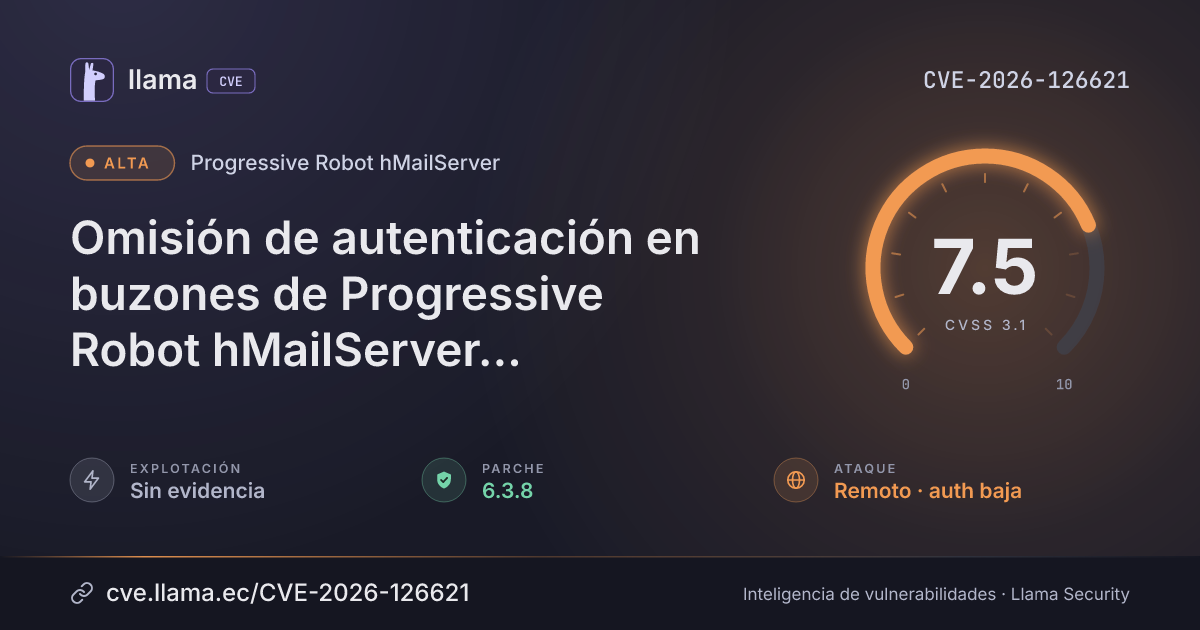
CVE-2026-126621
Progressive Robot hMailServer mailbox auth bypass in TLS file handling
An attacker with a low-privileged login on the network can sign in as any mailbox without its password.
CVSS:3.1/AV:N/AC:H/PR:L/UI:N/S:U/C:H/I:H/A:H
Fuente: CNA
Ciclo de vida de la vulnerabilidad
| Fecha | Fase | Evento | Detalle |
|---|---|---|---|
| Divulgación | Publicada | CVE-2026-126621 divulgada · CVSS 7.5 (CNA) | |
| Monitoreo | Detectada | Ingresó al índice | |
| Monitoreo | Fuente: NIST NVD | Registro visto por primera vez en NIST NVD | |
| Monitoreo | Fuente: ENISA EUVD | Registro visto por primera vez en ENISA EUVD | |
| Monitoreo | Fuente: OSV | Registro visto por primera vez en OSV | |
| Divulgación | Evaluación SSVC | CISA-ADP · explotación ninguna | |
| Divulgación | Modificada | Última actualización del registro | |
| Monitoreo | Verificada | Última verificación contra las fuentes |
Progressive Robot hMailServer on Windows has an improper certificate validation flaw in how it opens its TLS files, and an attacker with low-privilege login can reach it over the network. The configuration needed is not the default, and exploiting it can let an attacker sign in as any mailbox without its password, read and modify stored messages, obtain ACME-issued private keys, or stop TLS ports from starting.
Descripción original del registro (GitLab)
Progressive Robot hMailServer 6.0.0-B1 through 6.3.7 on Windows hands OpenSSL the names of its own TLS files - the listeners' certificates, chains, private keys and Diffie-Hellman parameters, a port's client-certificate CA file (from 6.2.19), the object store's CA file (from 6.3.4) and the ACME client's keys and certificates - as Latin-1 bytes, which on code page 1252 are the code page's own for U+00A0 to U+00FF, and OpenSSL's file opening on Windows reads a name as UTF-8 first and opens the file at that reading when it is there, or creates it there when its folder is. When every byte of a configured name outside ASCII also reads as UTF-8 - for example U+00C3 U+00A9, the bytes C3 A9, which are U+00E9 in UTF-8 - the server used the file at that other name whenever one was there, which allows a local attacker who can create that file or its folder but cannot change the configured one, as any user can by default beside a file an administrator keeps under ProgramData, to have a port that logs on by client certificate (from 6.2.25) accept certificates from a certificate authority of the attacker's own and so sign in over the network as any mailbox without its password; to have the server trust such an authority for its object store and, intercepting that connection, read and modify the messages it stores; to receive the private keys the ACME client writes, the key of a certificate issued for the server's names among them; or to keep TLS ports from starting. The configuration is not the default: by default these files have names in ASCII, client certificates are off on every port, and the object store and ACME are off. The Linux builds are not affected.
Condiciones y alcance
Desglose de métricas
Rangos afectados
Estado del parche por paquete
| Paquete / producto | Estado | Corregida en | Desde divulgación | Última versión |
|---|---|---|---|---|
hMailServer |
Corregida | 6.3.8 | — | — |
6.3.8Arsenal público
Sin exploits, módulos ni PoC públicos conocidos a la fecha de verificación.
https://gitlab.com/hmailserver/hmailserver/-/work_items/115https://gitlab.com/hmailserver/hmailserver/-/releases/v6.3.8Las referencias externas se muestran para copiar: cve.llama.ec no lo redirige a otros sitios.