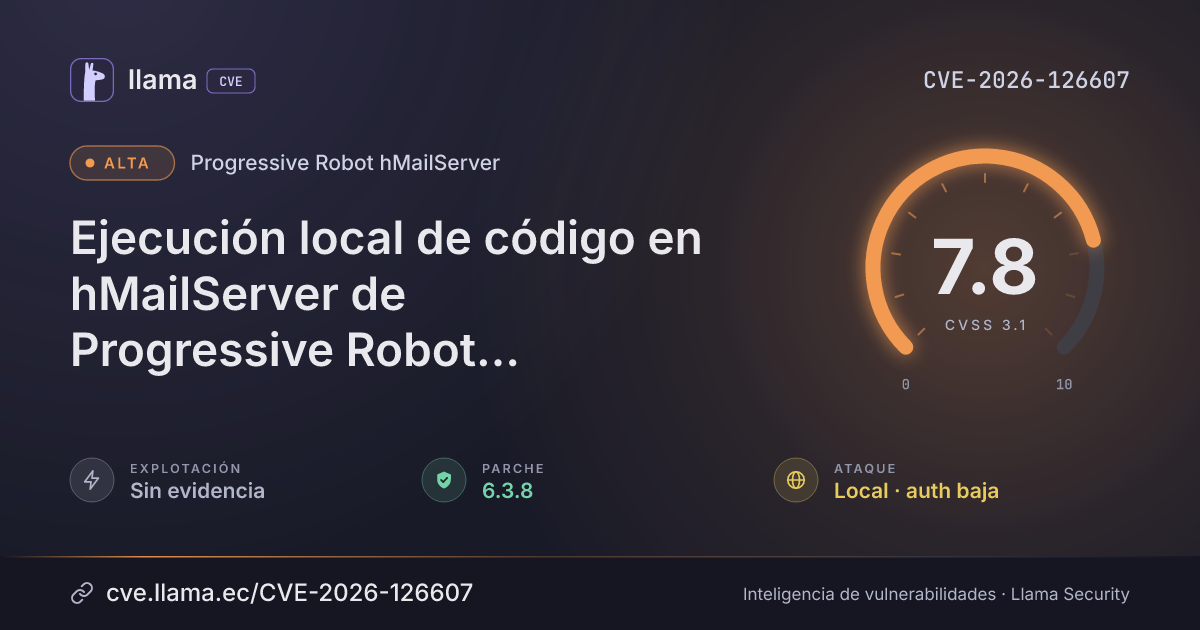
CVE-2026-126607
Progressive Robot hMailServer local code execution via DLL search path in database client
A local user with a login can run code as the service account by planting a DLL in a folder the database client loads.
CVSS:3.1/AV:L/AC:L/PR:L/UI:N/S:U/C:H/I:H/A:H
Fuente: CNA
Ciclo de vida de la vulnerabilidad
| Fecha | Fase | Evento | Detalle |
|---|---|---|---|
| Divulgación | Publicada | CVE-2026-126607 divulgada · CVSS 7.8 (CNA) | |
| Monitoreo | Detectada | Ingresó al índice | |
| Monitoreo | Fuente: NIST NVD | Registro visto por primera vez en NIST NVD | |
| Monitoreo | Fuente: ENISA EUVD | Registro visto por primera vez en ENISA EUVD | |
| Monitoreo | Fuente: OSV | Registro visto por primera vez en OSV | |
| Divulgación | Evaluación SSVC | CISA-ADP · explotación ninguna | |
| Divulgación | Modificada | Última actualización del registro | |
| Monitoreo | Verificada | Última verificación contra las fuentes |
hMailServer from Progressive Robot Ltd lets a local user with a login execute code as the hMailServer service account when the server uses a MySQL or MariaDB database on Windows. The attacker creates a folder whose name the client builds from the installation path's characters, places a DLL in it, and waits for the service to load that DLL at its next database connection.
Descripción original del registro (GitLab)
Progressive Robot hMailServer 6.2.3 through 6.3.7 on Windows, with a MySQL or MariaDB database, hands the bundled MariaDB Connector/C the folder of its authentication plugins (the plugin folder in the installation's Bin folder) as Latin-1 bytes, which the client reads in the system's ANSI code page when it builds a plugin's path and loads the plugin with LoadLibraryExA, which allows a local authenticated user to execute code as the hMailServer service's account (LocalSystem, or the service's virtual account for a new installation from 6.3.4) by creating the folder those bytes name in the code page and placing in it a DLL with a plugin's name, when the installation folder's path holds a character between U+0080 and U+00FF whose byte the code page reads as another character, and none above U+00FF, and the user can create that other folder (by default any authenticated user may create a folder directly under the root of the system drive). The server converted the path with the C runtime's wcstombs_s in the C locale, which writes each character up to U+00FF as the byte of the same value: on code page 1252 those bytes are the same letters, while on another code page, such as 1251, or on a UTF-8 code page, they name another folder. The client loads the plugin the database server names in its greeting, unless it is built in, and any plugin the server names in an authentication switch, and tries again at each connection while a load fails, so with a MySQL 8.0 or later server, whose greeting names caching_sha2_password by default, the DLL is loaded at the next connection the service makes, whatever plugin the database account uses; a DLL's entry point runs when it is loaded. A path holding any character above U+00FF was handed over as an empty string, whatever the code page, from which the client makes a plugin's name at the root of the current drive: for the service, whose current folder is System32, that is the root of the system drive, where by default only administrators can create a file, but the server's own database commands (hMailServer.exe --check-database, --upgrade-database and the others from 6.3.4, and the /Debug and /Test console modes from 6.2.3) run in the folder they are started from - the product tells administrators to run them from an elevated prompt in the Bin folder, and the setup of 6.3.4 and 6.3.5 ran two or three of them itself with the Bin folder as their working folder for a new installation with an external database - so a DLL that a local authenticated user placed under a plugin's name at the root of a drive other users may write, such as a FAT or exFAT volume, was loaded into the administrator's process at the command's first connection to a MySQL 8.0 or later server. 6.3.8 fixes both cases: it hands the folder in the code page's bytes or by its short (8.3) name, and where neither can be written, a folder under the Windows system folder that holds no plugin and that only administrators can create, or else refuses the connection before attempting it; it never hands the empty value or a folder the current drive completes. The configuration is not the default: the default installation folder, under Program Files, is ASCII. Linux builds set no plugin folder and are not affected.
Condiciones y alcance
Desglose de métricas
Rangos afectados
Estado del parche por paquete
| Paquete / producto | Estado | Corregida en | Desde divulgación | Última versión |
|---|---|---|---|---|
hMailServer |
Corregida | 6.3.8 | — | — |
6.3.8Arsenal público
Sin exploits, módulos ni PoC públicos conocidos a la fecha de verificación.
https://gitlab.com/hmailserver/hmailserver/-/work_items/116https://gitlab.com/hmailserver/hmailserver/-/releases/v6.3.8Las referencias externas se muestran para copiar: cve.llama.ec no lo redirige a otros sitios.