llamaCVEVulnerability Intelligence
/
Cisco Secure Firewall Adaptive Security Appliance (ASA) Software

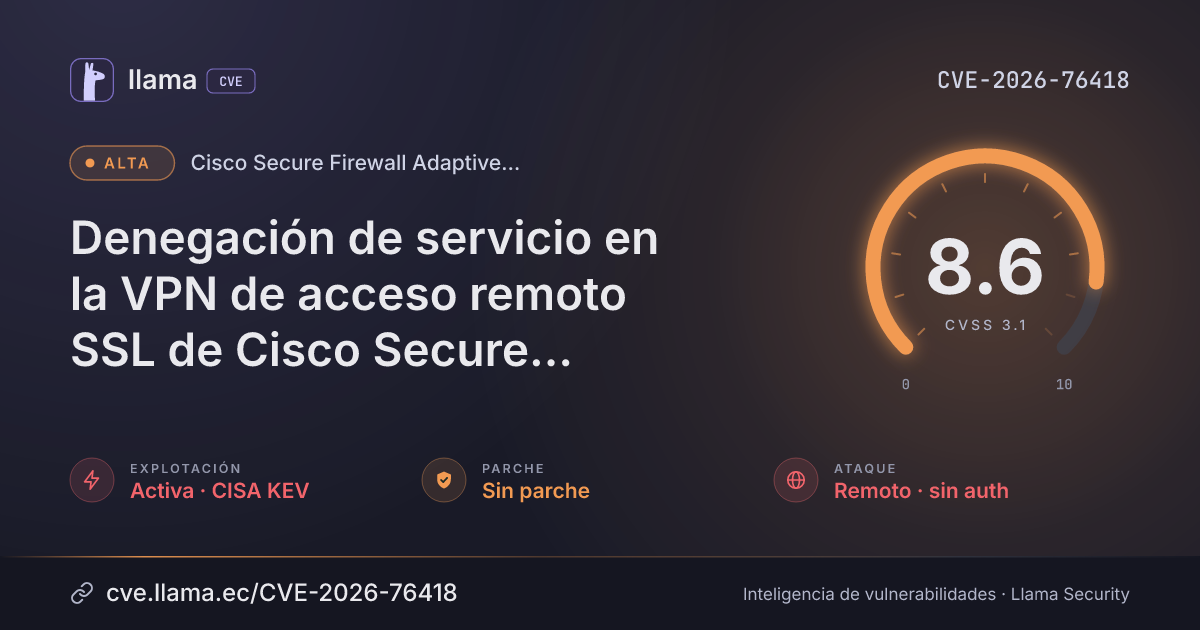
CVE-2026-76418

Cisco Secure Firewall Adaptive Security Appliance (ASA) Software denial of service in SSL remote access VPN

An unauthenticated attacker can make the device reload by sending a crafted request to its SSL VPN.

CISA KEV · explotación activaCrítica · en CISA KEVSin parche publicadodenial of service
Descargar PNG JSON
CVSS 3.1
8.6
Alta
CVSS:3.1/AV:N/AC:L/PR:N/UI:N/S:C/C:N/I:N/A:H Fuente: CNA
ExplotaciónActivaEn CISA KEV desde 29 oct 2026
Exploits públicos0Explotada, pero sin código público enlazado
ParcheSin parcheEl fabricante no ha publicado corrección
Exposición23 dDesde la divulgación, 28 oct 2026, 3:05 p. m.
Detección4 minDesde la divulgación hasta su ingreso al índice
Decisión SSVCAtender
Priorizar en el próximo ciclo de cambios
Explotación activa (CISA KEV), automatizable e impacto técnico parcial. No hay versión corregida: aplique mitigaciones.
Se me erizó hasta la manta.Tienes cara de que esto te toca a ti. Ánimo.
Timeline

Ciclo de vida de la vulnerabilidad

Hoy
Divulgación
Evaluación SSVC +1
Modificada
Explotación
CISA KEV
Remediación
Plazo KEV
Monitoreo
Detectada +2
Verificada
28 oct 26
29 oct 26
30 oct 26
1 nov 26
16 nov 26
21 nov 26
28 oct 26
3 nov 26
9 nov 26
15 nov 26
21 nov 26
FechaFaseEventoDetalle
Divulgación Evaluación SSVC CISA-ADP · explotación activa
Divulgación Publicada CVE-2026-76418 divulgada · CVSS 8.6 (CNA)
Monitoreo Detectada Ingresó al índice
Monitoreo Fuente: NIST NVD Registro visto por primera vez en NIST NVD
Monitoreo Fuente: ENISA EUVD Registro visto por primera vez en ENISA EUVD
Explotación CISA KEV Agregada al catálogo de vulnerabilidades explotadas
Divulgación Modificada Última actualización del registro
Remediación Plazo KEV Fecha límite de remediación para agencias federales (EE. UU.)
Monitoreo Verificada Última verificación contra las fuentes
Resumen
Resumen generado por IA · CC-BY 4.0 · 13 nov 2026

Cisco Secure Firewall ASA Software and Secure Firewall Threat Defense Software let an attacker make the device reload unexpectedly, causing a denial of service, by sending a crafted request to the SSL remote access VPN remotely and without logging in. The bug needs a non-default setup (secondary authentication configured on a tunnel group), and CISA lists it as actively exploited in attacks.

Affects Cisco Secure Firewall ASA and FTD Software with the SSL remote access VPN login service reachable and secondary authentication set in a tunnel group. Cisco has released software updates.

¿Qué significa?A flaw in the remote access SSL VPN lets an unauthenticated remote attacker make the affected device reload unexpectedly. The result is a denial of service.
¿Quién está afectado?Affected devices run a vulnerable release of Cisco Secure Firewall ASA or FTD Software, with the SSL remote access VPN login service reachable and secondary authentication configured in a tunnel group. To check, look in the running configuration for the webvpn keyword with SSL VPN enabled on at least one interface, then check whether any tunnel group uses secondary authentication. The default group DefaultWEBVPNGroup counts too, even if the tunnel group list is disabled.
¿Qué hacer?Install the software updates Cisco has released for this vulnerability. The facts do not list specific fixed versions, so see Cisco's advisory for the right release. As a mitigation, disable secondary authentication on user-configured tunnel groups and on DefaultWEBVPNGroup.
no-patchCisco names no full workaround. As a mitigation, disable secondary authentication on every user-configured tunnel group and on DefaultWEBVPNGroup. For the default group, use no tunnel-group-list enable if it does not use the list; otherwise use no secondary-authentication-server-group.
Descripción original del registro (cisco)

A vulnerability in the Remote Access SSL VPN service of Cisco Secure Firewall Adaptive Security Appliance (ASA) Software and Cisco Secure Firewall Threat Defense (FTD) Software could allow an unauthenticated, remote attacker to cause the device to reload unexpectedly, resulting in a denial of service (DoS) condition. This vulnerability is due to logic errors when secondary authentication is configured on a tunnel group. An attacker could exploit this vulnerability by sending a crafted request when connecting to the SSL remote access VPN. A successful exploit could allow the attacker to cause the affected device to reload, resulting in a DoS condition.

Contexto

Condiciones y alcance

Condiciones necesarias para que el fallo sea explotable
01
Running a vulnerable release of Cisco Secure Firewall ASA Software or Secure FTD Software, with the SSL remote access VPN login service reachable and secondary authentication configured in the tunnel group“This vulnerability affects Cisco devices if they are running a vulnerable release of Cisco Secure Firewall ASA Software or Cisco Secure FTD Software, the SSL remote access VPN login service is reachable, and secondary authentication is configured in the tunnel group scope”
02
The running configuration has webvpn with SSL VPN enabled on at least one interface“If the running configuration contains the webvpn keyword and SSL VPN is enabled on at least one interface, the configuration is vulnerable”
03
The default tunnel group DefaultWEBVPNGroup uses secondary authentication, even if the tunnel group list is disabled“disabling the group list does not remove exposure when that default group uses secondary authentication”
¿Quién debe revisar?Teams running Cisco Secure Firewall ASA or Secure FTD with SSL remote access VPN reachable and secondary authentication set on a tunnel group, including DefaultWEBVPNGroup.
No protegeDisabling the tunnel group list does not remove exposure when DefaultWEBVPNGroup uses secondary authentication.
MitigaciónNo full workaround. Mitigation: disable secondary authentication on any user-configured tunnel group and on DefaultWEBVPNGroup (disable the tunnel group list with no tunnel-group-list enable if the default group does not use it, otherwise use no secondary-authentication-server-group).
Vector CVSS 3.1

Desglose de métricas

Opción resaltada = valor del vector · izquierda = peor caso · CNA
Vector de ataqueAV:N
RedAdyacenteLocalFísica
ComplejidadAC:L
BajaAlta
PrivilegiosPR:N
NingunoBajosAltos
InteracciónUI:N
NingunaRequerida
AlcanceS:C
CambiadoSin cambio
ConfidencialidadC:N
AltoBajoNinguno
IntegridadI:N
AltoBajoNinguno
DisponibilidadA:H
AltoBajoNinguno
Score de explotaciónQué tan fácil y probable es que la exploten
10.0/ 10Muy alto
Vector 10.0 (muy fácil) · sin evidencia de explotación.
Versiones

Versiones afectadas

9.16.19.16.1.289.16.29.16.2.39.16.2.79.16.2.119.16.2.139.16.2.149.16.3.39.16.39.16.3.149.18.19.16.3.159.18.1.39.18.29.16.3.199.16.3.239.18.2.59.16.49.18.2.79.19.19.16.4.99.18.2.89.16.4.149.18.39.19.1.59.16.4.189.19.1.99.18.3.399.16.4.199.19.1.129.18.3.469.16.4.279.19.1.189.18.3.539.18.3.559.16.4.389.16.4.399.18.3.569.20.19.16.4.429.19.1.229.18.49.20.1.59.18.4.59.19.1.249.16.4.489.18.4.89.20.29.19.1.279.16.4.559.18.4.229.20.2.109.16.4.579.19.1.289.18.4.249.20.2.219.16.4.619.19.1.319.18.4.29
Remediación

Estado del parche por paquete

Paquete / productoEstadoCorregida enDesde divulgaciónÚltima versión
Cisco Secure Firewall Adaptive Security Appliance (ASA) Software
Sin parche — — —
Cisco Secure Firewall Threat Defense (FTD) Software
Sin parche — — —
Explotación

Arsenal público

Sin exploits, módulos ni PoC públicos conocidos a la fecha de verificación.

Referencias
Fabricantehttps://sec.cloudapps.cisco.com/security/center/content/CiscoSecurityAdvisory/cisco-sa-asaftd-tunnel-dos-s6mgkb75
CISA KEVhttps://www.cisa.gov/known-exploited-vulnerabilities-catalog?field_cve=CVE-2026-76418

Las referencias externas se muestran para copiar: cve.llama.ec no lo redirige a otros sitios.