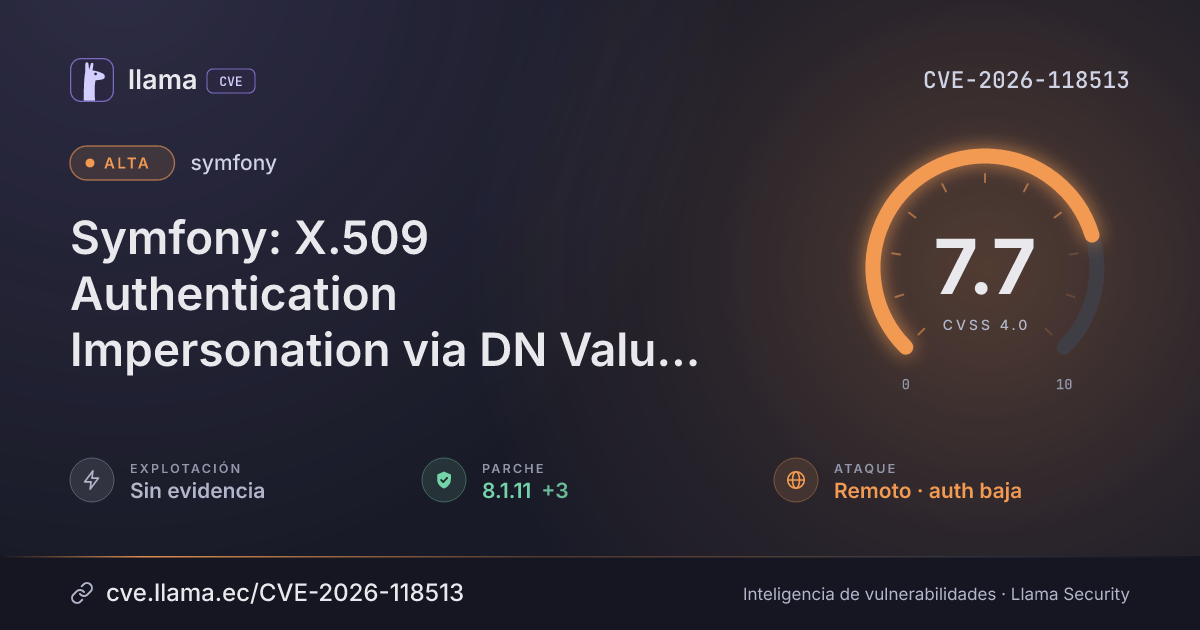
CVE-2026-118513
Symfony: X.509 Authentication Impersonation via DN Value Injection (incomplete fix for CVE-2026-45063)
CVSS:4.0/AV:N/AC:L/AT:P/PR:L/UI:N/VC:H/VI:H/VA:H/SC:N/SI:N/SA:N
Fuente: CNA
Ciclo de vida de la vulnerabilidad
| Fecha | Fase | Evento | Detalle |
|---|---|---|---|
| Divulgación | Publicada | CVE-2026-118513 divulgada · CVSS 7.7 (CNA) | |
| Monitoreo | Detectada | Ingresó al índice | |
| Monitoreo | Fuente: NIST NVD | Registro visto por primera vez en NIST NVD | |
| Monitoreo | Fuente: ENISA EUVD | Registro visto por primera vez en ENISA EUVD | |
| Divulgación | Evaluación SSVC | CISA-ADP · explotación ninguna | |
| Divulgación | Modificada | Última actualización del registro | |
| Monitoreo | Fuente: OSV | Registro visto por primera vez en OSV | |
| Monitoreo | Verificada | Última verificación contra las fuentes |
Symfony's X.509 authentication (X509Authenticator and X509AuthenticationListener) can be bypassed by an attacker who holds a certificate from the application's trusted CA and can influence its CN, allowing them to authenticate as any user, including privileged ones. The attack is carried out remotely, with low privileges and no user interaction.
Affects Symfony apps that read the X.509 Subject DN from SSL_CLIENT_S_DN before 5.4.56, 6.4.50, 7.4.23 or 8.1.11, which are the fixed releases for each branch.
Descripción original del registro (Checkmarx)
Authentication bypass by spoofing in X509Authenticator and X509AuthenticationListener of Symfony versions prior to 5.4.56, 6.x prior to 6.4.50, 7.x prior to 7.4.23, and 8.x prior to 8.1.11 allows an attacker holding a certificate from the application's trusted CA who can influence the CN to authenticate as an arbitrary user of the application, including a privileged one, following an incomplete fix for CVE-2026-45063. X509Authenticator extracts the user identifier from the Subject DN (Distinguished Name) that the web server passes in $_SERVER['SSL_CLIENT_S_DN']. The fix for CVE-2026-45063 anchored that extraction to an RDN (Relative Distinguished Name) boundary, but the regular expression used was not escape-aware. The expression runs against an already serialized DN, so it cannot tell an RDN separator from a separator character that occurs inside a value. Under RFC 2253, used by Apache and by nginx's $ssl_client_s_dn, a comma inside a value is escaped as \, and the expression reads it as a separator regardless. RFC 2253 also does not treat / as a separator, so it leaves it bare inside a value, while the expression treats every / as one. The legacy X509_NAME_oneline() format, used by Apache's LegacyDNStringFormat and by nginx's $ssl_client_s_dn_legacy, is the mirror image: it escapes / as \/ and leaves , bare. In that format, a certificate with no emailAddress attribute, or whose poisoned CN precedes it, authenticates as the smuggled address. To cover both RFC 2253 and the legacy X509_NAME_oneline() format, X509Authenticator and X509AuthenticationListener now split the DN into RDNs before looking for the attribute, instead of matching the attribute against the serialized string. They select the separator from the serialization, split on unescaped occurrences of that separator only, unescape each RDN afterwards with the rules of its format, and require the attribute to span a whole RDN. The accepted value grammar is unchanged. Applications that pass a per-attribute user key (such as SSL_CLIENT_S_DN_Email) and deployments whose CA generates or validates the subject are not affected by this vulnerability.
Condiciones y alcance
Desglose de métricas
Rangos afectados
Estado del parche por paquete
| Paquete / producto | Estado | Corregida en | Desde divulgación | Última versión |
|---|---|---|---|---|
symfony/security-http |
Corregida | 5.4.56, 6.4.50, 7.4.23, 8.1.11 | — | — |
5.4.566.4.507.4.238.1.11Arsenal público
Sin exploits, módulos ni PoC públicos conocidos a la fecha de verificación.
https://github.com/symfony/symfony/security/advisories/GHSA-5w3m-mfwg-9f8rhttps://github.com/symfony/symfony/commit/0f5e26b664d17cb235ca6b6d15bf4e7ac83d25cbhttps://github.com/symfony/symfony/commit/e885d7549a234530ce1d59121d4ac3ee35b1caeaLas referencias externas se muestran para copiar: cve.llama.ec no lo redirige a otros sitios.