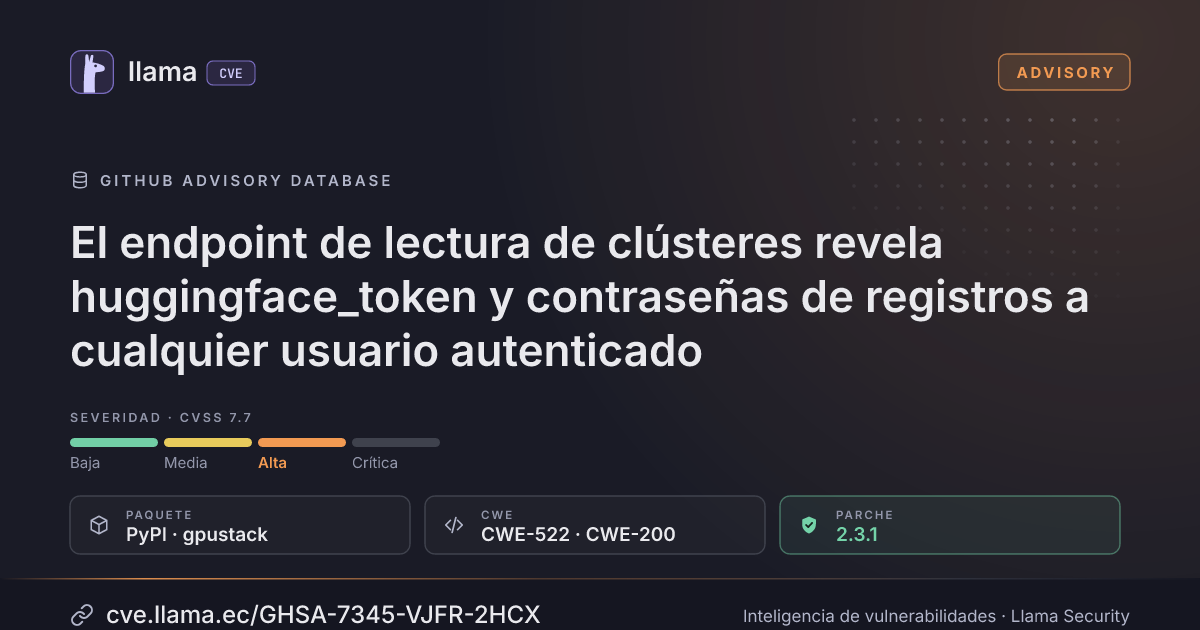
GHSA-7345-VJFR-2HCX
Cluster read endpoint discloses huggingface_token and registry passwords to any authenticated user
Texto original en inglés · Ver en español
CVSS:3.1/AV:N/AC:L/PR:L/UI:N/S:C/C:H/I:N/A:N
Fuente: GitHub
Ciclo de vida de la vulnerabilidad
| Fecha | Fase | Evento | Detalle |
|---|---|---|---|
| Divulgación | Publicada | GHSA-7345-VJFR-2HCX divulgada · CVSS 7.7 (GitHub) | |
| Divulgación | Modificada | Última actualización del registro | |
| Remediación | Parche 2.3.1 | gpustack · 0 d desde divulgación | |
| Monitoreo | Detectada | Ingresó al índice | |
| Monitoreo | Verificada | Última verificación contra las fuentes |
Summary
GPUStack's cluster read APIs expose configured Hugging Face access tokens and container registry passwords in plaintext to authenticated users who can view the cluster.
Cluster visibility does not imply permission to retrieve these credentials. However, the public cluster response includes sensitive fields without masking them.
Affected surfaces include cluster list and detail responses and cluster watch events.
Affected configurations
Exploitation requires:
- An authenticated account with permission to view a cluster.
- A Hugging Face token or container registry password stored in that cluster's configuration.
Platform-default clusters are shared with authenticated users by default unless that access grant has been revoked. As a result, a non-administrator account can meet the visibility requirement without any additional organization membership.
The issue does not grant access to clusters the caller cannot otherwise view.
Impact
An attacker can obtain the values of `worker_config.huggingface_token` and passwords in `k8s_options.imageCredentials` for a visible cluster.
These credentials may allow access to private models or container images. Credentials with broader permissions may also permit changes to external repositories or other resources. Subsequent access depends on the credential's scope and the external service's access controls.
Cluster watch events may also expose sensitive values through configuration change history.
Affected versions
GPUStack versions >= 2.2.0 and < 2.3.1.
Patches
GPUStack 2.3.1 masks Hugging Face tokens and container registry passwords in public cluster responses, including list, detail, and watch responses.
Sensitive configuration history is removed from cluster watch events. Authorized configuration updates preserve existing credentials when masked values are submitted and continue to support explicit credential replacement.
Upgrading prevents further disclosure through these responses but does not invalidate credentials that may already have been exposed. Revoke or rotate potentially exposed Hugging Face tokens and registry credentials after securing the affected deployment.
Workarounds
Until upgrading, restrict cluster read access to trusted users who are authorized to hold the configured credentials, including access through list, detail, and watch endpoints.
Alternatively, remove the affected credentials from cluster configuration where they are not required. Restrict access or remove the credentials before rotating them to avoid exposing replacement values.
Incluye detalles técnicos publicados por el investigador. Úselos solo para validar y corregir sus propios sistemas.
Desglose de métricas
Rangos afectados
Estado del parche por paquete
| Paquete / producto | Estado | Corregida en | Desde divulgación | Última versión |
|---|---|---|---|---|
pypigpustack |
Corregida | 2.3.1 | 0 d | 2.3.1 no afectada |
2.3.1Arsenal público
Sin exploits, módulos ni PoC públicos conocidos a la fecha de verificación.
https://github.com/gpustack/gpustack/security/advisories/GHSA-7345-vjfr-2hcxLas referencias externas se muestran para copiar: cve.llama.ec no lo redirige a otros sitios.