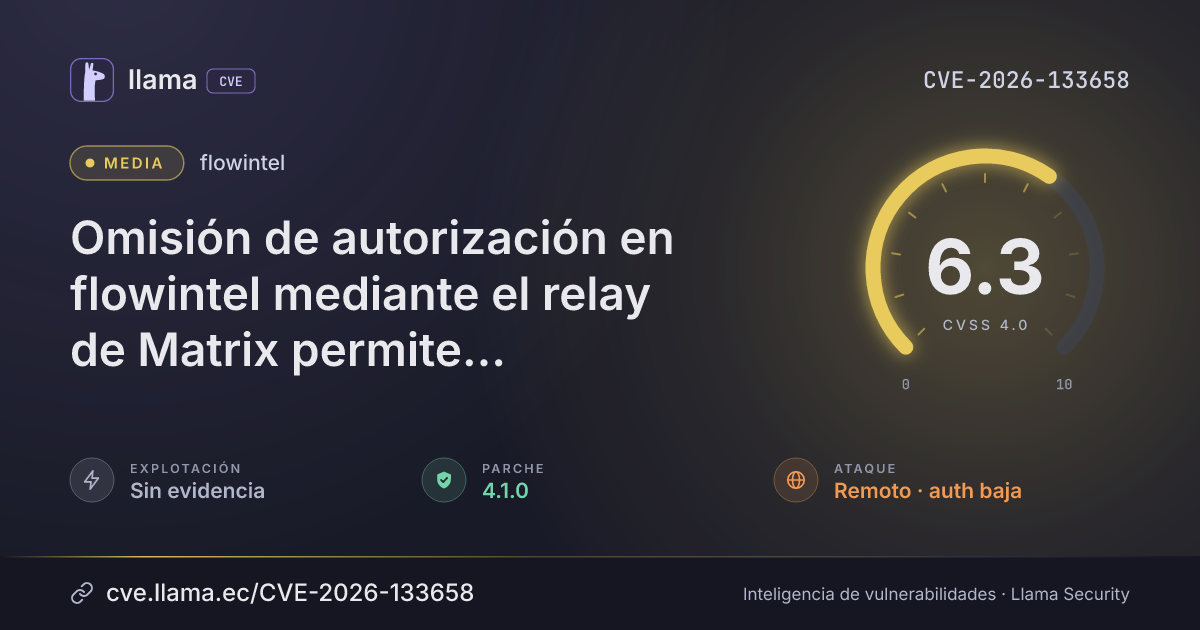
CVE-2026-133658
flowintel auth bypass in Matrix relay allows privilege escalation
Low-privilege users can edit restricted data and impersonate the Matrix bot by copying its profile name and email.
CVSS:4.0/AV:N/AC:L/AT:N/PR:L/UI:N/VC:N/VI:N/VA:N/SC:N/SI:H/SA:N
Fuente: CNA
Ciclo de vida de la vulnerabilidad
| Fecha | Fase | Evento | Detalle |
|---|---|---|---|
| Divulgación | Publicada | CVE-2026-133658 divulgada · CVSS 6.3 (CNA) | |
| Monitoreo | Detectada | Ingresó al índice | |
| Monitoreo | Fuente: NIST NVD | Registro visto por primera vez en NIST NVD | |
| Divulgación | Evaluación SSVC | CISA-ADP · explotación ninguna | |
| Divulgación | Modificada | Última actualización del registro | |
| Monitoreo | Fuente: ENISA EUVD | Registro visto por primera vez en ENISA EUVD | |
| Monitoreo | Verificada | Última verificación contra las fuentes |
Flowintel's Matrix relay integration has an authorization flaw that lets an attacker with a low-privileged account, reached remotely over the network, make write changes to cases, tasks, calendar events, templates, and user directory entries that their restricted role should block. Because the relay is recognized by editable profile name and email fields, an ordinary user who sets those fields to match the bot can impersonate the trusted relay and gain its elevated privileges.
Descripción original del registro (CIRCL)
Flowintel contains a privilege escalation vulnerability in its Matrix relay (bot) integration. When the relay forwarded API requests on behalf of a represented user, the authorization and permission checks evaluated the relay bot's elevated role while the request handlers acted as the lower-privileged represented user. This mismatch allowed users with restricted roles (e.g., Read Only) to perform write operations, directory lookups, calendar modifications, assignment changes, template creation, and import actions they were not authorized to perform. Additionally, relay authority was determined by matching editable user profile fields (name and email) rather than a protected, non-spoofable identifier. An ordinary user who modified their profile to match the expected bot name could be recognized as the trusted relay, enabling impersonation of the bot and potential access to its elevated privileges. Preconditions: - A valid Flowintel user account with a restricted role (e.g., Read Only) - Access to the Matrix relay integration or the ability to send API requests with the relay's API key and a MATRIX-ID header - For the impersonation vector: ability to edit one's own profile name fields Security impact: - Unauthorized write operations by users with read-only or otherwise restricted permissions - Potential impersonation of the trusted relay bot by ordinary users - Bypass of organization-level access controls and role-based restrictions - Unauthorized modification of cases, tasks, calendar events, templates, and user directory entries Affected versions: Flowintel prior to 4.1.0
Desglose de métricas
Rangos afectados
Estado del parche por paquete
| Paquete / producto | Estado | Corregida en | Desde divulgación | Última versión |
|---|---|---|---|---|
flowintel |
Corregida | 4.1.0 | — | — |
4.1.0Arsenal público
Sin exploits, módulos ni PoC públicos conocidos a la fecha de verificación.
https://github.com/flowintel/flowintel/commit/48e9e1b847ecd22da11e70829f1ecfaa0df3791dLas referencias externas se muestran para copiar: cve.llama.ec no lo redirige a otros sitios.