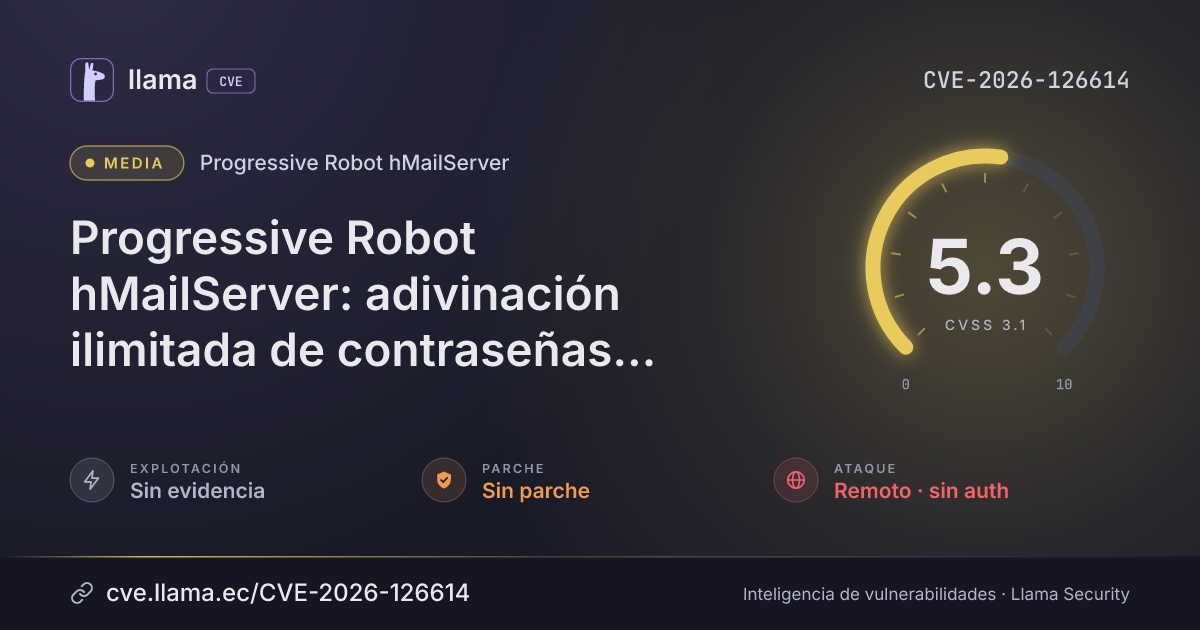
CVE-2026-126614
Progressive Robot hMailServer unlimited password guessing via web services sign-in
An unauthenticated remote attacker can keep guessing account passwords over HTTPS even after being banned.
CVSS:3.1/AV:N/AC:L/PR:N/UI:N/S:U/C:L/I:N/A:N
Fuente: CNA
Ciclo de vida de la vulnerabilidad
| Fecha | Fase | Evento | Detalle |
|---|---|---|---|
| Divulgación | Publicada | CVE-2026-126614 divulgada · CVSS 5.3 (CNA) | |
| Monitoreo | Detectada | Ingresó al índice | |
| Monitoreo | Fuente: NIST NVD | Registro visto por primera vez en NIST NVD | |
| Monitoreo | Fuente: ENISA EUVD | Registro visto por primera vez en ENISA EUVD | |
| Monitoreo | Fuente: OSV | Registro visto por primera vez en OSV | |
| Divulgación | Evaluación SSVC | CISA-ADP · explotación ninguna | |
| Divulgación | Modificada | Última actualización del registro | |
| Monitoreo | Verificada | Última verificación contra las fuentes |
A remote attacker who does not need to log in can keep guessing account passwords through the hMailServer web services listener's HTTPS sign-in, even after the server has banned the attacker's address. The attacker reaches the flaw over the network on the listener's HTTPS port.
Descripción original del registro (GitLab)
The web services listener of Progressive Robot hMailServer 6.3.3 through 6.3.7 does not apply the server's IP ranges to the connections it accepts, which allows a remote unauthenticated attacker to go on guessing account passwords at the listener's sign-ins after the auto-ban has banned the attacker's address. The listener is off by default (WebServicesHttpPort and WebServicesHttpsPort 0). From 6.3.3 its CardDAV, and from 6.3.4 its CalDAV and its Outlook Autodiscover answer to a request that carries credentials, sign an account in with HTTP Basic over HTTPS. A failed sign-in there counts towards the auto-ban as a failed logon on any other protocol does: when the failures counted from one address reach MaxInvalidLogonAttempts (3 within 30 minutes by default), the server writes an IP range that refuses the address for AutoBanMinutes (60 by default), and the SMTP, POP3, IMAP and ManageSieve listeners refuse it. The web services listener asked no IP range when it accepted a connection (in 6.3.3 nothing, from 6.3.4 the country policy alone), so it went on serving such an address, whether its ban had been earned there or on another protocol, and also an address that an administrator's IP range allowing nothing holds. Each failed sign-in there closed only its own connection, and the next connection was accepted, during the ban and after it. The firewall rule and command the auto-ban can drive (AutoBanFirewall and AutoBanCommand, off by default) are told only the SMTP, POP3 and IMAP ports, so that the firewall rule and the packaged hook did not close the listener's ports, and the fail2ban jail packaged for Linux (off by default) lists only the mail and ManageSieve ports. The only limit left on the guesses at one account there was the per-name lockout (AccountLockoutThreshold in hMailServer.ini, 0, off, by default), which has a separate defect fixed in the same release. The flaw is reached on the listener's HTTPS port: behind a TLS-terminating proxy the listener sees the proxy's address for every client, and a ban never named the client there.
Desglose de métricas
Rangos afectados
Estado del parche por paquete
| Paquete / producto | Estado | Corregida en | Desde divulgación | Última versión |
|---|---|---|---|---|
hMailServer |
Sin parche | — | — | — |
Arsenal público
Sin exploits, módulos ni PoC públicos conocidos a la fecha de verificación.
https://gitlab.com/hmailserver/hmailserver/-/work_items/105https://gitlab.com/hmailserver/hmailserver/-/releases/v6.3.8Las referencias externas se muestran para copiar: cve.llama.ec no lo redirige a otros sitios.