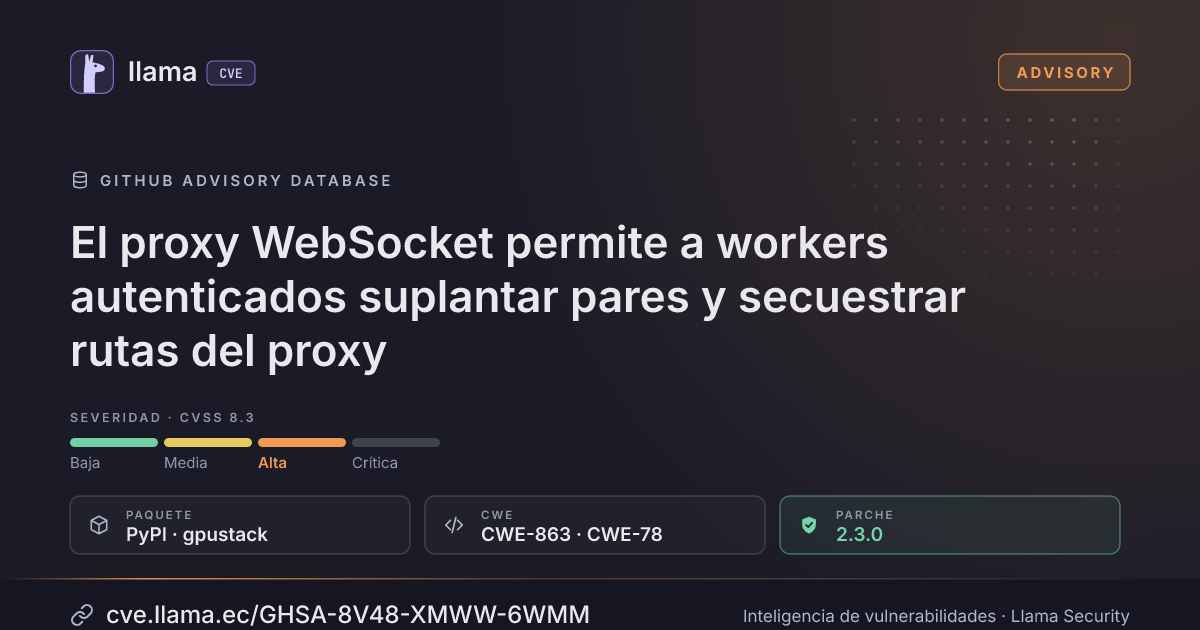
GHSA-8V48-XMWW-6WMM
WebSocket proxy allows authenticated workers to impersonate peers and hijack proxy routes
Texto original en inglés · Ver en español
CVSS:3.1/AV:N/AC:L/PR:L/UI:N/S:U/C:H/I:H/A:L
Fuente: GitHub
Ciclo de vida de la vulnerabilidad
| Fecha | Fase | Evento | Detalle |
|---|---|---|---|
| Remediación | Parche 2.3.0 | gpustack · -3 d desde divulgación | |
| Divulgación | Publicada | GHSA-8V48-XMWW-6WMM divulgada · CVSS 8.3 (GitHub) | |
| Monitoreo | Detectada | Ingresó al índice | |
| Monitoreo | Verificada | Última verificación contra las fuentes |
Summary
Insufficient authorization in GPUStack's WebSocket proxy registration allows an authenticated worker to act as a federation peer and submit unauthorized proxy route claims.
In affected versions, a worker can obtain registered worker route metadata across organizations on the accepting server and redirect matching proxied connections through infrastructure it controls.
Exploitation requires valid credentials associated with a registered worker and network access to the server's WebSocket proxy endpoint. An ordinary user session or inference-only API key is not sufficient for this attack path.
Details
The endpoint authenticates the worker but does not separately authorize the caller to act as a federation peer. Caller-supplied federation metadata can therefore select a more privileged registration path.
Client route registration also lacks sufficient authorization and ownership checks. An exact CIDR registration can replace another client's route, while broader route claims can affect destinations not covered by more specific legitimate routes.
Additional worker identity update paths allow changes to the identifier used to associate authenticated workers with route ownership.
Impact
An attacker can obtain registered worker route metadata from the accepting server and redirect or disrupt matching connections passing through the affected proxy.
For traffic without effective end-to-end encryption and peer authentication, this can expose or allow modification of application requests and responses, potentially including inference prompts and completions.
This vulnerability does not by itself decrypt correctly authenticated TLS traffic inside a CONNECT tunnel. Such connections can still be interrupted or prevented from completing.
The impact is limited to traffic using the affected proxy and matching the attacker's registered routes. More specific legitimate routes take precedence over broader claims.
Patches
Fixed in 2.3.0.
The production endpoint no longer accepts worker connections as federation peers. Worker route claims are restricted to host routes matching addresses recorded for the authenticated worker, and claims cannot replace exact CIDRs already owned by another client.
The fix also prevents worker status reports and re-registration from changing server-assigned worker identity or using worker credentials to update another worker's record.
Workarounds
Until upgrading, restrict worker registration to trusted operators and revoke credentials associated with compromised or untrusted workers.
Use end-to-end TLS with certificate verification for sensitive proxied traffic. This reduces content disclosure and modification risks but does not prevent route manipulation or denial of service.
Incluye detalles técnicos publicados por el investigador. Úselos solo para validar y corregir sus propios sistemas.
Desglose de métricas
Rangos afectados
Estado del parche por paquete
| Paquete / producto | Estado | Corregida en | Desde divulgación | Última versión |
|---|---|---|---|---|
pypigpustack |
Corregida | 2.3.0 | -3 d | 2.3.1 no afectada |
2.3.0Arsenal público
Sin exploits, módulos ni PoC públicos conocidos a la fecha de verificación.
https://github.com/gpustack/gpustack/security/advisories/GHSA-8v48-xmww-6wmmLas referencias externas se muestran para copiar: cve.llama.ec no lo redirige a otros sitios.