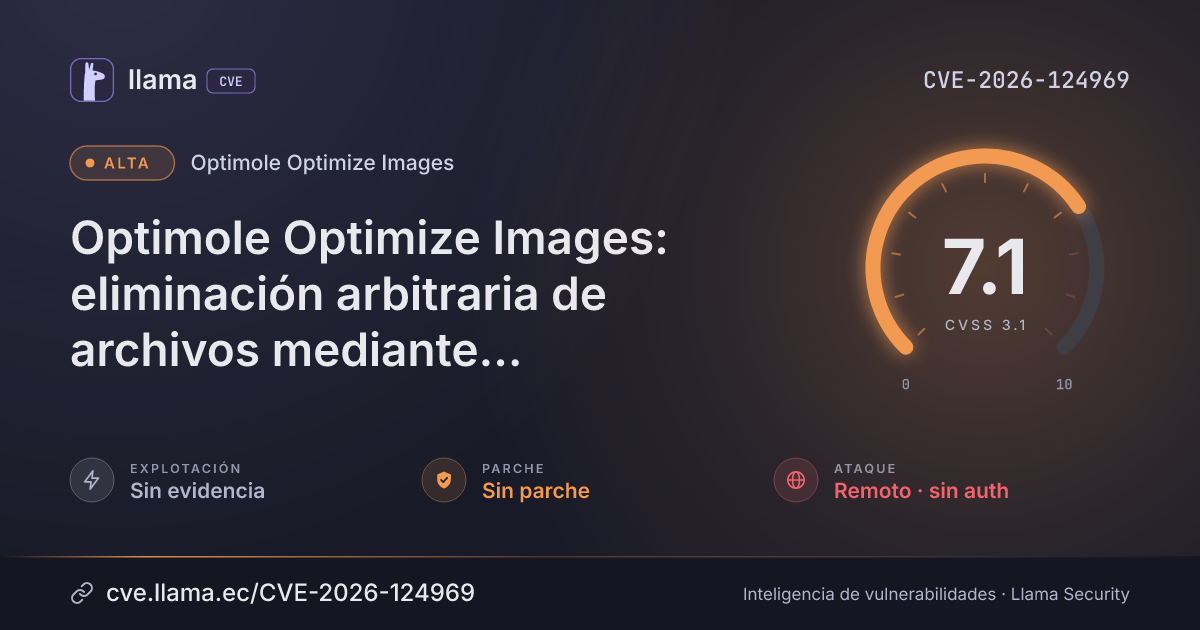
CVE-2026-124969
Optimole Optimize Images arbitrary file deletion via deserialization in comments
Unauthenticated attackers can delete arbitrary files, and removing wp-config.php can lead to code execution.
CVSS:3.1/AV:N/AC:L/PR:N/UI:R/S:U/C:N/I:L/A:H
Fuente: CNA
Ciclo de vida de la vulnerabilidad
| Fecha | Fase | Evento | Detalle |
|---|---|---|---|
| Divulgación | Publicada | CVE-2026-124969 divulgada · CVSS 7.1 (CNA) | |
| Monitoreo | Detectada | Ingresó al índice | |
| Monitoreo | Fuente: NIST NVD | Registro visto por primera vez en NIST NVD | |
| Divulgación | Evaluación SSVC | CISA-ADP · explotación ninguna | |
| Divulgación | Modificada | Última actualización del registro | |
| Monitoreo | Fuente: ENISA EUVD | Registro visto por primera vez en ENISA EUVD | |
| Monitoreo | Verificada | Última verificación contra las fuentes |
Remotely, without logging in, an attacker can delete arbitrary files on a server running the Optimole WordPress image optimization plugin (versions up to and including 4.2.19), which can lead to remote code execution if a critical file such as wp-config.php is removed. The attack requires an administrator to take a specific action, and the PEAR Archive_Tar library to be present on the host.
Descripción original del registro (Wordfence)
The Optimole – Optimize Images | Convert WebP & AVIF | CDN & Lazy Load | Image Optimization plugin for WordPress is vulnerable to arbitrary file deletion due to insufficient file path validation in the replace_urls_in_value function in all versions up to, and including, 4.2.19. This makes it possible for unauthenticated attackers to delete arbitrary files on the server, which can easily lead to remote code execution when the right file is deleted (such as wp-config.php). Successful exploitation requires PEAR's Archive_Tar library to be present and loadable on the host (common in official WordPress Docker images and many PHP distributions), and an administrator must subsequently use the plugin's Rename control on any attachment after the attacker has staged a malicious payload in a comment. Successful exploitation additionally requires an action by an administrator — the attacker cannot trigger the vulnerability on their own.
Desglose de métricas
Rangos afectados
Estado del parche por paquete
| Paquete / producto | Estado | Corregida en | Desde divulgación | Última versión |
|---|---|---|---|---|
Optimole – Optimize Images | Convert WebP & AVIF | CDN & Lazy Load | Image Optimization |
Sin parche | — | — | — |
Arsenal público
Sin exploits, módulos ni PoC públicos conocidos a la fecha de verificación.
https://www.wordfence.com/threat-intel/vulnerabilities/id/277b9a34-8e0b-496e-b07b-602b25f125d8?source=cvehttps://plugins.trac.wordpress.org/browser/optimole-wp/tags/4.2.19/inc/media_rename/attachment_db_renamer.php#L415https://plugins.trac.wordpress.org/browser/optimole-wp/tags/4.2.19/inc/media_rename/attachment_db_renamer.php#L548https://plugins.trac.wordpress.org/browser/optimole-wp/tags/4.2.19/inc/media_rename/attachment_db_renamer.php#L319https://plugins.trac.wordpress.org/browser/optimole-wp/tags/4.2.19/inc/media_rename/attachment_rename.php#L107https://plugins.trac.wordpress.org/browser/optimole-wp/tags/4.2.19/inc/media_rename/attachment_edit.php#L311https://plugins.trac.wordpress.org/browser/optimole-wp/tags/4.2.20Las referencias externas se muestran para copiar: cve.llama.ec no lo redirige a otros sitios.