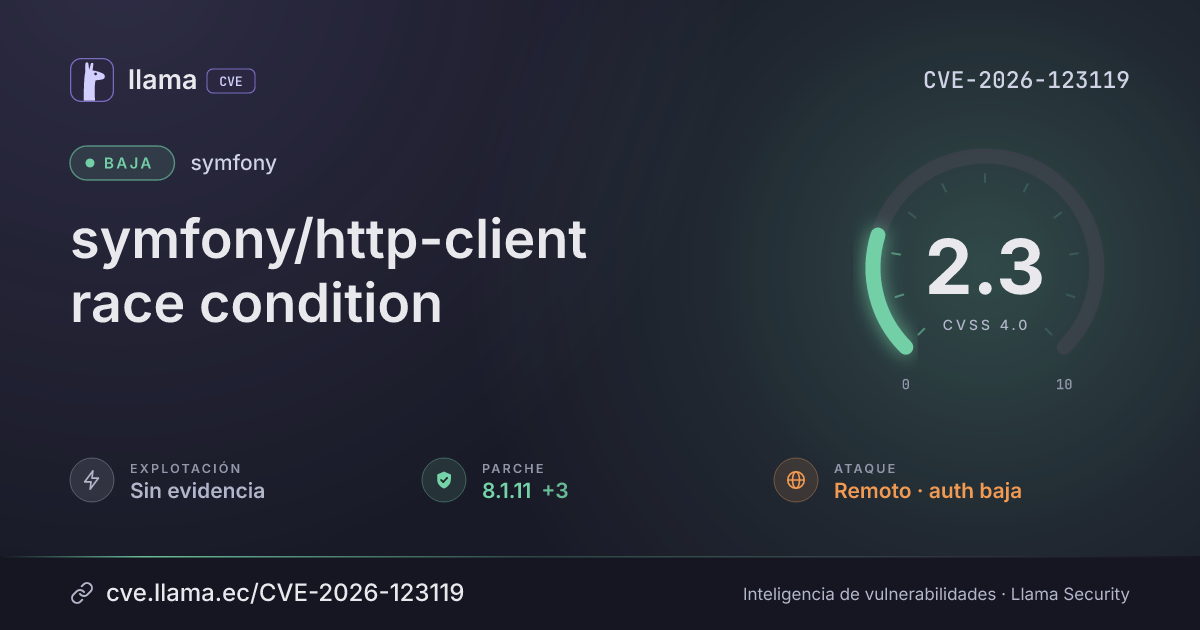
CVE-2026-123119
symfony/http-client race condition
CVSS:4.0/AV:N/AC:L/AT:P/PR:L/UI:N/VC:N/VI:N/VA:N/SC:L/SI:N/SA:N
Fuente: CNA
Ciclo de vida de la vulnerabilidad
| Fecha | Fase | Evento | Detalle |
|---|---|---|---|
| Divulgación | Publicada | CVE-2026-123119 divulgada · CVSS 2.3 (CNA) | |
| Monitoreo | Detectada | Ingresó al índice | |
| Monitoreo | Fuente: NIST NVD | Registro visto por primera vez en NIST NVD | |
| Divulgación | Evaluación SSVC | CISA-ADP · explotación ninguna | |
| Divulgación | Modificada | Última actualización del registro | |
| Monitoreo | Fuente: ENISA EUVD | Registro visto por primera vez en ENISA EUVD | |
| Monitoreo | Fuente: OSV | Registro visto por primera vez en OSV | |
| Monitoreo | Verificada | Última verificación contra las fuentes |
Symfony's HttpClient component (NoPrivateNetworkHttpClient) fails to pin the checked IP address for cached hosts, so an attacker controlling a host's DNS can use DNS rebinding to get past private-network restrictions and enumerate internal hosts and ports, remotely and with low-privilege login. The attack requires an application that sends several requests to the attacker's host through the same client, such as one fetching multiple user-supplied repository URLs.
Descripción original del registro (Checkmarx)
The Symfony HttpClient component NoPrivateNetworkHttpClient does not pin the checked IP address of cached hosts, allowing for DNS rebinding to bypass private network restrictions, resulting in enumeration of internal hosts and ports in Symfony versions prior to 5.4.56, 6.x prior to 6.4.50, 7.x prior to 7.4.23, and 8.x prior to 8.1.11. NoPrivateNetworkHttpClient resolves the host of each request and checks the IP before connecting. It caches the result per host, and passes the IP to the decorated client through the resolve option so that the client connects to the exact IP that was checked. The issue is that resolve was only passed on the first lookup of a host: on subsequent requests, the decorated client resolved the host again on its own. An attacker who controls a host's DNS can exploit this with DNS rebinding by answering the first lookup with a public IP, and subsequent lookups with a private IP, so when an application sends several requests to that host through the same client, the later requests connect to the private IP. This happens, for example, when an application fetches several URLs of a repository provided by a user. The check of the primary_ip in the on_progress callback still aborts the request before anything is sent, but the connection is made, and the error differs depending on whether the port is open or closed. This allows enumerating internal hosts and ports, as in CVE-2024-50342.
Desglose de métricas
Rangos afectados
Estado del parche por paquete
| Paquete / producto | Estado | Corregida en | Desde divulgación | Última versión |
|---|---|---|---|---|
symfony/http-client |
Corregida | 5.4.56, 6.4.50, 7.4.23, 8.1.11 | — | — |
5.4.566.4.507.4.238.1.11Arsenal público
Sin exploits, módulos ni PoC públicos conocidos a la fecha de verificación.
https://github.com/symfony/symfony/security/advisories/GHSA-c7hm-wqwp-f9v8https://github.com/symfony/symfony/commit/ab084826b2b5db8d0b91af635fe2b5e1c4f699f9Las referencias externas se muestran para copiar: cve.llama.ec no lo redirige a otros sitios.