Exposición1 dDesde la divulgación, 19 nov 2026, 2:55 p. m.
Detección5 minDesde la divulgación hasta su ingreso al índice
Decisión SSVCSeguir
Remediar en la ventana regular de mantenimiento
Sin explotación conocida, automatizable e impacto técnico parcial. Hay versiones corregidas disponibles.
Avísale a infraestructura antes de que te avisen a ti.Si la dejas para después, después te va a doler.
Timeline
Ciclo de vida de la vulnerabilidad
Hoy
Divulgación
Publicada
Evaluación SSVC +1
Explotación
Remediación
Monitoreo
Detectada +1
Fuente: ENISA EUVD +1
02:55 p. m.
03:00 p. m.
02:56 p. m.
03:07 p. m.
05:14 a. m.
02:55 p. m.
12:30 a. m.
10:05 a. m.
07:40 p. m.
05:14 a. m.
Fecha
Fase
Evento
Detalle
Divulgación
Publicada
CVE-2026-76536 divulgada · CVSS 9.4 (CNA)
Monitoreo
Detectada
Ingresó al índice
Monitoreo
Fuente: NIST NVD
Registro visto por primera vez en NIST NVD
Divulgación
Evaluación SSVC
CISA-ADP · explotación ninguna
Divulgación
Modificada
Última actualización del registro
Monitoreo
Fuente: ENISA EUVD
Registro visto por primera vez en ENISA EUVD
Monitoreo
Verificada
Última verificación contra las fuentes
Resumen
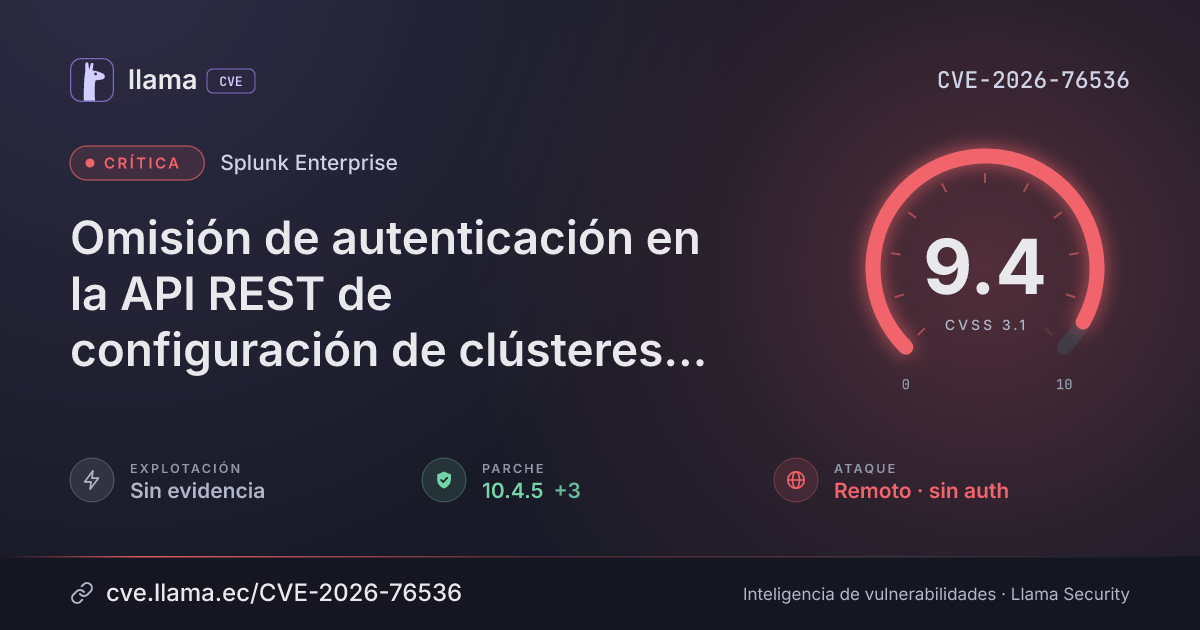
In Splunk Enterprise versions below 10.4.5, 10.2.9, 10.0.12, and 9.4.17, an unauthenticated user could use an empty clustering shared secret to read and modify clustering configuration through the cluster configuration Representational State Transfer (REST) API endpoint on a standalone instance. This could expose clustering configuration, persist attacker-controlled clustering settings, and disrupt clustering operations.
The vulnerability is possible because Splunk Enterprise accepts the empty clustering shared secret as a shared-authentication candidate on a standalone instance when clustering is turned off.
Only affects Splunk Enterprise standalone instances with clustering turned off, in versions below 10.4.5, 10.2.9, 10.0.12, or 9.4.17. Fixed in 10.4.5, 10.2.9, 10.0.12, and 9.4.17.
¿Qué significa?The cluster configuration REST API accepts an empty clustering shared secret as a shared-authentication candidate, which bypasses authentication. An attacker could read and change clustering configuration, keep attacker-controlled clustering settings in place, and disrupt clustering operations.
¿Quién está afectado?Splunk Enterprise versions below 10.4.5, 10.2.9, 10.0.12, and 9.4.17 are affected, and the issue applies to standalone instances with clustering turned off. To check, run the splunk version command on the instance and compare the result with the fixed versions, and check whether clustering is enabled in the [clustering] stanza of server.conf.
¿Qué hacer?Upgrade to Splunk Enterprise 10.4.5, 10.2.9, 10.0.12, or 9.4.17 or higher on the matching release line. Splunk recommends 10.6.1 as a newer version.
Contexto
Condiciones y alcance
Condiciones necesarias para que el fallo sea explotable
01
Splunk Enterprise instance is a standalone instance with clustering turned off“accepts the empty clustering shared secret as a shared-authentication candidate on a standalone instance when clustering is turned off”
02
Splunk Enterprise version below 10.4.5, 10.2.9, 10.0.12, or 9.4.17“In Splunk Enterprise versions below 10.4.5, 10.2.9, 10.0.12, and 9.4.17”
¿Quién debe revisar?Teams running standalone Splunk Enterprise instances with clustering turned off on versions below 10.4.5, 10.2.9, 10.0.12, or 9.4.17.
MitigaciónSet a strong, unique pass4SymmKey value in the [clustering] stanza in server.conf, including on standalone instances, and restart Splunk Enterprise. The value must be at least 12 characters.
Vector CVSS 3.1
Desglose de métricas
Opción resaltada = valor del vector · izquierda = peor caso · CNA
Vector de ataqueAV:N
RedAdyacenteLocalFísica
ComplejidadAC:L
BajaAlta
PrivilegiosPR:N
NingunoBajosAltos
InteracciónUI:N
NingunaRequerida
AlcanceS:U
CambiadoSin cambio
ConfidencialidadC:L
AltoBajoNinguno
IntegridadI:H
AltoBajoNinguno
DisponibilidadA:H
AltoBajoNinguno
Score de explotaciónQué tan fácil y probable es que la exploten
10.0/ 10Muy alto
Vector 10.0 (muy fácil) · sin evidencia de explotación.
Versiones
Rangos afectados
AfectadaCorregida
Splunk Enterprise≥ 9.4 < 9.4.17
Splunk Enterprise≥ 10.0 < 10.0.12
Splunk Enterprise≥ 10.2 < 10.2.9
Splunk Enterprise≥ 10.4 < 10.4.5
9.4
9.4.17
10.0
10.0.12
10.2
10.2.9
10.4
10.4.5
Remediación
Estado del parche por paquete
Paquete / producto
Estado
Corregida en
Desde divulgación
Última versión
Splunk Enterprise
Corregida
9.4.17, 10.0.12, 10.2.9, 10.4.5
—
—
Versiones corregidas9.4.1710.0.1210.2.910.4.5
Explotación
Arsenal público
Sin exploits, módulos ni PoC públicos conocidos a la fecha de verificación.
Registro
EscenarioGENERALcisco
MitigaciónIf you cannot immediately upgrade to a fixed version, set a strong, unique `pass4SymmKey` value in the `[clustering]` stanza in the `server.conf` configuration file, including on standalone instances. The `pass4SymmKey` value must contain at least 12 characters. The file is at `etc/system/local/server.conf` under the Splunk Enterprise installation directory. Restart Splunk Enterprise for the change to take effect.
For more information see [Secure Splunk Enterprise services with pass4SymmKey](https://help.splunk.com/en/splunk-enterprise/administer/manage-users-and-security/10.4/secure-distributed-and-clustered-splunk-environments/secure-splunk-enterprise-services-with-pass4symmkey) in the Splunk documentation.cisco
solutionUpgrade Splunk Enterprise versions 10.6.1, 10.4.5, 10.2.9, 10.0.12, and 9.4.17 or higher.cisco
Usamos cookies propias estrictamente necesarias para que el sitio funcione y sea seguro. Con tu permiso, también usamos almacenamiento local para recordar tus preferencias y medir el uso del sitio de forma agregada. Puedes aceptar, rechazar o configurar cada categoría, y cambiar tu decisión cuando quieras desde el enlace “Preferencias de cookies” del pie de página. Más información
Preferencias de cookies
Elige qué permites
Solo usamos tecnologías propias de este dominio. Sin publicidad ni rastreadores de terceros. Detalle en la Política de cookies.