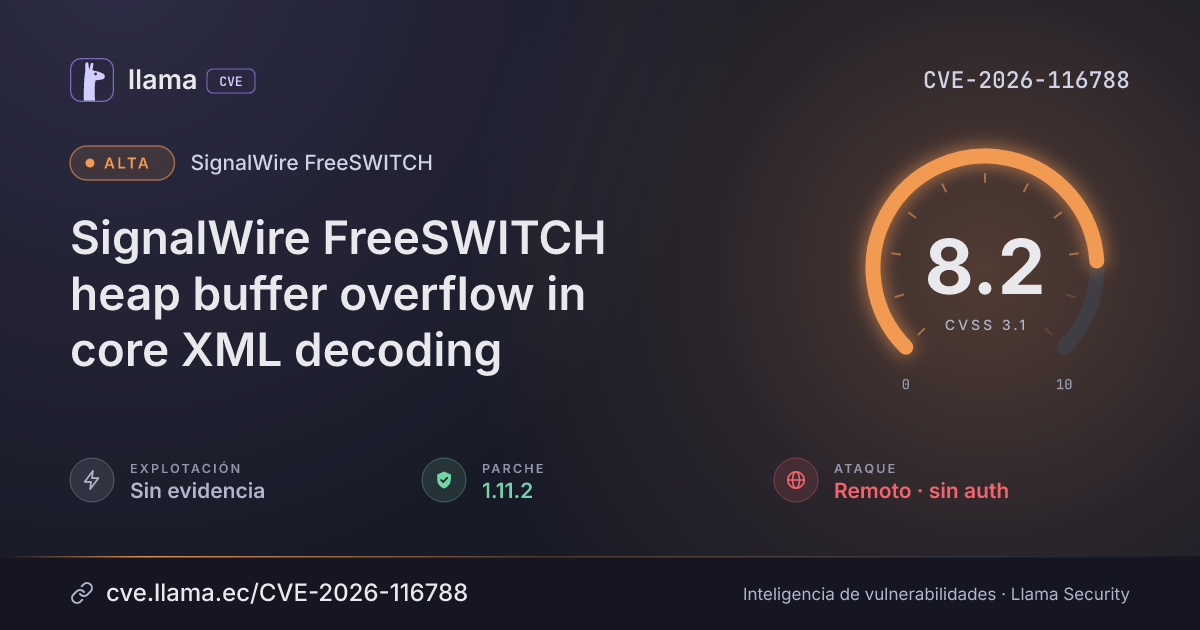
CVE-2026-116788
SignalWire FreeSWITCH heap buffer overflow in core XML decoding
An unauthenticated attacker can send a crafted SIP PUBLISH request to crash the service and interrupt all active calls.
CVSS:3.1/AV:N/AC:L/PR:N/UI:N/S:U/C:N/I:L/A:H
Fuente: CNA
Ciclo de vida de la vulnerabilidad
| Fecha | Fase | Evento | Detalle |
|---|---|---|---|
| Divulgación | Publicada | CVE-2026-116788 divulgada · CVSS 8.2 (CNA) | |
| Monitoreo | Detectada | Ingresó al índice | |
| Monitoreo | Fuente: NIST NVD | Registro visto por primera vez en NIST NVD | |
| Monitoreo | Fuente: ENISA EUVD | Registro visto por primera vez en ENISA EUVD | |
| Divulgación | Evaluación SSVC | CISA-ADP · explotación ninguna | |
| Divulgación | Modificada | Última actualización del registro | |
| Monitoreo | Fuente: OSV | Registro visto por primera vez en OSV | |
| Monitoreo | Verificada | Última verificación contra las fuentes |
FreeSWITCH, an open-source telecommunications platform, is affected by a heap buffer overflow in its core XML decoding that can be triggered remotely, without logging in, through a crafted SIP PUBLISH request. An attacker who reaches a SIP profile with presence management and DTD processing enabled can corrupt heap memory and crash the FreeSWITCH process, interrupting all active calls.
Affects FreeSWITCH before 1.11.2 on SIP profiles with manage-presence enabled, such as the default internal profile, when an XML DTD declares an entity with an empty value. Fixed in 1.11.2.
Descripción original del registro (GitHub_M)
FreeSWITCH is an open-source software telecommunications platform. Before version 1.11.2, an integer underflow in switch_xml_decode() can cause an undersized heap allocation when an XML document declares an entity with an empty replacement value. Subsequent copying overruns the allocated buffer. An unauthenticated attacker who can reach a SIP profile with presence management enabled and DTD processing permitted can trigger the vulnerability through a crafted SIP PUBLISH request. Exploitation can corrupt heap memory and terminate the FreeSWITCH process, interrupting all active calls. This vulnerability is fixed in version 1.11.2.
Condiciones y alcance
Desglose de métricas
Rangos afectados
Estado del parche por paquete
| Paquete / producto | Estado | Corregida en | Desde divulgación | Última versión |
|---|---|---|---|---|
freeswitch |
Corregida | 1.11.2 | — | — |
1.11.2Arsenal público
Sin exploits, módulos ni PoC públicos conocidos a la fecha de verificación.
https://github.com/signalwire/freeswitch/security/advisories/GHSA-f73w-xph4-pjp3https://github.com/signalwire/freeswitch/commit/587474a1584488f0c04201e6e61efe76aa5bda01https://github.com/signalwire/freeswitch/releases/tag/v1.11.2Las referencias externas se muestran para copiar: cve.llama.ec no lo redirige a otros sitios.