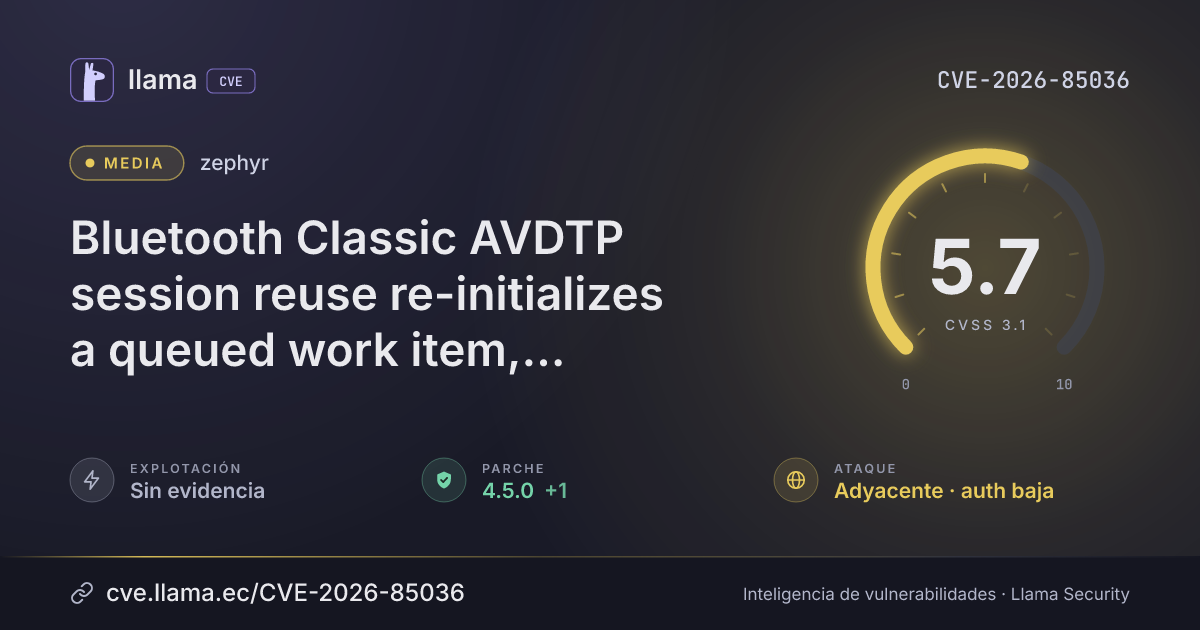
CVE-2026-85036
Bluetooth Classic AVDTP session reuse re-initializes a queued work item, corrupting the system work queue
CVSS:3.1/AV:A/AC:L/PR:L/UI:N/S:U/C:N/I:N/A:H
Fuente: CNA
Ciclo de vida de la vulnerabilidad
| Fecha | Fase | Evento | Detalle |
|---|---|---|---|
| Divulgación | Publicada | CVE-2026-85036 divulgada · CVSS 5.7 (CNA) | |
| Monitoreo | Detectada | Ingresó al índice | |
| Monitoreo | Fuente: NIST NVD | Registro visto por primera vez en NIST NVD | |
| Divulgación | Evaluación SSVC | CISA-ADP · explotación ninguna | |
| Divulgación | Modificada | Última actualización del registro | |
| Monitoreo | Fuente: OSV | Registro visto por primera vez en OSV | |
| Monitoreo | Verificada | Última verificación contra las fuentes |
The Bluetooth Classic AVDTP layer defers releasing a session's stream endpoints: bt_avdtp_l2cap_disconnected() in subsys/bluetooth/host/classic/avdtp.c ends with k_work_submit(&session->_release_work), placing the embedded struct k_work on the system work queue's pending list. When the same struct bt_avdtp object is immediately reused for a new signalling connection, the session memory is re-initialized — a2dp_get_connection() in subsys/bluetooth/host/classic/a2dp.c memset()s the whole struct bt_a2dp, and bt_avdtp_l2cap_accept() / bt_avdtp_connect() call k_work_init() on session->_release_work — while that work item is still linked into k_sys_work_q.pending. Zeroing a linked sys_snode_t truncates the list while its tail pointer keeps pointing past the truncation. The reuse window is deterministic rather than a race. All host RX processing runs on the Bluetooth RX work queue at a cooperative priority (CONFIG_BT_RX_PRIO), while _release_work is submitted to the lower-priority system work queue, so the release handler cannot run until the RX thread blocks. Because l2cap_br_recv() processes every signalling command contained in a single L2CAP signalling PDU back-to-back, a peer can send one PDU holding an L2CAP Disconnection Request for the AVDTP signalling channel followed by a Connection Request for PSM 0x0019; the second command reaches the session-reuse path with the release work provably still queued. The peer must already hold an encrypted AVDTP signalling channel, i.e. be a paired/bonded BR/EDR device. The result is corruption of the global system work queue's pending list: either the queue silently stops executing any work at all (subsequent submissions are appended to a chain the head can no longer reach, and the orphaned items keep their K_WORK_QUEUED flag forever) or, in the tail variant, the list acquires a self-referencing node that the queue thread spins on. The written values are pointers to other struct k_work objects and are not attacker-controlled, so the impact is a device-wide, reboot-required denial of service rather than a controllable write primitive. Only builds with CONFIG_BT_CLASSIC and CONFIG_BT_A2DP are affected. The fix is a two-commit unit, and neither commit closes the path on its own. ec822ceed83b adds a pending-release check to bt_avdtp_connect() and bt_avdtp_l2cap_accept(), but the A2DP upper layer's a2dp_get_connection() memset()s the session — including the queued work item's list node and flags — before those checks run, so k_work_busy_get() would observe an already-cleared state. 2bd5ea88c69b closes that by making a2dp_get_connection() itself skip the reuse and return NULL while the release work is still pending, which both callers already handle by rejecting the connection attempt. Apply both commits together; either one alone leaves the device vulnerable.
Desglose de métricas
Rangos afectados
Estado del parche por paquete
| Paquete / producto | Estado | Corregida en | Desde divulgación | Última versión |
|---|---|---|---|---|
zephyr |
Corregida | 4.3.2, 4.5.0 | — | — |
4.3.24.5.0Arsenal público
Sin exploits, módulos ni PoC públicos conocidos a la fecha de verificación.
https://github.com/zephyrproject-rtos/zephyr/security/advisories/GHSA-ffxg-752w-mv9xhttps://github.com/zephyrproject-rtos/zephyr/commit/ec822ceed83b5008d4a28700fdacf2ff80020963https://github.com/zephyrproject-rtos/zephyr/commit/2bd5ea88c69bdd94fc5a9e6757b29e1de9903ef5Las referencias externas se muestran para copiar: cve.llama.ec no lo redirige a otros sitios.