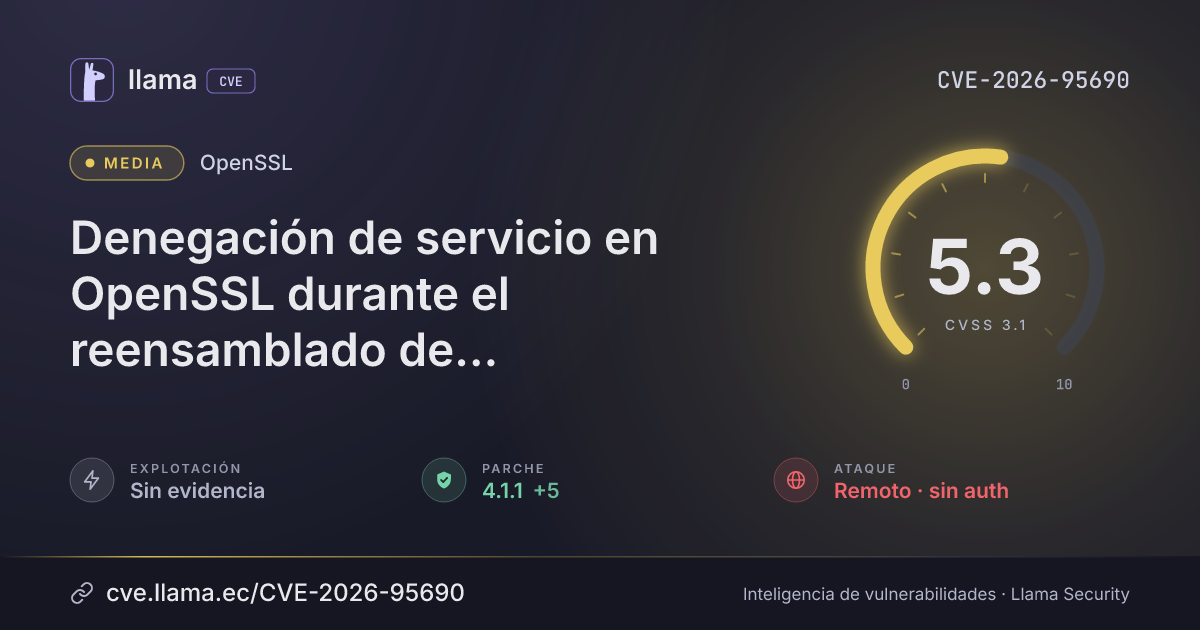
CVE-2026-95690
OpenSSL denial of service in DTLS handshake reassembly
A remote attacker can exhaust server memory by sending small crafted DTLS handshake fragments.
CVSS:3.1/AV:N/AC:L/PR:N/UI:N/S:U/C:N/I:N/A:L
Fuente: CISA-ADP
Ciclo de vida de la vulnerabilidad
| Fecha | Fase | Evento | Detalle |
|---|---|---|---|
| Divulgación | Publicada | CVE-2026-95690 divulgada · CVSS 5.3 (CISA-ADP) | |
| Monitoreo | Detectada | Ingresó al índice | |
| Divulgación | Evaluación SSVC | CISA-ADP · explotación ninguna | |
| Monitoreo | Fuente: ENISA EUVD | Registro visto por primera vez en ENISA EUVD | |
| Divulgación | Modificada | Última actualización del registro | |
| Monitoreo | Verificada | Última verificación contra las fuentes |
Receiving crafted out-of-sequence DTLS handshake fragments can make OpenSSL allocate a full message-length reassembly buffer for each buffered message. As a result, a small amount of data sent over the network can consume a large amount of memory.
Descripción original del registro (openssl)
Issue summary: Receiving crafted out-of-sequence DTLS handshake fragments may cause OpenSSL to allocate a full message-length reassembly buffer for each buffered message, so a small amount of wire data consumes a large amount of memory. Impact summary: A remote attacker can send a few small crafted DTLS handshake fragments to make a DTLS server or client allocate well over a megabyte of memory per connection, which may lead to memory exhaustion and Denial of Service if many connections are made. CWE: CWE-770: Allocation of Resources Without Limits or Throttling Description: DTLS handshake messages can arrive out of order and fragmented, so OpenSSL buffers fragments of up to ten out-of-sequence messages until reassembly is possible. When the first fragment of a new message arrives, OpenSSL allocates a buffer sized to the full message length declared in the fragment header, plus a reassembly bitmap, instead of storing only the bytes actually received. The declared length is capped by the maximum certificate list size, 128KB by default, and that cap applies to every handshake message type rather than only to Certificate messages. Only DTLS endpoints reach this code. TLS, QUIC and applications that do not use DTLS are unaffected. An attacker sends fragments that declare a large message length but carry almost no data, using up to ten distinct message sequence numbers. A single connection can then hold roughly 1.4MB of buffers from about 156 bytes on the wire. Because the number of buffered messages is capped, memory exhaustion requires many connections or many peers, which is why the severity is Low. FIPS impact: no The affected code is outside the FIPS module boundary.
Desglose de métricas
Rangos afectados
Estado del parche por paquete
| Paquete / producto | Estado | Corregida en | Desde divulgación | Última versión |
|---|---|---|---|---|
OpenSSL |
Corregida | 1.0.2zt, 1.1.1zk, 3.0.24, 3.5.10, 4.0.4, 4.1.1 | — | — |
1.0.2zt1.1.1zk3.0.243.5.104.0.44.1.1Arsenal público
Sin exploits, módulos ni PoC públicos conocidos a la fecha de verificación.
https://github.com/openssl/openssl/pull/33620https://github.com/openssl/openssl/pull/33729Las referencias externas se muestran para copiar: cve.llama.ec no lo redirige a otros sitios.