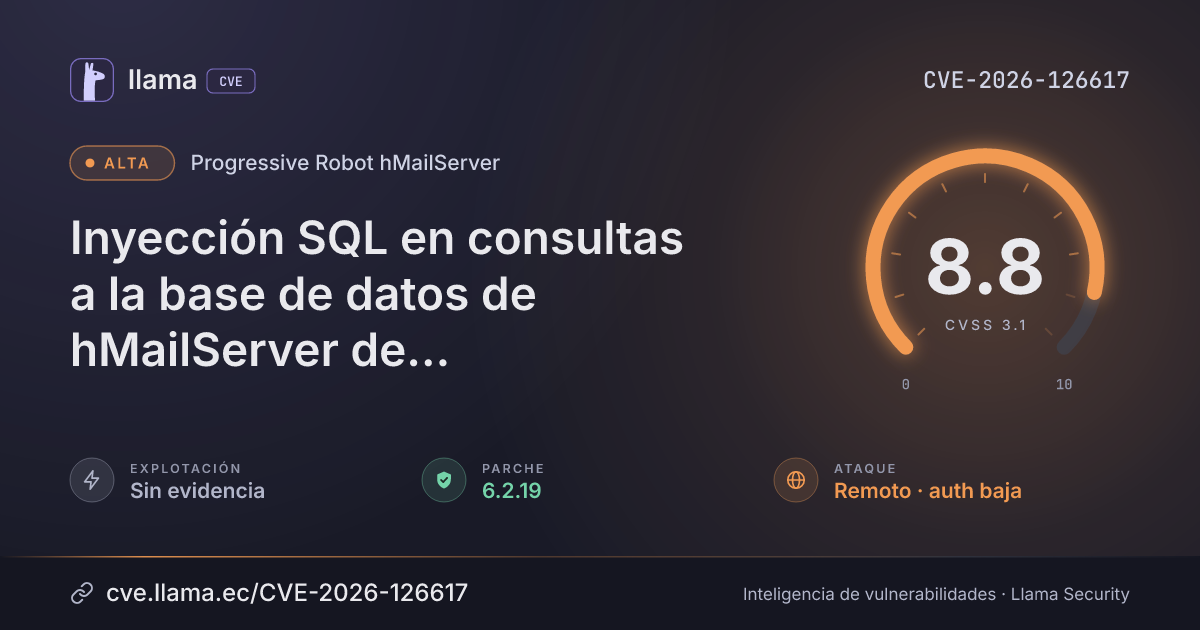
CVE-2026-126617
Progressive Robot hMailServer SQL injection in mail server database queries
A remote attacker can alter the SQL statements the server runs, with the database account's privileges.
CVSS:3.1/AV:N/AC:L/PR:L/UI:N/S:U/C:H/I:H/A:H
Fuente: CNA
Ciclo de vida de la vulnerabilidad
| Fecha | Fase | Evento | Detalle |
|---|---|---|---|
| Divulgación | Publicada | CVE-2026-126617 divulgada · CVSS 8.8 (CNA) | |
| Monitoreo | Detectada | Ingresó al índice | |
| Monitoreo | Fuente: NIST NVD | Registro visto por primera vez en NIST NVD | |
| Monitoreo | Fuente: ENISA EUVD | Registro visto por primera vez en ENISA EUVD | |
| Monitoreo | Fuente: OSV | Registro visto por primera vez en OSV | |
| Divulgación | Evaluación SSVC | CISA-ADP · explotación ninguna | |
| Divulgación | Modificada | Última actualización del registro | |
| Monitoreo | Verificada | Última verificación contra las fuentes |
SQL injection in Progressive Robot Ltd's hMailServer, when it runs on MySQL/MariaDB or PostgreSQL, lets a remote attacker alter the SQL statements the server runs, with the privileges of the database account. In the default setup, a logged-in user who is allowed to send mail can trigger it by sending to an address of their choosing.
Affects hMailServer 6.0.0-B1 through 6.2.18 on Windows only. Fixed in 6.2.19.
Descripción original del registro (GitLab)
SQL injection in the database layer of Progressive Robot hMailServer 6.0.0-B1 through 6.2.18, when the server uses MySQL/MariaDB or PostgreSQL, allows a remote attacker to alter SQL statements the server runs. On those two engines parameters are not bound: SQLStatement::GenerateFromCommand wrote each value into the statement's text as a quoted literal with a separate string replacement over the whole text per parameter, so a value holding the name of a parameter substituted after it had that name replaced, inside the value, by the later value with its own quotes, which ended the literal early and placed the later value in the statement as SQL. The row the server writes for each recipient of a queued message carries the recipient's address twice, so in the default configuration an authenticated user who may send mail reaches it by sending to an address of their choosing. A remote unauthenticated sender reaches the same statement through a message the server sends to the envelope sender, such as a delivery failure notice or an automatic reply, and, when greylisting or message indexing is enabled (both are off by default), through the greylisting record's envelope addresses or through the message metadata the server stores for IMAP SORT, which carries four header fields of a received message. An altered statement runs with the privileges of the server's database account; on PostgreSQL, whose client call runs every statement in the text it is given, further statements can follow it, while on MySQL/MariaDB, where one statement is run per call, the change is confined to the statement it is in. SQL Server and SQL Server Compact, where parameters are bound, are not affected.
Condiciones y alcance
Desglose de métricas
Rangos afectados
Estado del parche por paquete
| Paquete / producto | Estado | Corregida en | Desde divulgación | Última versión |
|---|---|---|---|---|
hMailServer |
Corregida | 6.2.19 | — | — |
6.2.19Arsenal público
Sin exploits, módulos ni PoC públicos conocidos a la fecha de verificación.
https://gitlab.com/hmailserver/hmailserver/-/work_items/101https://gitlab.com/hmailserver/hmailserver/-/releases/v6.2.19Las referencias externas se muestran para copiar: cve.llama.ec no lo redirige a otros sitios.