llamaCVEVulnerability Intelligence
/
WSO2 API Manager

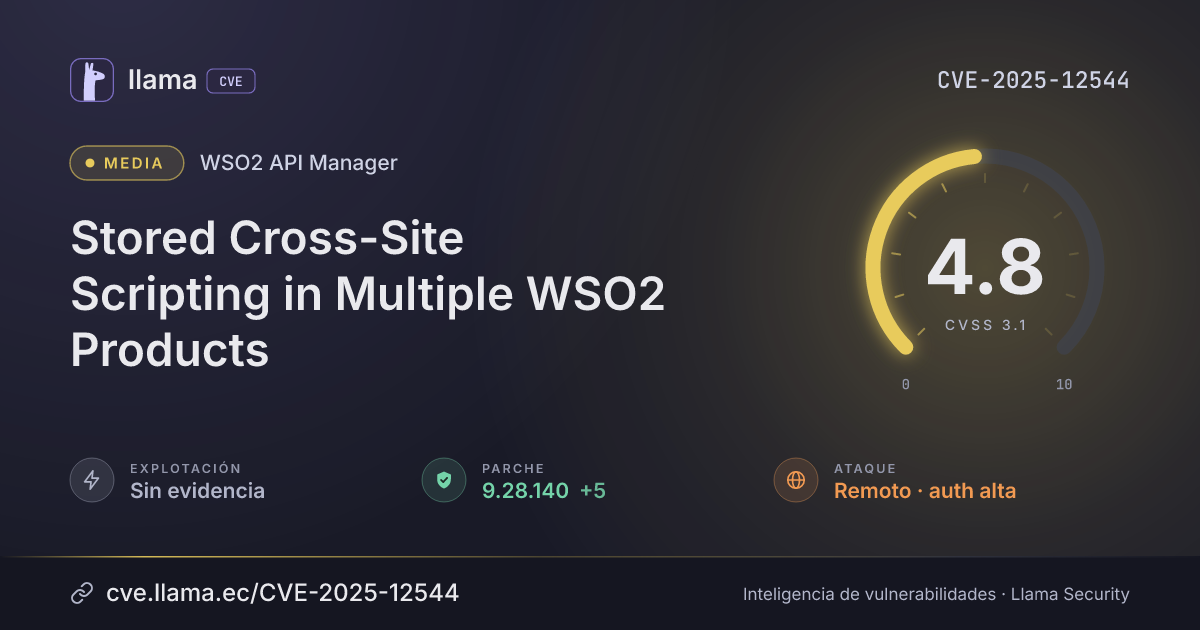
CVE-2025-12544

Stored Cross-Site Scripting in Multiple WSO2 Products

Specific setups onlyParche disponiblecross-site scripting (XSS)
Descargar PNG JSON
CVSS 3.1
4.8
Media
CVSS:3.1/AV:N/AC:L/PR:H/UI:R/S:C/C:L/I:L/A:N Fuente: CNA
ExplotaciónSin evidenciaSSVC: none · no figura en CISA KEV
Exploits públicos0Ninguno conocido
Parche6 versiones3.2.0.449 · 3.2.1.68 · 4.0.0.368 · 4.1.0.60 …
Exposición17 dDesde la divulgación, 2 nov 2026, 5:23 a. m.
Detección9 minDesde la divulgación hasta su ingreso al índice
Decisión SSVCSeguir
Remediar en la ventana regular de mantenimiento
Sin explotación conocida, no automatizable e impacto técnico parcial. Hay versiones corregidas disponibles.
Timeline

Ciclo de vida de la vulnerabilidad

Hoy
Divulgación
Publicada +2
Explotación
Remediación
Monitoreo
Detectada +2
Verificada
2 nov 26
16 nov 26
19 nov 26
2 nov 26
6 nov 26
11 nov 26
15 nov 26
19 nov 26
FechaFaseEventoDetalle
Divulgación Publicada CVE-2025-12544 divulgada · CVSS 4.8 (CNA)
Monitoreo Detectada Ingresó al índice
Monitoreo Fuente: NIST NVD Registro visto por primera vez en NIST NVD
Monitoreo Fuente: ENISA EUVD Registro visto por primera vez en ENISA EUVD
Divulgación Evaluación SSVC CISA-ADP · explotación ninguna
Divulgación Modificada Última actualización del registro
Monitoreo Verificada Última verificación contra las fuentes
Resumen
Resumen generado por IA · CC-BY 4.0

Multiple WSO2 products with the Publisher portal are affected by a stored cross-site scripting flaw caused by inadequate validation of uploaded SVG files. An attacker with the Publisher role could use a crafted SVG to run malicious scripts in victims' browsers, enabling redirects, page tampering, or information theft, though session cookies marked httpOnly limit session hijacking.

Affects WSO2 API Manager 3.2.0 through 4.2.0 and the Carbon API Manager Publisher REST API before 9.28.140. Users with the Publisher role can trigger the stored XSS. Fixed in the listed builds.

¿Qué significa?A user with the Publisher role can store malicious script in the product, which then runs in the browser of other users who view that content. The script can redirect the victim's browser to an arbitrary website, change the web page UI, or retrieve information from the browser. Session hijacking is not possible because session-related sensitive cookies use the httpOnly flag.
¿Quién está afectado?WSO2 API Manager versions 3.2.0, 3.2.1, 4.0.0, 4.1.0 and 4.2.0 before their fixed builds (3.2.0.449, 3.2.1.68, 4.0.0.368, 4.1.0.60, 4.2.0.7) are listed as affected, as is the WSO2 Carbon API Manager Publisher REST API before 9.28.140. Compare your installed product version against these ranges, and note that the attack needs an account with the Publisher role.
¿Qué hacer?Upgrade WSO2 API Manager to the fixed build for your release line: 3.2.0.449, 3.2.1.68, 4.0.0.368, 4.1.0.60 or 4.2.0.7. Upgrade the WSO2 Carbon API Manager Publisher REST API to 9.28.140 or later.
Descripción original del registro (WSO2)

The Publisher portal fails to enforce proper validation on uploaded SVG files, allowing users with the Publisher role to inject malicious scripts. This weakness can be exploited by uploading a crafted SVG file, which is then stored and rendered by the application. The security consequences include the ability for a malicious actor to redirect the victim's browser to an arbitrary website, modify the web page's UI, or retrieve information from the browser. However, the impact is mitigated as session-related sensitive cookies are protected with the httpOnly flag, preventing session hijacking.

Contexto

Condiciones y alcance

Condiciones necesarias para que el fallo sea explotable
01
Affects WSO2 API Manager versions 4.2.0, 4.1.0, 4.0.0, 3.2.1 and 3.2.0.“WSO2 API Manager : 4.2.0, 4.1.0, 4.0.0, 3.2.1, 3.2.0”
02
The attacker must have a user account with the Publisher role.“a user with the Publisher role can exploit a stored Cross-Site Scripting (XSS) vulnerability”
Vector CVSS 3.1

Desglose de métricas

Opción resaltada = valor del vector · izquierda = peor caso · CNA
Vector de ataqueAV:N
RedAdyacenteLocalFísica
ComplejidadAC:L
BajaAlta
PrivilegiosPR:H
NingunoBajosAltos
InteracciónUI:R
NingunaRequerida
AlcanceS:C
CambiadoSin cambio
ConfidencialidadC:L
AltoBajoNinguno
IntegridadI:L
AltoBajoNinguno
DisponibilidadA:N
AltoBajoNinguno
Versiones

Rangos afectados

Afectada Corregida
org.wso2.carbon.apimgt:org.wso2.carbon.apimgt.rest.api.publisher.v1< 9.28.140
WSO2 API Manager≥ 3.2.0 < 3.2.0.449
WSO2 API Manager≥ 3.2.1 < 3.2.1.68
WSO2 API Manager≥ 4.0.0 < 4.0.0.368
WSO2 API Manager≥ 4.1.0 < 4.1.0.60
WSO2 API Manager≥ 4.2.0 < 4.2.0.7
3.2.0
3.2.0.449
3.2.1
3.2.1.68
4.0.0
4.0.0.368
4.1.0
4.1.0.60
4.2.0
4.2.0.7
9.28.140
Remediación

Estado del parche por paquete

Paquete / productoEstadoCorregida enDesde divulgaciónÚltima versión
WSO2 API Manager
Corregida 3.2.0.449, 3.2.1.68, 4.0.0.368, 4.1.0.60, 4.2.0.7 — —
WSO2 Carbon API Manager Publisher REST API
Corregida 9.28.140 — —
Versiones corregidas3.2.0.4493.2.1.684.0.0.3684.1.0.604.2.0.79.28.140
Explotación

Arsenal público

Sin exploits, módulos ni PoC públicos conocidos a la fecha de verificación.

Registro
EscenarioGENERALWSO2
solutionFollow the instructions given on https://security.docs.wso2.com/en/latest/security-announcements/security-advisories/2026/WSO2-2025-4500/#solutionWSO2
Referencias
Fabricantehttps://security.docs.wso2.com/en/latest/security-announcements/security-advisories/2026/WSO2-2025-4500/

Las referencias externas se muestran para copiar: cve.llama.ec no lo redirige a otros sitios.