llamaCVEVulnerability Intelligence
/
Red Hat Satellite

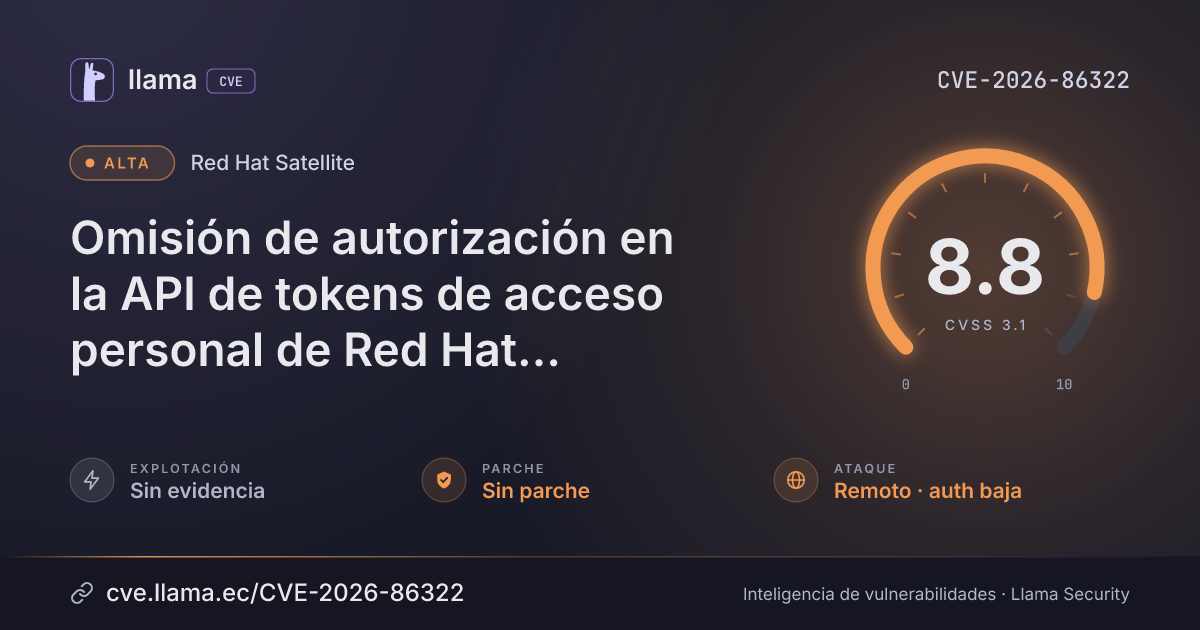
CVE-2026-86322

Red Hat Satellite authorization bypass in personal access token API

A low-privilege user with token permission can create tokens for others, including admins, and sign in as them.

Solo en configuraciones específicasSin parche publicadoinsecure direct object reference (IDOR)
Descargar PNG JSON
CVSS 3.1
8.8
Alta
CVSS:3.1/AV:N/AC:L/PR:L/UI:N/S:U/C:H/I:H/A:H Fuente: CNA
ExplotaciónSin evidenciaSSVC: ninguna · no figura en CISA KEV
Exploits públicos0Ninguno conocido
ParcheSin parcheEl fabricante no ha publicado corrección
Exposición8 dDesde la divulgación, 12 nov 2026, 3:19 p. m.
Detección10 minDesde la divulgación hasta su ingreso al índice
Decisión SSVCSeguir de cerca
Monitorear y programar la remediación
Sin explotación conocida, no automatizable e impacto técnico total. No hay versión corregida: aplique mitigaciones.
Si el fabricante actualiza el aviso, vuelve a mirar.Huele a "ya lo veré". No la dejes así.
Timeline

Ciclo de vida de la vulnerabilidad

Hoy
Divulgación
Publicada
Evaluación SSVC
Modificada
Explotación
Remediación
Monitoreo
Detectada +1
Fuente: ENISA EUVD
Verificada
12 nov 26
13 nov 26
18 nov 26
21 nov 26
12 nov 26
15 nov 26
17 nov 26
19 nov 26
21 nov 26
FechaFaseEventoDetalle
Divulgación Publicada CVE-2026-86322 divulgada · CVSS 8.8 (CNA)
Monitoreo Detectada Ingresó al índice
Monitoreo Fuente: NIST NVD Registro visto por primera vez en NIST NVD
Monitoreo Fuente: ENISA EUVD Registro visto por primera vez en ENISA EUVD
Divulgación Evaluación SSVC CISA-ADP · explotación ninguna
Divulgación Modificada Última actualización del registro
Monitoreo Verificada Última verificación contra las fuentes
Resumen
Resumen generado por IA · CC-BY 4.0 · 12 nov 2026

Red Hat Satellite 6's foreman package has an authorization flaw that lets a remote attacker with low-privilege login access and the create_personal_access_tokens permission create a personal access token for another user, including administrator accounts. The attacker can then use that token to sign in as the victim and take over the account.

¿Qué significa?A user who holds the create_personal_access_tokens permission can create a Personal Access Token for another user. The target user's account must be accessible by ID within the attacker's taxonomy scope. The flaw is an authorization check in foreman::controller::useraware#find_user, used by api::v2::personalaccesstokenscontroller.
¿Quién está afectado?The affected products are Red Hat Satellite 6.16 for RHEL 8, Red Hat Satellite 6.16 for RHEL 9, Red Hat Satellite 6.17 for RHEL 9, Red Hat Satellite 6.18 for RHEL 9, and Red Hat Satellite 6.19 for RHEL 9. The sources do not list affected version ranges. The conditions to check are which roles grant create_personal_access_tokens and which taxonomy scopes those roles cover.
¿Qué hacer?The sources checked do not name a fixed version or patch identifiers for this vulnerability. Check Red Hat's advisory for CVE-2026-86322 for the fixed release.
no-patchThe sources checked do not describe a workaround. The stated conditions depend on who holds the create_personal_access_tokens permission and on taxonomy scope, so reviewing those assignments is the only lever the facts point to.
Descripción original del registro (redhat)

A flaw was found in Foreman’s Api::V2::PersonalAccessTokensController, where Foreman::Controller::UserAware#find_user resolves the target account using User.find(params[:user_id]) without applying the required parent-user authorization check. An attacker with the create_personal_access_tokens permission can therefore invoke POST /api/v2/users/:user_id/personal_access_tokens with another user’s ID and create a Personal Access Token on their behalf. The resulting plaintext token is returned in the API response, while PersonalAccessToken#check_permissions_after_save only validates create_personal_access_tokens on the token and does not enforce edit_users authorization on the target user. The attacker can then use the forged token to authenticate as the victim, potentially resulting in complete account takeover, including administrator accounts.

Contexto

Condiciones y alcance

Condiciones necesarias para que el fallo sea explotable
01
Attacker must hold the create_personal_access_tokens permission.“a user who has the create_personal_access_tokens permission can create a Personal Access Token for another user”
02
Target user's account must be accessible by ID within the attacker's taxonomy scope.“whose account is accessible by ID within the user's taxonomy scope”
¿Quién debe revisar?Teams running Red Hat Satellite 6.16 (RHEL 8 or 9), 6.17, 6.18 or 6.19 for RHEL 9 with users holding create_personal_access_tokens
Vector CVSS 3.1

Desglose de métricas

Opción resaltada = valor del vector · izquierda = peor caso · CNA
Vector de ataqueAV:N
RedAdyacenteLocalFísica
ComplejidadAC:L
BajaAlta
PrivilegiosPR:L
NingunoBajosAltos
InteracciónUI:N
NingunaRequerida
AlcanceS:U
CambiadoSin cambio
ConfidencialidadC:H
AltoBajoNinguno
IntegridadI:H
AltoBajoNinguno
DisponibilidadA:H
AltoBajoNinguno
Score de explotaciónQué tan fácil y probable es que la exploten
8.3/ 10Alto
Vector 8.3 (muy fácil) · sin evidencia de explotación.
Remediación

Estado del parche por paquete

Paquete / productoEstadoCorregida enDesde divulgaciónÚltima versión
foreman
Sin parche — — —
Explotación

Arsenal público

Sin exploits, módulos ni PoC públicos conocidos a la fecha de verificación.

Registro
MitigaciónMitigation for this issue is either not available or the currently available options do not meet the Red Hat Product Security criteria comprising ease of use and deployment, applicability to widespread installation base, or stability.redhat
Referencias
Advisoryhttps://access.redhat.com/errata/RHSA-2026:100120
Advisoryhttps://access.redhat.com/errata/RHSA-2026:99949
Advisoryhttps://access.redhat.com/errata/RHSA-2026:99950
Advisoryhttps://access.redhat.com/errata/RHSA-2026:99952
Análisishttps://bugzilla.redhat.com/show_bug.cgi?id=2529289
Otrahttps://access.redhat.com/security/cve/CVE-2026-86322

Las referencias externas se muestran para copiar: cve.llama.ec no lo redirige a otros sitios.